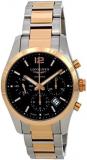
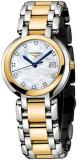
The Longines Master Collection GMT in 18 karat yellow gold measures 40.00 mm across the case and holds a self-winding movement, a specification set that places it firmly among the brand’s most formal gold-cased offerings. Solid gold changes the entire character of a watch: it adds density on the wrist, shifts how light moves across polished surfaces, and signals a different intent than any gold-plated or capped alternative.
That distinction matters because Longines works with several gold formats across its catalogue. Understanding what each one actually is, where solid 18K gold appears, and what a buyer should inspect before committing makes the difference between a considered purchase and an expensive surprise.
Solid Gold, Gold Cap, and What the Difference Means
Longines states in its own materials that solid gold carries the fineness mark 750/1000, or 18K, indicating a 75 percent pure gold content within the alloy. That stamp is not decorative. It is a legal hallmark applied to the material itself, and it appears alongside purity markings required by the jurisdictions in which the watch is sold.
Gold cap is a separate construction. The Longines Spirit Zulu Time, for instance, is catalogued with a stainless steel case and an 18 karat yellow gold cap 200, which means a substantial layer of gold fused over a steel core rather than a case cut entirely from bullion. Both approaches produce a two-tone visual effect, but they age differently, weigh differently, and sit at very different positions on the price scale.
The practical consequence is straightforward. A solid gold case can be polished repeatedly across decades of servicing and retains its material throughout. A capped case relies on the integrity of the gold layer above the steel, so owners should treat aggressive refinishing with caution and rely on a watchmaker familiar with the construction.
The Master Collection as the Core Gold Expression
Longines positions the Master Collection as its central line for classical dress watchmaking, and the gold variants sit at the top of that range. The GMT reference L2.844.6.71.2 combines a 40 mm 18 karat yellow gold case with a dual-time function, which is an unusual pairing: most GMT complications in this segment live inside steel sports cases rather than formal gold ones.
Water resistance is rated at 3 bar on this reference. That figure is worth reading precisely, because it defines the watch’s boundaries rather than inviting ambiguity. Three bar covers splashes, hand washing, and rain, and stops short of swimming or showering. Buyers who need water resistance beyond that threshold should be looking at a different category entirely.
The reference belongs to a wider Longines range of Swiss dress and heritage watches that spans everything from heritage reissues to contemporary sports models, and the gold Master pieces anchor the formal end of that spectrum.
Case Diameter and Proportion in Gold
A 40 mm case in solid gold wears differently from the same diameter in steel. Gold alloys used in watchmaking are denser than stainless steel, so the mass sits lower and feels more deliberate on the wrist. That weight is one of the reasons gold dress watches are worn close to the cuff and rarely buried under a jacket sleeve for long.
The Longines Master Collection also includes smaller gold references. A 34 mm automatic version in stainless steel and 18 karat yellow gold cap 200 offers a distinctly different wear experience, and the smaller format suits wrists that find 40 mm too assertive for formal dress. Case size, in this context, is not a trivial preference. It determines the balance between dial and bezel, the visual weight of the lugs, and how much of the case profile is visible from the side.
Buyers weighing proportion should also consider the lug-to-lug measurement rather than diameter alone, since that figure governs where the strap or bracelet breaks over the wrist. For a formal gold watch intended to sit beneath a shirt cuff, a compact lug-to-lug is often the deciding variable.
Dial Execution and the Role of Material Contrast
Yellow gold cases change the calculus for dial design. A warm case wants a dial that either harmonises or deliberately counters it, and the accent colours on hands, indices, and markers must be selected with the case hue in mind. Silver-toned dials under a gold bezel read as restrained; champagne and cream tones lean warmer and more traditional; darker dials create sharper contrast and a more contemporary impression.
Appropriate attention also belongs on the markers. Applied gold indices catch ambient light and create small specular highlights that printed markers cannot produce, which contributes disproportionately to perceived quality in a formal setting. Photographs rarely capture this accurately, so viewing a gold reference in daylight, rather than under store spotlights, gives a truer picture of how the watch actually presents.
Heritage References and the Decorative Tradition
Longines has a deep archive of decorative dial work, and the Flagship Heritage range demonstrates where that tradition leads. One reference carries a hand-painted enamel caravel on an 18-carat gold medallion within a 38.50 mm case, an object that is closer to miniature craft than to industrial dial printing.
This matters to buyers evaluating gold because it shows the breadth of what gold enables in the brand’s hands: the material is not only a case option but a carrier for enamelling, engraving, and medallion work that would be impractical in base metals. Collectors drawn to that level of detail should study heritage references alongside the Master Collection before deciding where their budget belongs.
Movements, Servicing, and Long-Term Ownership
Every reference discussed here runs on a self-winding mechanical movement, and Longines lists a power reserve of up to 72 hours on at least one gold-capped sports model in the current catalogue. That reserve figure determines how long the watch runs off the wrist before stopping, which in turn affects how often it needs resetting rather than servicing.
Ownership cost is a factor seldom discussed plainly with gold watches. Solid gold cases require a watchmaker experienced in working with soft, scratch-prone alloy, and polishing should be conservative on any case with engraved or bevelled surfaces. Buyers should confirm service arrangements and turnaround expectations before purchase, and should be prepared to accept slower servicing cycles as a normal part of gold ownership rather than as a defect.
How Gold Watches Sit in the Wider Market
The gold dress segment is competitive, and Longines competes on specification value rather than on scarcity marketing. Comparable precious-metal propositions from the Cartier watch lineup and top Omega selections frequently start above the Longines price point, so a solid 18K Master reference represents a genuinely accessible route into full precious-metal construction.
Brands such as Tissot and Baume Mercier occupy adjacent positions, with strong steel and gold-capped offerings but less emphasis on solid-gold formality. Positioning the Longines correctly means recognising that it is not attempting to out-luxury the higher houses; it is delivering verified Swiss movement engineering inside a genuinely solid gold case at a lower entry figure.
Frequently Asked Questions About Longines Gold Watches
- Is a Longines 18K gold watch solid gold? Not every gold-accented Longines is solid. References marked 18 karat gold solid carry the 750/1000 hallmark; references described as gold cap 200 use a gold layer over stainless steel.
- How can the purity be verified? Longines confirms that solid gold is marked 750/1000 or 18K, indicating 75 percent pure gold content, alongside the hallmarks required in the market of sale.
- Can a gold-capped watch be polished like solid gold? No. The gold layer is finite in thickness, so any refinishing should be handled by a watchmaker familiar with capped construction.
- What water resistance should be expected? The Master Collection GMT reference L2.844.6.71.2 is rated to 3 bar, suitable for splashes rather than swimming.
- Are gold accents the same across the catalogue? No. Longines offers solid 18K cases, gold caps, and steel references with gold detailing, and each construction has different maintenance implications.
Who Should Buy a Longines in Solid Gold
A buyer considering a solid gold Longines is typically seeking a watch that lives in formal rooms rather than on trails: a board meeting, a wedding, an evening where a slim gold case reads as considered rather than conspicuous. The GMT function on the Master Collection reference adds practical value to that profile, since it serves travellers who want a second time zone without adopting an oversized sports watch.
Anyone weighing a solid gold Master against a comparably priced steel reference from rival collections should think carefully about the trade they are making. The money buys material in the Longines; it may buy complication or finishing detail elsewhere. Neither choice is wrong, but the priorities differ substantially, and recognising the difference before purchase is what separates a sound decision from an impulse.
A final word on proportion and restraint: solid gold is a material that rewards a disciplined dial, a sensible case diameter, and a modest level of ornament. The Longines references that carry it well do so by letting the metal speak and keeping the complication set purposeful. For collectors building toward one formal precious-metal piece rather than many watches, that combination of verified purity, Swiss mechanical engineering, and classical proportion is precisely the argument a solid gold Longines makes on its own terms.