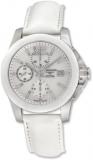
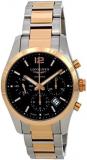
The Longines GMT line is defined by one tangible feature: a dedicated 24-hour hand that tracks a second time zone alongside local time. On the HydroConquest GMT reference L3.790.4.56.6, that hand moves across a dial set within a 41.00 mm stainless steel case, framed by a ceramic bezel and rated to 30 bar, or 300 metres of water resistance. These figures describe a watch built to move between a meeting room in one hemisphere and a dive deck in another without missing a beat.
Understanding what this collection represents means looking past the surface. The line sits where Swiss watchmaking tradition meets the practical demands of people who cross time zones regularly, and that intersection is where the details begin to matter.
What a GMT Complication Actually Does
A GMT watch solves a problem that ordinary three-hand watches cannot: it displays two time zones at once. The mechanism typically pairs a local hour hand with an independent 24-hour hand, and Longines documents the arrangement clearly in its instruction manuals, listing an hour, minute, seconds, date and second time zone hour display on models fitted with the complication. On the HydroConquest GMT, the rotating bezel carries a 24-hour scale, adding a third reference point for anyone coordinating across multiple regions.
The calibre inside this reference runs at 25,200 vibrations per hour, a frequency that balances smooth seconds-hand motion against long-term durability. Longines specifies a power reserve of up to 72 hours, meaning the watch can sit unworn across a weekend and still be running when it returns to the wrist on Monday morning. That reserve figure matters more than it might appear: a GMT is often a travel or rotation watch rather than a daily beater, so autonomy between wears is a genuine functional concern.
Reading the Traveler’s Watch Landscape
The Longines GMT does not exist in isolation. The dual-time category has a deep bench, and understanding where this line sits means understanding its neighbours. The Rolex GMT-Master II established the modern template for the travelling watch, and its influence is visible across the category. Longines approaches the same brief from a different angle, prioritising legibility and restraint over overt luxury signalling.
Dive-oriented GMTs occupy their own niche, and pieces within the Rolex Submariner line illustrate how water resistance and tool-watch build quality became a benchmark for sports watches generally. The HydroConquest GMT’s 300-metre rating places it firmly in that conversation, and the ceramic bezel insert adds scratch resistance that a plain steel insert cannot match. Longines keeps the case at 41.00 mm, a size that reads as substantial without overwhelming a wrist, and the stainless steel construction keeps the watch grounded in everyday wearability.
The HydroConquest GMT in Detail
The reference L3.790.4.56.6 is the clearest expression of what the line offers. The stainless steel and ceramic bezel pairing is a deliberate choice: ceramic resists fading and scratching, which matters on a bezel that gets rotated and referenced constantly by a traveller. The screw-in crown, documented in Longines’ manual literature as part of the water-resistance architecture, contributes to the 300-metre rating.
- Case: 41.00 mm stainless steel with ceramic bezel insert
- Water resistance: 30 bar (300 metres)
- Movement: Automatic, 25,200 vph
- Power reserve: Up to 72 hours
- Functions: Hours, minutes, seconds, date, GMT/24-hour hand
Each of these specifications carries practical weight. The 72-hour reserve reduces the need for a winder. The 300-metre rating covers swimming, snorkelling and the occasional accidental submersion with margin to spare. The 41.00 mm diameter is the largest single decision point for most buyers, and it is worth trying on rather than assuming, because case size interacts with lug design and bracelet taper in ways that photographs cannot convey.
Design Language and Wearing Experience
The Longines GMT aesthetic is disciplined. The HydroConquest line has always leaned toward sport rather than ornament, and the GMT variants stay within that vocabulary. Dial layouts prioritise readability: the GMT hand is differentiated so it can be read at a glance, and the 24-hour scale on the bezel is engineered for quick parsing rather than decoration.
On the wrist, the 41.00 mm case sits in a versatile middle ground. It reads appropriately under a shirt cuff and holds its own against casual wear, which is precisely the brief for a travel watch that has to perform across contexts. The stainless steel bracelet balances the case visually, and in the manufacturer’s own positioning the line is built for people who want a single watch that covers business travel, leisure and water activity without a change of strap.
The GMT Complication as a Daily Tool
There is a persistent misconception that GMT watches are only useful for people who fly frequently. In practice, the second time zone hand earns its keep in more ordinary situations: tracking a family member’s location, coordinating with a colleague in another region, or keeping a mental clock on a place one cares about. The Longines interpretation supports this everyday role because the complication is legible rather than cluttered, and the 72-hour reserve means the watch stays set even when it spends a couple of days in a drawer.
The longer power reserve also reduces wear on the movement’s winding mechanism by rewarding a simple routine: wear it, set it, and expect it to keep running between rotations. Meanwhile, the broader world of Breitling Professional timepieces demonstrates how aviation-adjacent brands translate navigation functions into wrist instruments, a reminder that the GMT complication has roots in practical navigation rather than fashion. Longines draws on that functional heritage without over-claiming it.
Movement, Service, and Long-Term Ownership
Longines’ automatic calibres are designed for serviceability, and that is a meaningful ownership consideration. The 25,200 vph frequency is a conventional, well-understood specification, which means independent watchmakers and authorised service centres both have the familiarity to maintain it. A 72-hour reserve indicates a reasonably modern mainspring and gear train design, and ceramic bezel inserts are effectively permanent, needing no refinishing across the life of the watch.
Buyers weighing the Longines GMT against established alternatives should consider ownership costs honestly. Compared with pieces in the Rolex GMT-Master II family, the Longines positions itself differently on the price and exclusivity spectrum, and that is a conscious trade rather than a shortfall. For many owners, the combination of a ceramic bezel, 300-metre water resistance and a 72-hour automatic movement at this level is the more practical answer to the question of what a travel watch should actually do.
Which Buyer Should Consider a Longines GMT
The most natural fit is the frequent traveller who wants a single, robust watch that handles flights, meetings and water without anxiety. The 41.00 mm case and the legible dial suit this role well, and the automatic movement with its 72-hour reserve means the watch survives a busy schedule without constant attention.
The second buyer is the enthusiast building a focused collection around functional complications. A GMT adds a distinct capability without duplicating a diver or a chronograph, and Longines watches carry a heritage that collectors recognise. As with any watch purchase at this level, the right approach is to audition the case size in person, verify the reference number, and confirm the service history of any pre-owned example.
A Travel Companion With a Clear Purpose
What the Longines GMT proposes is a coherent idea of the travelling watch: a second time zone hand that is easy to read, a case built to withstand real life, and an automatic movement with enough autonomy to keep up with a demanding calendar. The 41.00 mm steel case, the ceramic bezel and the 300-metre rating are specifications the manufacturer publishes, not promotional claims, and they describe a watch designed for movement. For anyone who measures a watch by what it can do rather than how it looks in a display case, the Longines GMT makes its argument cleanly and on its own terms.