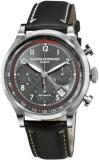
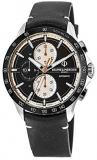
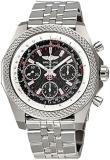
The Baume Mercier Capeland Automatic stands as a compelling tribute to the golden era of motorsport timing, capturing the spirit of mid-20th-century racing chronographs through a thoroughly contemporary lens. This collection, which draws its name from the legendary circuit at Capeland, represents a thoughtful dialogue between the brand’s rich archival heritage and the demands of modern watchmaking. For collectors seeking a timepiece that carries genuine historical resonance without sacrificing daily wearability, the Capeland Automatic offers a uniquely compelling proposition in the crowded field of Swiss chronographs.
The collection’s defining characteristic lies in its confident, masculine proportions. Reference models such as the 10063 feature a substantial 44mm round case, while other iterations explore diameters between 40mm and 45mm, with thickness figures reaching 14.9mm. These are not subtle dress pieces; rather, they are statement instruments that command attention on the wrist. The steel cases, available in both polished and brushed finishes, display a level of architectural complexity that reveals itself gradually – from the gently curved lugs to the distinctive pump-style pushers that flank the fluted crown, every element evokes the aerodynamic lines of classic sports cars.
Design Language and Visual Identity
The Capeland’s dial architecture demonstrates why Baume Mercier has earned respect as a maison capable of sophisticated visual storytelling. The multi-layered approach to chronograph legibility pays homage to vintage instruments, with contrasting sub-dials that sit against a sunray-brushed main surface. Depending on the specific reference, dials arrive in shades ranging from deep black and sleek grey to warmer brown tones, each one treated to enhance depth under varying light conditions. Rose gold versions introduce a richer color palette, creating a warmer interplay between case metal and dial surface that feels both luxurious and approachable.
Historical Inspiration and the Flyback Function
What elevates the Capeland beyond mere retro styling is its functional heritage. Several models within the collection, including the 10094, incorporate a flyback chronograph mechanism – a complication that allows the chronograph hand to be reset and restarted in a single push. This feature was developed to assist pilots and navigators in rapid recalculations and carries genuine historical weight. The presence of both telemeter and tachymeter scales on various references underscores the watch’s original purpose as a precision timing tool. These scales, printed on the dial flange or outer track, allow wearers to measure distance and speed with simple observation, directly connecting the modern wearer to the watch’s racing DNA.
Movement Engineering and Performance
At the heart of the automatic Capeland references beats a Swiss self-winding movement that has earned respect for its robustness and serviceability. Earlier examples utilized the ETA 7753 élaboré caliber, a workhorse movement that forms the backbone of countless professional chronographs. This caliber operates at a frequency of 28,000 vibrations per hour (4Hz), the standard for modern mechanical chronographs, ensuring precise timekeeping and smooth sweeping motion of the center seconds hand.
The movement construction reflects solid, purposeful engineering principles rather than exotic innovation. It employs 27 jewels to reduce friction at critical pivot points, features an Etachron regulator for precise rate adjustment, and incorporates the Incabloc shock absorption system to protect the delicate balance staff from sudden impacts. The power reserve measures approximately 42 to 44 hours depending on the specific iteration, a figure that remains practical for daily rotation wear. The sapphire crystal case back – a feature documented on models like the 10063 – offers an unobstructed view of the oscillating weight and gear train, showcasing the decorated rotor and perlage-finished bridges that speak to Baume Mercier’s commitment to finish quality.
Material Choices and Wearing Experience
Material selection across the Capeland collection demonstrates thoughtful consideration for different wearer preferences. The predominant material remains stainless steel, chosen for its combination of structural integrity, corrosion resistance, and its ability to maintain an attractive finish over years of regular wear. The sapphire crystal covering both dial and exhibition case back delivers exceptional scratch resistance, a critical factor for a daily-worn timepiece. Water resistance on automatic references is rated at 50 meters (5 ATM), sufficient for everyday exposure to moisture and rain, though the crown and pushers should remain untouched in actual swimming environments. That said, the solid construction ensures reliable performance in all normal urban scenarios.
The wearing comfort is influenced by the substantial case diameter and the integration of the steel bracelet or strap. The watch’s weight provides a reassuring presence without becoming burdensome, and the articulated links of the metal bracelet conform to varying wrist shapes. Leather strap options, particularly on the dressier dial variants, transform the watch into a genuinely versatile accessory that can transition from a casual weekend to a formal evening engagement.
- Case Diameter: 44mm (dominant reference) with variants from 40mm to 45mm
- Case Thickness: 14.9mm providing assertive wrist presence
- Movement: ETA 7753 élaboré automatic chronograph (28,000 vph, 27 jewels)
- Power Reserve: 42–44 hours depending on reference
- Crystal: Scratch-resistant sapphire with case-back exhibition
- Water Resistance: 5 ATM (50 meters) for general wear
Positioning Within the Baume Mercier Lineage
To understand the Capeland’s significance, one must appreciate its place within the broader Baume Mercier universe, which includes diverse families ranging from elegant dress models to sporty tool watches. The maison, established in 1830 in the Swiss Jura, has built its reputation on offering accessible luxury with genuine horological substance. The Capeland collection crystallizes the brand’s affinity with automotive-inspired chronographs – a segment where it competes comfortably alongside sports-oriented offerings from more established motorsport brands. For those seeking similar complications at a more focused price point, exploring Baume Mercier offers alternative interpretations of the same concept, and it is worth examining that connection in a broader market context.
For collectors building a well-rounded watch library, the Capeland Automatic offers a distinctive voice that complements more clinical tool watches or minimalist dress pieces. Its size and visual character mean it does not back down easily, yet its overall refinement prevents it from ever feeling brutish. The elevated aesthetic combines perfectly with pieces like the TAG Heuer Aquaracer, which approaches water sports with a similarly literal tool-watch focus, creating a complementary pair covering land and aquatic environments.
Investment Considerations and Collector Appeal
From a collector’s perspective, the Capeland Automatic presents certain practical advantages. The use of a widely understood and well-documented ETA movement base ensures the availability of future service support from independent watchmakers, a significant long-term ownership benefit over exotic in-house calibers. The dials and cases maintain a distinctive visual identity that remains instantly recognizable, assisted by the enduring popularity of vintage racing chronograph aesthetics. While not positioned as a limited production model, the transition of Baume Mercier’s focus toward newer collections in recent years has created conditions where well-conditioned Capeland references have held reasonable value on the secondary market, which is testament to their sustained demand landscape within the broader vintage-inspired segment.
Final Reflection
The Baume Mercier Capeland Automatic represents something increasingly rare in contemporary watchmaking: a chronograph that fully commits to its historical inspiration while remaining entirely modern in execution. Its commanding proportions, purposeful flyback complications, and elaborately finished Swiss automatic movement combine to produce a timepiece of genuine substance. There is a compelling authenticity in how the watch channels the era of racing when timing precision was inseparable from competitive advantage. This connects the wearer to a pivotal historical moment in both automotive and horological history, evoking the spirit of classic circuits. For the discerning buyer who understands that sophistication means embracing historical purity over passing fads, the Capeland collection offers a meaningful and rich opportunity.