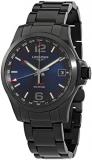
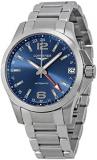
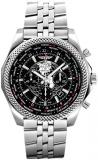
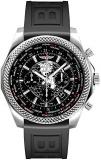
The Longines VHP GMT occupies a specific and somewhat contrarian position in contemporary watchmaking. It is a travel watch built around a thermo-compensated quartz movement rather than a mechanical calibre, and the Very High Precision designation refers to a documented family of Longines movements engineered to hold rate stability far beyond ordinary battery-powered watches. The GMT variant layers a second time zone display on top of that platform, which turns an exercise in accuracy into a genuinely useful tool for anyone who moves between zones on a regular basis.
What Very High Precision Means in Practice
Standard quartz movements drift with temperature. A conventional calibre may lose or gain a noticeable margin each month as ambient conditions shift, and that drift is often accepted as an inherent limitation of battery-powered timekeeping. The VHP platform takes a different route. Longines builds in a thermo-compensation circuit that reads ambient temperature and adjusts the oscillator frequency accordingly, which suppresses the rate variation that would otherwise accumulate over weeks of wear.
The consequence for a GMT watch is more significant than it first appears. A dual-time display is only useful if the underlying timekeeping is dependable, because the whole point is to trust the reading at a glance without cross-checking it against a phone. Pairing a second time zone hand with a movement designed around stability rather than cost is a deliberate design decision, and it shapes how the watch behaves over years rather than days.
Thermo-Compensation on the Wrist
The practical effect of thermo-compensation emerges in ordinary use rather than on a specification sheet. A watch worn through a day encounters temperature swings that range from cold outdoor air to the warmth of an office or a heated car interior. An uncompensated quartz calibre responds to those swings with measurable rate changes, which is why so many quartz watches require periodic resetting. The VHP movement corrects internally, so the indicated time remains consistent whether the watch rests on a nightstand or spends an afternoon in the sun.
Perpetual calendar functionality typically accompanies the VHP platform as well, which means the date advances correctly through months of different lengths, including February in a leap year. For a traveler, that removes a small but recurring administrative task from the routine of keeping a watch accurate across long journeys.
Battery Service and Low-Maintenance Ownership
A quartz watch is defined in part by its service interval, and the VHP GMT is designed to minimize that interruption. Longines specifies an extended battery life for the VHP family, supported by an end-of-life indicator that warns the wearer before the cell is exhausted. The ownership model is therefore straightforward: no winding, no servicing schedule tied to mechanical wear, and a predictable multi-year interval between battery replacements.
This stands in contrast to mechanical GMT watches, which require periodic servicing to keep their gear trains and complications in order. Neither approach is inherently superior, but the VHP GMT makes a clear case for buyers who want a watch that functions without a custodial relationship.
The GMT Complication in Daily Use
A GMT function answers one question at a glance: what time is it somewhere else? Traditional GMT designs use a fourth hand that sweeps the dial once every twenty-four hours against a marked scale, reading against a 24-hour track rather than a conventional twelve-hour chapter ring. The Longines VHP GMT follows this convention, giving the wearer an independent reference for a second time zone without disturbing the primary time display.
What distinguishes the VHP version is how the quartz platform interacts with the complication. Because the movement is electronically driven rather than mechanically geared, certain adjustments are handled differently than on a traditional automatic GMT. Longines documents a flash-setting system in its user guide for the Conquest VHP GMT, which allows rapid correction of the displayed time when the watch has been left unworn and has entered a power-saving state. Owners can restore the correct time quickly rather than cycling through hour after hour.
Reading the 24-Hour Scale
The 24-hour scale is the key to using any GMT watch correctly. The GMT hand points to a numeral on that track rather than to a conventional hour marker, so a reading of fourteen corresponds to two in the afternoon. Once the wearer internalizes that mapping, checking a second time zone becomes a reflex rather than a calculation.
For frequent travelers, this removes the mental arithmetic that otherwise accompanies every call or message scheduled across an ocean. Setting the GMT hand to a home time zone and leaving it in place means the primary hands can be adjusted freely on arrival without losing the reference point. That separation of functions is the core utility of any GMT design, and the VHP GMT delivers it with the added assurance of a high-precision movement.
Design, Materials, and Everyday Wearability
The Conquest family’s design language carries through to the VHP GMT: a stainless steel case with clean, faceted lines and a dial that prioritizes legibility over ornament. Longines has positioned the Conquest line as a versatile everyday collection rather than a niche specialty range, and the GMT variant fits that brief. It reads as a tool watch without drifting into the oversized, hyper-technical territory occupied by dedicated expedition models.
Case sizes in the VHP GMT range are proportioned for a broad spectrum of wrists, and the bracelet and strap options allow the watch to shift between formal and casual contexts. The dial layout accommodates the GMT hand and 24-hour scale without becoming cluttered, an achievement that reflects careful attention to hierarchy in the design.
Wearers weighing this reference against other travel watches may find it instructive to study how established GMT families have handled the same complication, including the Rolex GMT-Master II. The contrast is philosophical rather than merely technical: one approach leans on mechanical engineering and horological tradition, the other on electronic precision and low-maintenance ownership.
Water Resistance and Durability
Longines equips the Conquest VHP GMT with a level of water resistance suited to everyday wear, including exposure to rain, hand washing, and incidental splashes. While it is not marketed as a professional dive instrument, the construction shares the robust case architecture of the broader Conquest range, which gives it a resilience appropriate for active daily use.
The sapphire crystal covering the dial resists the scratches that would quickly dull a less durable material, keeping the display clear over years of wear. Combined with the stainless steel case, this makes the watch a practical choice for wearers who want a GMT they do not need to coddle.
Where the VHP GMT Fits in the Broader Market
The GMT category is crowded at every price and prestige level. Mechanical GMT watches dominate enthusiast conversation, and models from brands with long aviation and travel histories command significant attention. Against that backdrop, the Longines approach is distinctive precisely because it steps outside the mechanical arms race. The VHP GMT argues that reliability, accuracy, and convenience are the values a travel watch should optimize for, and that quartz technology, when executed at a high enough standard, serves those values better than a conventional automatic movement.
This is not a fringe position. Thermo-compensated quartz has a real technical heritage, and Longines has invested in it deliberately rather than treating quartz as a budget category. The result is a watch that can claim accuracy figures most mechanical GMTs cannot match, without the servicing cadence and positional variation that accompany mechanical calibres.
The trade-off is intangible: the movement inside cannot be admired through a case back, and it lacks the sweeping seconds hand that many enthusiasts associate with fine watchmaking. Buyers motivated by craftsmanship will look elsewhere, while buyers motivated by function will find the VHP GMT’s argument compelling.
Who Should Consider This Watch
The clearest audience for the Longines VHP GMT is the frequent traveler who wants dual-time reading without the rituals of mechanical ownership. Business travelers crossing multiple zones in a week, aviation professionals, and anyone coordinating regularly with colleagues or family in another country all fit the profile. The perpetual calendar and rapid setting features further reduce the friction of regular use, which matters for people who expect a watch to keep pace with a demanding schedule.
A second audience is the collector who already owns mechanical pieces and wants a dependable quartz GMT for situations where accuracy and robustness outweigh romantic considerations. Using a VHP GMT as a travel companion alongside a mechanical collection is a sensible division of labor: the precision instrument handles the logistics, while the mechanical watches are enjoyed in lower-risk settings.
Finally, the watch appeals to anyone who values the Conquest line’s straightforward aesthetic. Longines has built the family around restrained, legible design rather than trend-driven flourishes, and the GMT variant preserves that character while adding genuine utility.
A Different Answer to an Old Question
The question of how best to track two time zones has produced many answers over the decades, from rotating bezels to independent hour hands to complications that would impress a clockmaker. The Longines VHP GMT offers one of the more pragmatic answers available: a movement engineered for stability, a complication designed for clarity, and a construction intended for daily life rather than display cases. It is a watch that treats precision as the foundation on which every other feature rests, and for a certain kind of wearer, that priority is exactly right. The GMT complication tells you what time it is somewhere else; the VHP movement, quietly and consistently, makes sure the answer is one you can trust.