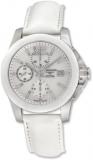
The Longines Heritage Classic line exists because the brand keeps its own archive close at hand. Sector dials, tuxedo chronographs, and enamel Flagship reissues each trace back to a specific decade of Longines production, and each arrives in a modern case with a self-winding movement inside. The result is a family of dress watches that look backward for their design language but forward for their engineering.
Archive References That Shape the Design
The Heritage Classic is not one watch but a rotating cast of reissues, and the sector dial variant, reference L2.828.4.53.6, shows how the programme works. Its dial splits into concentric zones for hours, minutes, and seconds, a layout that appeared across the 1930s and 1940s because it made reading time faster at a glance. Applied Arabic numerals and slim leaf hands keep the period character intact without tipping into costume.
What separates these pieces from straightforward reproductions is what sits beneath the dial. The sector dial model runs on a self-winding mechanical movement beating at 25,200 vibrations per hour, with a power reserve of up to 72 hours. The vintage exterior and the current calibre coexist deliberately, which is the whole point of how the Longines brand’s heritage programme is structured.
Case Proportions and Material Choices
Sizing across the range stays restrained, generally landing between 38mm and 40mm. That suits the dress-watch brief and preserves the vintage feel, since a modern 42mm case would change the character entirely. The tuxedo chronograph, for example, uses a 40mm case with an opaline ivory dial and a bezel engraved with a tachymeter scale. That scale is functional rather than decorative, letting the wearer calculate speed over a known distance with the chronograph engaged.
Water resistance across the collection is rated at 3 bar, which covers splashes and rain but rules out swimming or diving. This is normal for the dress-watch category, where slim profiles take priority over heavy gasket sealing. Buyers who want a heritage aesthetic with real water resistance tend to look at dive-oriented lines instead, since a 3 bar rating is simply a different design brief.
Sapphire crystal is standard across the line, and the cases mix polished and brushed finishing. The Flagship Heritage variant adds an enamel dial, fired at high temperature to produce a depth of colour that painted dials cannot match. Enamel also resists fading across decades, which matters for a watch meant to be worn and handed down rather than stored.
Movement Architecture and Timing Behaviour
Two movement families appear in the Heritage Classic range. The time-and-date models use calibres running at 25,200 vibrations per hour with extended power reserves, while chronograph references such as the tuxedo L2.830.4.93.0 use movements beating at 28,800 vibrations per hour with roughly 54 hours of reserve. The higher beat rate helps when the stopwatch function is actually in use.
Both types are self-winding, drawing energy from wrist motion through an oscillating weight. No battery changes are involved, which keeps the ownership experience consistent with the mechanical tradition the collection references. Many references use exhibition case backs, so the rotor, bridges, and finishing remain visible.
- Sector dial models: 25,200 vph, up to 72 hours power reserve
- Tuxedo chronograph: 28,800 vph, approximately 54 hours power reserve
- Flagship Heritage: automatic calibre with an enamel dial option
Wearers used to high-frequency calibres may notice the slower sweep of the seconds hand on the 25,200 vph movements. That beat rate has historical grounding, though, since it was common in mid-century Longines watches, and it can contribute to longer intervals between servicing.
Dial Treatments and Visual Identity
Several dial treatments sit within the Heritage Classic range, and each carries its own identity. The sector dial uses contrasting finishes on a single surface, with a snailed or matte centre and an opaline or grained outer track. That textural contrast creates legibility without bright colours or oversized markers.
The tuxedo chronograph takes its nickname from the black-and-white scheme borrowed from formal evening wear. An opaline ivory dial pairs with contrasting sub-dials, producing a layout that reads as sporty when the chronograph is running and dressy when it is not. Bi-compax and tri-compax arrangements appear depending on the reference.
Comparisons with other heritage programmes are inevitable. The Tissot Heritage line revisits mid-century designs at a more accessible price, while the Breitling Superocean Heritage applies the same revival logic to dive watches rather than dress watches. Each brand reads its own archive differently, and Longines leans toward restraint rather than dramatic reinvention.
Wearing Experience and Strap Pairings
On the wrist, Heritage Classic models wear close to their nominal dimensions. The 40mm tuxedo chronograph sits comfortably on medium wrists, with lugs that curve downward to follow the wrist contour. The 38mm and 39mm variants suit smaller wrists or anyone who prefers a quieter presence. Leather dominates the factory strap options, usually alligator or calfskin, with pin buckles or deployant clasps depending on the reference.
Strap choice changes the watch more than most owners expect. A black alligator strap pushes the tuxedo chronograph toward formal wear, while brown or tan calfskin makes the same watch feel considerably more casual. Factory bracelet options are limited within the line, since leather is used to protect the vintage aesthetic.
For daily wear, the 3 bar rating means the watch comes off before showering, swimming, or washing dishes. That is a real adjustment for anyone used to sports watches rated to 100m or beyond. The compensation is a slimmer case and a more elegant profile, which many wearers consider a fair exchange.
Positioning Against Rival Dress Watches
The Heritage Classic occupies a specific slot: mechanical dress watches with genuine archival references, priced below high horology brands such as Jaeger LeCoultre or Cartier but above entry-level mechanical offerings. That middle ground appeals to buyers who want Swiss automatic movements, sapphire crystal, and archive-inspired design without stepping into the high horology bracket.
Within the brand’s own catalogue, the Heritage Classic sits apart from the sports-oriented lines. The Spirit collection targets aviation enthusiasts with higher water resistance and luminescent dials, while the HydroConquest serves the dive market. The Heritage Classic stays focused on formal and smart-casual contexts, and the separation is deliberate rather than accidental.
Ownership, Servicing, and Long-Term Value
Mechanical watches in the Heritage Classic line need periodic servicing, typically every five to seven years depending on use. The self-winding movements are robust, but like any mechanical calibre they benefit from professional maintenance to preserve accuracy. Longines maintains a broad global service network, which simplifies ownership compared with smaller independent makers.
The vintage-inspired aesthetic is unlikely to date in ten or twenty years. Sector dials, tuxedo layouts, and enamel finishes are rooted in designs that have already proven their staying power across multiple decades. For collectors who want a watch to wear regularly rather than store in a safe, the balance of historical interest and everyday practicality is the core appeal.
The collection also benefits from Longines’ deep institutional history, which supplies a steady stream of archive material for future reissues and special editions. Buyers who enjoy the backstory behind a watch will find plenty to explore, from the original Flagship models of the 1950s to the chronographs that once timed sporting events. Each Heritage Classic carries a fragment of that history, translated into a wearable modern object that respects its origins without being trapped by them.