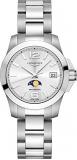
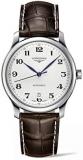
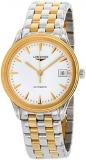
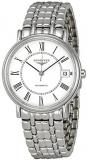
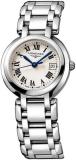
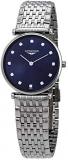
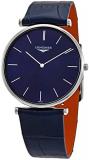
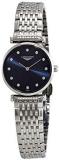
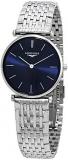
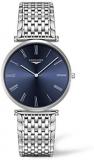
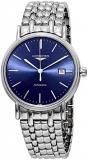
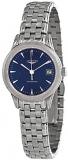
Longines has long built its reputation on the ethos of “Elegance is an attitude,” a philosophy that finds its purest expression in watches that favor graceful restraint over ostentatious complexity. Founded in Saint-Imier, Switzerland, in 1832, the brand holds one of the deepest archives in horological history, encompassing more than 4,000 registered movements and a legacy of technical achievements that spans nearly two centuries. The Longines Retrograde collection extends that lineage into a contemporary register, applying a complication historically reserved for high complications and placing it within the reach of collectors who value mechanical authenticity.
The Poetic Mechanics of the Retrograde Complication
At the heart of any retrograde watch lies a distinctive mechanical behavior. Hands advance in the conventional direction until they reach a prescribed point on the dial, then snap back instantaneously to their starting position rather than completing a full circle. This return action depends on a spring-loaded lever system that builds tension throughout the cycle and releases it in a fraction of a second. It is among the more demanding complications to calibrate, because the reset must occur precisely at midnight or at the stroke of a designated hour without drift over time.
Traditional watchmaking literature frequently describes the retrograde mechanism as one of the more lyrical complications, since its visible snap-back gesture turns a purely functional indication into something approaching kinetic art. The Longines brand’s approach treats this complication not as spectacle alone but as an enhancement of legibility. On a well-executed retrograde dial, the wearer reads the time more intuitively because the hand’s position maps directly to a curved scale rather than to radial numerals.
Design Language Across the Retrograde Family
The collection draws heavily on Longines’s mid-century design vocabulary. Sunray or silvered dials with guilloch茅 texturing, slender applied indices, and blued steel hands appear throughout the range. Case sizes settle largely between 38.5mm and 41mm, keeping the proportions wearable for a broad segment of collectors rather than chasing oversized trends.
Dial Architecture and Reading Logic
Retrograde formatting typically manifests through a fan-shaped date track positioned at the upper half of the dial, or occasionally at the 3 o’clock position as an arched sector. The advantage of this layout is spatial economy: an arc occupies less vertical real estate than a full calendar subdial, leaving room for additional complications such as moonphase displays or day-and-month windows.
Longines generally pairs the retrograde indicator with a classic three-handed time display, and in some references with a moonphase aperture at 6 o’clock. This arrangement allows a single watch to communicate date, lunar cycle, and time without cluttering the face, a balance that fewer watchmakers manage to achieve gracefully.
Case, Crystal, and Finish
Stainless steel forms the backbone of the collection, with alternating polished and brushed surfaces that define the lugs and flanks. A domed sapphire crystal with anti-reflective treatment protects the dial while preserving the vintage curvature that photographs so well. Many references include a sapphire exhibition case back, revealing the decorated rotor and movement bridges beneath.
Movement and Calibre Considerations
Longines equip the retrograde references with self-winding mechanical calibres based on proven automatic architectures. Power reserves in this segment typically sit in the 42 to 64 hour range, sufficient to survive a weekend off the wrist without requiring a reset. Beat rates of 28,800 vibrations per hour are standard, reflecting the wider industry convention for reliable timekeeping stability. Water resistance, meanwhile, generally settles at 3 bar, which covers handwashing and incidental rain but should not be confused with swim ratings.
The presence of a retrograde module inevitably adds components, from return springs to cam profiles, and each of these must be finished and assembled to tolerances tighter than those required by an ordinary date mechanism. For collectors who follow movement architecture closely, the retrograde calibre represents a meaningful step up in mechanical complexity relative to a straightforward automatic.
Context Within the Broader Swiss Landscape
The complication is not unique to Longines. The Panerai collection explores the concept through its own bold, Italian-influenced lens, while other Swiss houses have applied similar mechanisms to sportier references. What distinguishes the Longines interpretation is its restraint. Rather than placing the retrograde indication at the center of a dramatic, oversized dial, it is integrated into a balanced classical composition that still reads equally well with a suit as it does with a casual weekend ensemble. Collectors comparing the options might also note that an Omega Seamaster approaches calendar complications differently, prioritizing dive-rated robustness rather than the dress-oriented elegance that defines the retrograde references. For anyone exploring elegant Swiss alternatives outside the mainstream sports watch conversation, brands such as Raymond Weil offer comparable classical design intent.
Everyday Wearability
The proportions, materials, and finish make the retrograde refs well-suited to office settings, formal occasions, and evening wear. The absence of a highly polished bracelet on many references means the watch wears more like a strap piece, which typically reduces perceived bulk on the wrist. Leather strap options, often in alligator or calf, complete the classical presentation.
Collecting Considerations
Because retrograde mechanisms are more complex than standard calendar modules, servicing requires technicians trained specifically in the return mechanism function. Prospective owners benefit from confirming service intervals with authorized service centers rather than assuming a generic schedule. On the secondary market, limited editions with distinctive dial finishes tend to attract stronger collector interest than standard references, though the core collection remains the more accessible entry point.
Why This Complication Resonates Today
Contemporary watch collecting increasingly rewards mechanical character over simpler quartz convenience. The retrograde snap-back offers exactly that: a visible, tactile demonstration of mechanical engineering that occurs once every twenty-four hours. It rewards the wearer who happens to glance down at the right moment, and it rewards the owner who understands what must happen inside the case to make that moment possible. In a market saturated with smartwatches and homogenous dive silhouettes, a watch that performs a mechanical ritual every midnight occupies a distinct niche.
Longines positions the retrograde family as an entry point into serious complication collecting without abandoning the wearability that defines the brand. Years of archive-driven design research mean that the case profiles and dial layouts feel rooted in a century of continuous watchmaking in Saint-Imier, rather than surfacing from a purely contemporary marketing brief. The curved date scale is not an arbitrary flourish. It is a design solution tested across decades of catalogues and museum pieces.
For collectors weighing a purchase, a practical first step is to compare the retrograde references against similar complications from other Swiss manufacturers. Models such as the Tissot Heritage collection offer an interesting counterpoint through their own reinterpretation of vintage calendar displays, often at a more accessible price level. Meanwhile, enthusiasts drawn to chronograph complications might find the analog pusher layout of the Breitling Chronomat collection worth examining as an entirely different category of mechanical engagement.
What remains consistent across the horological landscape is that complications which transform a static dial into a dynamic performance continue to hold cultural weight. The retrograde hand’s sudden return to zero, executed in a blink, concentrates two centuries of Swiss manufacturing discipline into a gesture most owners will witness without ever fully seeing. That paradox, mechanical spectacle that unfolds largely unnoticed, is arguably the most authentic expression of understated watchmaking there is, and it is the reason this family continues to find devoted admirers among collectors who look past surface trends and toward the artistry beneath the dial.