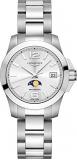
The Longines Conquest VHP takes its name from three words that describe exactly what it does: Very High Precision. At the heart of this series sits a thermo-compensated quartz calibre engineered to hold its rate within tight tolerances across temperature swings that would unsettle an ordinary battery movement.
The result is a Swiss sport watch that behaves less like a conventional quartz piece and more like an instrument. Where mechanical watches charm with sweeping seconds and servicing intervals, the Conquest VHP answers a different brief altogether: set it, wear it, and trust it to stay there.
What Very High Precision Actually Means
Tucked into the Longines brand’s wider catalogue of sport and dress models, the Conquest VHP competes on a specification sheet rather than on heritage alone. Annual deviation for a standard quartz watch can drift into the range of several seconds per month; the VHP calibre narrows that considerably by compensating for temperature, the single biggest enemy of quartz oscillator stability.
The practical benefit is simple. A watch that loses a few seconds a month forces a correction every few weeks. A watch that loses a few seconds a year does not. For anyone who rotates between several watches, that difference matters more than any finishing detail, because the watch is ready the moment it leaves the drawer.
Longines also fits a perpetual calendar to several VHP references, which removes another recurring chore: date adjustment at the end of short months. Combined with the accuracy of the movement, that feature turns the watch into something close to a fit-and-forget instrument.
A Movement Built Around Silicon and Thermal Stability
The VHP story is not only about rate. The quartz architecture uses a silicon balance spring and silicon components that resist magnetic fields and temperature fluctuation, two forces that quietly degrade the performance of conventional quartz watches. Silicon is also light and corrosion-resistant, which supports long-term consistency inside the case rather than degrading it.
The Battery Question
Battery life in the VHP sits in the realm of several years rather than several months, helped by a movement that draws power efficiently and by an end-of-life indicator that warns before the watch stops.
The more interesting engineering detail concerns what happens when the battery is eventually replaced. The VHP is supported by a flash-setting system that lets the wearer reset the hands quickly rather than cycling them one position at a time through a full 24-hour rotation, which is why the brand publishes a dedicated flash-setting guide alongside the standard instruction manual. Midnight-crossing date changes, so often the most fiddly part of a quartz reset, become a brief procedure rather than an exercise in patience.
For travellers, the VHP architecture also accommodates GMT references, where a quick-adjust hour hand lets the wearer step the local time forward or backward in one-hour increments without stopping the movement. The date follows the hour hand automatically, which keeps the watch useful across time zones rather than merely decorative in an airport lounge.
Case, Crystal, and the Conquest Design Language
Visually, the Conquest VHP sits firmly within the Conquest family rather than borrowing the diver cues of the HydroConquest or the chronograph layout of the Conquest Chronograph. The dial is clean, with applied indices, a slim date window, and hands that read clearly against the background whether the dial is silver, blue, or black.
Sapphire crystal with anti-reflective treatment protects the face, and the stainless-steel case is finished with the blend of brushed and polished surfaces that has defined the Conquest line for years. Several references accept an interchangeable strap system, which lets the owner move between leather and steel without visiting a watchmaker.
Water resistance is rated for daily wear including swimming and showering, a sensible specification for a sport watch that will mostly see office light but occasionally face a pool or a rainstorm. The case sizes available include options in the 41mm to 43mm range, which keeps the watch wearable on a wide variety of wrists without the heft of a full dive instrument.
- Movement: Thermo-compensated quartz, silicon components, flash-setting system
- Rate tolerance: Roughly a few seconds per year rather than per month
- Calendar: Perpetual calendar on select references
- Crystal: Sapphire with anti-reflective coating
- Case: Stainless steel with interchangeable strap options
- Water resistance: Suitable for swimming and everyday wear
One design decision deserves attention. The Conquest VHP does not chase the visual drama of a rotating bezel or a skeletonised movement; the case is unfussy by intent. That restraint mirrors the broader case for precision quartz: the watch is designed to disappear into daily life and simply report the correct time.
VHP vs Mechanical: A Preference, Not a Hierarchy
A mechanical automatic rewards the owner with a sweeping seconds hand, a visible escapement, and the rituals of winding and servicing. A quartz VHP trades that ritual for rate stability and the freedom to ignore the watch for weeks. Neither choice is superior in absolute terms, but they suit different owners.
Case size also shapes the decision. A 41mm VHP on a bracelet wears noticeably different from a 43mm date reference on leather, and the right answer depends on wrist size, ambient light where the watch is worn, and whether the strap or bracelet will see seasonal swapping.
For anyone comparing the VHP against a classic automatic chronograph with a Valjoux-derived movement, the deciding question is not which watch is more impressive to look at but which one will be accurate the next time the owner reaches for it after a fortnight in a drawer.
Readers drawn to the reference for its precision-driven identity often look at other Swiss-made pieces in the same price band, which bring a different flavour of engineering to the wrist. Neither line cancels the other out; they simply answer different watch-shopping questions.
Servicing, Ownership, and the Long View
Ownership of a VHP reference is markedly cheaper to maintain than a mechanical counterpart. A quartz movement of this type does not require the periodic oiling and regulation that an automatic does, and the main consumable is the battery. Beyond that, the wearing expense is limited to gasket replacement and an occasional crystal polish.
That economics-of-ownership argument is often underrated. The cost of a service on a mechanical chronograph can approach a significant share of the watch’s purchase price over a decade; a VHP owner can reasonably expect lower ongoing outlay, which matters for anyone building a collection rather than buying a single heirloom.
Resale value is a different conversation. Sustained demand for mechanical sports watches has historically outstripped quartz equivalents, and buyers who prioritise market liquidity over daily reliability should weigh that trade-off explicitly. The VHP rewards a specific buyer: someone who values rate precision, low friction in wearing, and modern engineering over vintage-derived marketing.
Who the Conquest VHP Is For
The clearest use case is a person who wears one watch for long stretches and wants it to read correctly without intervention. The VHP rewards a wearer who appreciates a precise measurement but not the chore of a hand-wound movement.
A second audience is the traveller who rotates through time zones. GMT references in the VHP line pack quick-set hour adjustment alongside the underlying precision architecture, so the local time can be stepped forward or backward without pulling the crown for midnight sweeps or losing the date entirely.
A third group covers anyone assembling a small collection with a quartz anchor aboard. The VHP will not ask for winding or resetting; it ends up being the default grab-and-go piece while the mechanical watches on the shelf stay on rotation.
Design-conscious wearers looking for a quartz alternative to a traditional Swiss sport watch face are well served here as well. The Conquest VHP also compares sensibly against entries with a more fashion-forward identity, where the sales pitch is heritage and dial complexity rather than quartz rate stability.
None of these alternatives is a stand-in for the VHP. The point is that a buyer deserves to know which problem each watch is solving before committing, and the Conquest VHP is candid about the problem it exists to solve: keeping time better than almost any other quartz movement Longines produces.
Battery life measured in years, rate accuracy measured in seconds per year, and a servicing routine that involves little more than a strap change and an occasional battery swap all point to the same conclusion. The Conquest VHP is not a compromise solution for buyers who cannot afford mechanical watches; it is a deliberate answer to a question that mechanical movements cannot address.
The reference sits closer to laboratory instrumentation than to fashion accessory, and that positioning gives the watch its value: steady, unglamorous accuracy available whenever the owner glances at the wrist, whatever year, whatever city, whatever season.
For anyone who has ever reset a quartz watch after a month in a drawer, the VHP offers a simple proposition: precision that does not need to be managed, only worn.