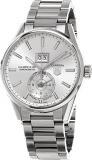
The Longines Spirit Zulu Time centers on a bidirectional rotating bezel marked with a 24-hour scale, paired with an independent GMT hand that tracks a second time zone at a glance. That combination gives the watch a clear purpose: separating home time from local time without interrupting the primary hour, minute, and second display.
The architecture of this timepiece reaches back to an era when Longines supplied navigational instruments and cockpit chronometers for early aviators. The modern Spirit Zulu Time reinterprets that utilitarian lineage through a contemporary lens, balancing the robustness expected of a tool watch with the finishing standards of a luxury sports piece.
Design and Case Architecture
The visual identity of the Spirit Zulu Time is rooted in legibility. It comes in two principal case diameters, 39mm and 42mm, so buyers can match the watch to their wrist size without compromising presence. Brushed and polished surfaces alternate across the case flanks and lugs, creating a play of light that sharpens the profile.
The bidirectional bezel carries a colored ceramic insert, a material chosen for scratch resistance and color stability. Its 24-hour scale stays crisp over years of use, and the bezel action is firm enough to prevent accidental displacement during daily wear.
On the dial, applied Arabic numerals and baton indices are treated with Super-LumiNova for low-light visibility, a holdover from night-flying requirements. The GMT hand is picked out in a contrasting color, giving an immediate reference for the second time zone, while a date window at 3 o’clock keeps the layout balanced.
The GMT Movement and Mechanical Integrity
Inside sits a self-winding Longines exclusive caliber beating at 25,200 vibrations per hour (3.5 Hz). The inclusion of a silicon balance spring is a meaningful technical detail, since silicon resists magnetic fields and temperature swings better than traditional alloys, supporting long-term rate stability.
The GMT complication is built for intuitive use. The independent 24-hour hand can be set to a second time zone without stopping the watch or disturbing the main timekeeping. This traveler-style GMT layout lets the wearer jump the local hour hand forward or backward when crossing zones, a function frequent flyers and professionals coordinating across continents tend to value.
- Case Sizes: 39mm and 42mm stainless steel options
- Bezel: Bidirectional rotating with ceramic insert
- Water Resistance: Rated for daily wear and active environments
- Crystal: Scratch-resistant sapphire with anti-reflective coating
- Lume: Super-LumiNova on hands and numerals
- Functions: Hours, minutes, seconds, date, and GMT
A transparent case back reveals the oscillating weight and the finishing of the bridges. The exhibition back serves a dual purpose: it invites the owner to appreciate the mechanical work and acts as a point of authentication for the caliber’s finishing techniques.
Aesthetic Variations and Materials
The Spirit Zulu Time range offers several dial and bezel color combinations, each with a distinct character. A matte black dial matched to a black ceramic bezel delivers a monochromatic, understated look suited to daily wear. Anthracite dials and green bezel variants nod to military and field-watch traditions.
Steel bracelet options integrate closely with the case, closing with a folding clasp and push-piece mechanism for security. The brushed finish on the links echoes the case top surfaces, producing a cohesive appearance that moves easily from a business setting to casual travel attire.
For a more classic or vintage-inspired look, the watch is also offered on leather straps. Quick-release spring bars allow tool-free changes, so the wearer can switch between a sporty steel bracelet and a refined alligator strap depending on the occasion. That versatility positions the Spirit Zulu Time as a go-anywhere companion, equally at home in the boardroom and the departure lounge.
Aviation Heritage and Modern Context
The “Zulu” designation comes from the NATO phonetic alphabet for the letter Z, which historically stands for Coordinated Universal Time in military and aviation contexts. By adopting that nomenclature, Longines ties the model to a legacy of precision timekeeping that began when the brand supplied chronometers to the pioneers of flight.
In a contemporary travel environment, the utility of a GMT watch remains intact. While smart devices can display world time, a mechanical GMT such as the Spirit Zulu Time is a self-contained, battery-free solution that needs no charging and holds its value over time. It represents a tool-watch approach that prioritizes function without abandoning the aesthetic codes of traditional watchmaking.
Wearing Experience and Ergonomics
The wearing experience of the Spirit Zulu Time is defined by balance. The 39mm variant sits comfortably on smaller wrists, while the 42mm version offers more heft for those accustomed to larger cases. Curved lugs follow the wrist, preventing the watch from sliding despite the added weight of a metal bracelet.
The crown is grooved for a secure grip when winding the movement or setting the functions. Where pushers appear in the design, they sit smoothly within the case profile, so they do not snag on clothing or cabin equipment. This attention to ergonomic detail underlines the practicality of the design.
Dial legibility holds up in both bright sunlight and shadow. Contrast between the hands and the backdrop is strong enough to read the time at a glance, and the GMT hand’s distinct color prevents confusion when checking a second time zone. That clarity matters to pilots, but it is equally useful for anyone who needs to read the time quickly in a meeting, on a hike, or in transit.
Comparison with Contemporary Travel Watches
The GMT segment is crowded, with options spanning entry-level to luxury. The Spirit Zulu Time competes by combining materials and specifications usually found at higher price points. A ceramic bezel and a silicon-spring movement place it in a distinctive position within its bracket.
Within the Longines brand’s broader catalog, the Spirit Zulu Time sits alongside dive watches and chronographs, each addressing a different style of timekeeping. A diver-style bezel, for example, serves underwater elapsed-time tracking rather than the 24-hour reference a GMT provides, so the two formats solve separate problems even when they share a case aesthetic.
Racing chronographs represent another philosophy of measurement altogether. Where a GMT tracks a steady second time zone, a chronograph counts elapsed intervals on demand, and the two complications rarely overlap in daily use. That distinction helps clarify why the Spirit Zulu Time occupies its own niche rather than duplicating the role of a stopwatch-equipped model.
The decision to choose a GMT watch like the Spirit Zulu Time often comes down to the specific type of travel or coordination the wearer performs. Unlike a standard three-hand watch, the GMT offers a dedicated tracking capability, making it a specialized tool that doubles as an everyday timepiece. This blend of utility and style is central to its ongoing popularity.
Final Thoughts on the Longines Spirit Zulu Time
The Spirit Zulu Time stands as a robust expression of Longines’ ability to produce technically competent and historically grounded watches. It is a timepiece designed for motion, whether that motion is across an ocean or across a city. The design invites a sense of preparedness and awareness of the wider world.
For the individual who values a mechanical connection to their environment and needs a reliable instrument to track their movements through multiple time zones, this model offers a compelling proposition. It encapsulates a spirit of exploration that is as relevant to the modern traveler as it was to the navigators of the past.