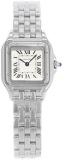
The Cartier Panthère de Cartier, in its medium steel configuration, measures 27 mm by 37 mm with a slim 6 mm profile, a geometry that allows the case to trace the wrist like a second skin rather than sit upon it. Few watches in the luxury category achieve such a precise balance between jewelry and instrument, and fewer still sustain that balance across four decades of production.
The Genesis of a Jewelry-Watch Icon
Cartier introduced the Panthère in 1983, during a period when the maison was actively translating its heritage in precious objects into wristwear that could be worn daily. The name references the panther motif that had appeared in Cartier’s design language since the early twentieth century, but the watch itself was never a literal animal portrait. Instead, the panther informed the case architecture: supple, taut, and poised. The bracelet’s link structure was designed to mimic the flexibility of a feline’s spine, allowing the metal to articulate fluidly rather than resist the wrist.
This design philosophy placed the Panthère in a category distinct from conventional dress watches. It was not conceived as a tool or a complication showcase, but as an object of adornment that happened to tell time. That distinction matters when evaluating the watch today, because it explains why Cartier prioritized case proportions, bracelet articulation, and dial legibility over mechanical complexity. The quartz movement inside the current medium model serves that same logic: it is slim, reliable, and unobtrusive, requiring no winding ritual to interrupt the experience of wearing the piece.
Case Architecture and Wrist Presence
The medium Panthère’s 27 mm by 37 mm case is a study in proportional restraint. The rectangular form is softened by curved lugs that flow directly into the bracelet, eliminating the visual break that a traditional strap would create. This integrated approach means the watch reads as a single continuous object, with the case and bracelet sharing the same visual rhythm. At 6 mm thick, the profile is thin enough to slide under a shirt cuff without catching, yet substantial enough to register as a serious piece of jewelry on the wrist.
The crown is set with a synthetic blue spinel, a detail that echoes Cartier’s historical use of colored stones in its watch crowns. The silvered dial provides high contrast against the blued-steel sword-shaped hands, a pairing that ensures legibility without sacrificing elegance. Water resistance is rated to 3 bar, approximately 30 metres, which covers incidental contact with water but signals clearly that this is not a sports watch. The steel bracelet closes with a hidden folding clasp, maintaining the clean lines of the case and bracelet junction.
Quartz Precision and the Logic of Maintenance
The quartz movement powering the medium Panthère is not a compromise; it is a deliberate design choice. Quartz calibres are inherently more accurate over short intervals than mechanical movements, and they require no periodic servicing beyond battery replacement. For a watch positioned as an everyday piece, this translates to lower ownership friction. The wearer does not need to think about winding, setting, or regulating the movement. The watch is ready whenever it is picked up, which aligns with the Panthère’s role as an accessory that integrates into daily life rather than demanding attention.
This approach also contributes to the case’s slimness. Mechanical movements, particularly automatic ones, require additional height for the rotor and mainspring barrel. By using a quartz calibre, Cartier was able to keep the case at 6 mm, preserving the elegant proportions that define the Panthère’s visual identity. The trade-off is that the case back is solid, so there is no exhibition window to view the movement. Given that the movement is a functional component rather than a decorative one, this is a coherent decision.
Style and Wearing Contexts
The Panthère’s aesthetic registers differently depending on how it is worn. On a bare wrist, the steel case and bracelet catch light in a way that emphasizes the watch’s sculptural qualities. Worn over a cuff or alongside other bracelets, it becomes part of a layered composition, its slim profile allowing it to sit comfortably without competing for space. This versatility is a direct result of the proportions: the 37 mm length across the wrist is substantial enough to be visible, while the 27 mm width keeps the watch from overwhelming smaller wrists.
For those building a collection, the Panthère functions as a bridge between categories. It is formal enough for evening wear but relaxed enough for daytime use. It pairs naturally with tailored clothing but does not look out of place with more casual attire. This range is unusual in a watch that commits so fully to a jewelry-first identity, and it explains why the Panthère has maintained a consistent presence in Cartier’s catalogue since its reintroduction in 2017.
Size Variations and Historical Context
The current Panthère line includes mini, small, and medium models, with the medium being the most widely recognized. The small model measures 22 mm by 30 mm, while the mini sits at approximately 19 to 21 mm on the case width. These variations allow the wearer to choose a scale that matches their wrist and personal aesthetic. First-generation Panthères, produced between 1983 and 2004, followed different sizing conventions, which is a consideration for collectors evaluating vintage examples.
- Medium model: 27 mm x 37 mm, 6 mm thick
- Small model: 22 mm x 30 mm
- Mini model: approximately 19 to 21 mm wide
- Water resistance: 3 bar (approximately 30 metres)
- Dial: Silvered, blued-steel sword-shaped hands
- Crown: Set with a synthetic blue spinel
The reintroduction of the Panthère in 2017 marked a return to a design that had been dormant for over a decade. The updated models retained the core proportions and visual codes of the original while updating the movement and manufacturing standards. This continuity is significant: it indicates that the Panthère’s design was not a passing trend but a resolved solution to a specific set of aesthetic and practical problems.
Craftsmanship and Material Choices
The use of steel in the medium Panthère is not a cost-saving measure. Steel allows for sharper edges and more precise finishing than softer precious metals, which is important for the articulated bracelet links. The links must move smoothly against each other, and steel provides the hardness needed to maintain those tolerances over years of wear. The high-polish finish on the case and bracelet is achieved through multiple stages of abrasion and buffing, a process that requires significant hand work.
The synthetic blue spinel in the crown is a deliberate echo of Cartier’s tradition of using colored stones in its designs. While not a precious stone in the traditional sense, the spinel provides a focal point of color that draws the eye to the crown without disrupting the watch’s overall restraint. The silvered dial and blued hands form a classic palette that has been a Cartier signature for decades, and the absence of numerals on the dial keeps the focus on the case and bracelet architecture.
This article is part of a broader Cartier collection covering the maison’s watchmaking heritage.
The Panthère in the Context of Cartier’s Watchmaking Legacy
Cartier’s approach to watch design has always been shaped by its origins as a jeweler. The maison’s most enduring watches, from the Tank to the Santos to the Panthère, share a common trait: they are conceived as objects with distinct silhouettes, not as platforms for mechanical complexity. This does not diminish their technical merit; the Santos, for example, was one of the first wristwatches designed for practical use. But it does explain why Cartier’s design language prioritizes form and proportion over movement specifications.
The Panthère is perhaps the purest expression of this philosophy in Cartier’s contemporary catalogue. It makes no claims to being a tool watch, a dive watch, or a complication. It is a piece of jewelry that tells time with precision, and it succeeds on those terms. The quartz movement, the slim case, the integrated bracelet, the minimal dial all serve a unified purpose. There is no extraneous detail, no feature included for the sake of a specification sheet.
For collectors and enthusiasts, this clarity of intent is what makes the Panthère worth considering. It represents a category of watchmaking that is often overlooked in discussions dominated by mechanical movements and technical specifications. The Panthère argues, quietly and consistently, that a watch can be valued for its design and its wearability rather than its complexity. That argument is as relevant today as it was in 1983.