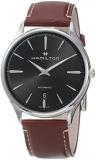
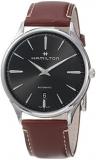
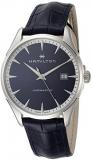
The Hamilton Khaki Field Quartz 38mm pairs a stainless steel case with a dial layout rooted in mid-century military specifications, where legibility under stress mattered more than decoration. That lineage continues to shape how the brand approaches its battery-powered models today, balancing utilitarian clarity with finishes suited to daily wear.
Quartz timing occupies a specific place within the broader Hamilton lineup: it delivers the accuracy of a regulated oscillator without the winding routine demanded by a mechanical caliber, which suits anyone who rotates between several watches or simply prefers set-and-forget ownership.
How Quartz Fits Into the Hamilton Design Language
Hamilton states that its quartz mechanisms are known for their accuracy, describing a deviation of only about one second per day in its own product literature. That figure frames the practical appeal of the movement family: rather than chasing chronometer certification, the quartz caliber prioritizes consistency across weeks of wear with no positional variation to consider.
The case construction follows the same logic. A highly resistant alloy of steel and chromium forms the base of models such as the Khaki Field Quartz, giving the watch corrosion resistance and enough structural rigidity to handle knocks against door frames, desks and hiking poles. The finish work varies across the range, from brushed surfaces that hide scratches to polished bevels that catch light along the case flanks.
The Field Watch Template
The dial architecture traces back to the specification watches Hamilton produced for military issue, where a hacking movement allowed synchronization of timepieces across a unit. The stop-second device described in the brand’s own historical notes let soldiers align their watches precisely before an operation, a function that remains useful for anyone coordinating schedules or timing tasks to the second.
Contemporary quartz references carry that template forward with restrained typography, high-contrast hour markers and hands treated for low-light reading. The result reads clearly at a glance without the visual noise that often accompanies sportier chronograph layouts.
Case Sizes Across the Range
The range spans several case diameters, and the choice matters more than the numbers suggest. A 33mm case sits close to the wrist and slips under a cuff, which suits narrower wrists and formal contexts. The 38mm version remains the middle ground, offering enough dial area for legibility while keeping the proportions modest. Larger aviation-oriented references push toward 42mm and beyond, where the additional surface area accommodates GMT and chronograph complications.
Lug-to-lug measurements deserve as much attention as the nominal diameter. A compact case with long lugs can overhang a small wrist, while a wider case with short lugs may wear smaller than expected. Trying a reference on, or at least checking the lug span, prevents the most common sizing disappointment.
What the Quartz Movement Means in Practice
Battery-powered calibers simplify ownership in ways that matter over years rather than days. There is no power reserve to monitor, no crown to wind and no amplitude drift to worry about after the watch sits in a drawer for a fortnight. A fresh cell typically carries the movement for a period measured in years, and a replacement is a routine service task rather than a mechanical overhaul.
Accuracy is the other practical dividend. Without a balance wheel subject to positional variation, a quartz caliber holds its rate consistently whether the watch rests dial-up overnight or stays on the wrist through a working day. For anyone who treats a watch as a tool rather than a mechanical companion, that stability removes a recurring source of mild annoyance.
The trade-off is the absence of the mechanical character that draws many enthusiasts to automatic movements. There is no sweeping seconds hand, no rotor visible through a case back and no sense of stored energy being released. A quartz Hamilton is chosen for dependability and low maintenance, not for the ritual of winding. Buyers weighing the two approaches often compare the quartz field models against automatic references in the same family, since the case design and dial language remain largely shared while the movement and price positioning diverge.
Reading the Dial and Case Details
Legibility on these references comes from contrast rather than size. Matte dial surfaces absorb light and prevent glare, while printed markers and applied numerals sit at different heights to create subtle shadow lines. Hands are typically filled with luminous compound, and the intensity of that compound determines how well the watch reads in darkness rather than the diameter of the hands themselves.
Crystal choice also affects the ownership experience. Domed sapphire resists scratches but can catch reflections at certain angles, while flatter profiles reduce glare at the cost of some vintage character. Hamilton’s field-oriented references generally favor practical clarity over decorative distortion.
Water resistance should be read carefully. A rating expressed in bar or metres indicates static pressure tolerance under laboratory conditions, not a guarantee for swimming or diving. Daily wear protection against rain and hand washing is a different requirement from water sports, and buyers should match the rating to the activity rather than assuming a field designation implies aquatic capability.
- Case material: stainless steel alloy with chromium for corrosion resistance
- Movement: quartz caliber with stated accuracy around one second per day
- Case diameters: 33mm, 38mm and larger aviation-oriented references
- Dial approach: matte surfaces with high-contrast markers and luminous hands
- Ownership profile: battery replacement rather than mechanical servicing
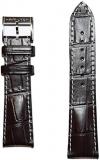
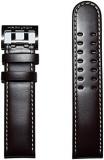
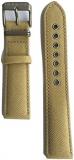
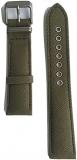
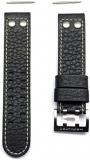
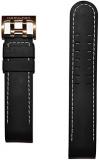
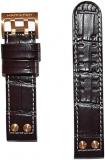
Strap and bracelet options shift the character considerably. A leather strap softens the field aesthetic for office wear, while a steel bracelet adds visual mass and durability. Quick-release spring bars, where fitted, make the swap a matter of seconds and encourage owners to treat the watch as a single case with several personalities.
Where the Quartz Range Sits Against Alternatives
Within the wider field of accessible precision timekeeping, several directions compete for the same wrist. Dive-oriented references such as the Breitling Superocean bring rotating bezels and higher water resistance ratings, but they carry more bulk and a different set of maintenance expectations. Dress-oriented lines lean the other way, trading tool-watch legibility for slimmer profiles and polished surfaces.
Pilot-style chronographs occupy yet another position, adding stopwatch functions and busier dials for those who time intervals regularly. A quartz field watch deliberately avoids that complexity. Its dial answers one question quickly, and its case thickness stays modest enough to disappear under a shirt cuff.
For buyers who want mechanical character in a similarly restrained package, automatic references in the same family offer sweeping seconds and a visible movement, at the cost of periodic servicing and less consistent rate keeping. The decision usually comes down to whether the watch is a tool or a hobby, and many owners eventually keep both.
Choosing the Right Reference for Daily Wear
Wrist size should drive the first decision. Measuring the flat top of the wrist and comparing it against a case’s lug-to-lug span gives a more reliable answer than diameter alone. Someone with a slender wrist may find the 33mm reference sits best for formal wear, while the 38mm version suits a broader range of outfits and occasions.
Dial colour and finish deserve attention beyond photographs. Dark dials read smaller and tend to look more formal, while lighter tones open up the visual space and feel more casual. Sunray finishes shift tone with the angle of light, which photographs capture poorly and which can surprise an owner in person.
Ownership costs run well below mechanical equivalents. A quartz caliber needs a battery at intervals and a gasket check during replacement, nothing more in ordinary use. That predictability appeals to anyone who prefers to set a watch once and forget it until the cell runs down.
The final consideration is intent. A quartz field watch works as a single reliable timepiece for someone who wants one watch to do everything, and it works equally well as a low-maintenance addition to a collection anchored by mechanical pieces. Its appeal rests on clarity of purpose: accurate time, readable at a glance, in a case that traces its shape back to instruments built for soldiers who needed exactly that.