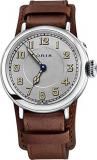
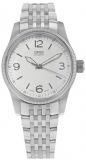
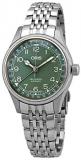
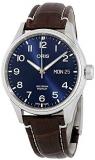
A domed sapphire crystal, a fluted bezel, and a central hand tipped with a crescent moon that sweeps across a ring of painted numerals: these are the defining signatures of the Big Crown family, and they separate it from nearly every other Swiss automatic on a dealer’s tray. The central pointer date is the feature that gives the line its identity, replacing the conventional cut-out window with a fourth hand that traces a circular calendar around the dial’s perimeter.
The layout traces back to 1938, when Oris produced oversized crowns for pilots who needed to operate a watch while wearing leather flight gloves. That functional origin still shapes the modern collection, which spans 29mm, 34mm, 38mm, and 40mm case sizes according to Oris, alongside chronograph and complete calendar variants. The result is a line that reads as a tool watch on paper and as a dress watch on the wrist.
What the Pointer Date Complication Actually Does
A conventional date window interrupts a dial, removing a numeral or an index and replacing it with a small aperture. The pointer system takes the opposite approach, preserving the full symmetry of the dial and relocating the calendar to a graduated track that circles the hour markers. On most Big Crown references this track is printed with the numbers 1 through 31, and a narrow hand with a crescent tip indicates the current day.
The advantage is legibility at a glance rather than through close inspection. Because the calendar hand is longer and more prominent than a date disc, the wearer reads the date with the same peripheral vision used to read the time. The trade-off is that setting the date requires winding through the crown rather than a quick-set button, a detail collectors either find charming or irritating depending on temperament. The reward is a dial that stays compositionally intact, which is precisely why the design has survived nearly nine decades without a fundamental rethink.
Case Proportions and the Question of Wrist Presence
Case diameter tells only part of the story, and the Big Crown is a good example of why lug-to-lug measurements matter. A 40mm version with crown guards measures roughly 42mm including the crown, while lug-to-lug sits near 48mm according to published hands-on measurements. The 38mm Pointer Date Calibre 403 reference trims those figures to approximately 45.7mm lug-to-lug, a reduction that changes the watch from a substantial presence to something closer to a classic mid-century proportion.
This matters for buyers comparing across the line. A 40mm case on a 6.5-inch wrist reads as deliberate and slightly vintage; the same watch on a 7.5-inch wrist reads as understated. The 34mm and 29mm references move further toward jewelry territory, with the smaller cases drawing attention to the bezel work and the dial’s negative space rather than the movement inside.
Dial Furniture and Readability
Most Big Crown dials share a set of consistent design choices that support fast reading. Applied numerals or baton indices sit on a matte or sunray-brushed surface, and the hands are typically polished with luminous inserts on the sword-style hour and minute hands. The red-tipped pointer hand appears on many references, providing a visual accent that allows the calendar to be distinguished from the time-telling hands without a second glance.
Crystal choice is worth noting for anyone who intends to wear the watch hard. Domed sapphire appears on the current catalog, and the curvature produces distortion at the dial edges that mirrors the acrylic crystals of mid-century pilot watches. That aesthetic decision is intentional, and it is one reason the line photographs better than it specs on paper.
Sizes Across the Range
- 29mm: the smallest Pointer Date, positioned as a dress-oriented option
- 34mm: a mid-size case that suits narrower wrists without shrinking the dial
- 38mm: the reference proportion for the Calibre 403 variant
- 40mm: the standard modern size for the core automatic line
Movement Options from the Entry Point to the Calibre 403
The standard Pointer Date runs a Swiss-made automatic with 26 jewels, a frequency of 28,800 vibrations per hour, hacking seconds, and a power reserve quoted at roughly 38 hours. A display case back exposes the movement, which is finished at a level appropriate to the price point rather than to haute horlogerie standards. Owners who care about movement architecture will find the standard caliber competent rather than spectacular, and that is consistent with its role as a daily-wear workhorse.
The Calibre 403 reference changes the calculation considerably. Oris states a five-day automatic with a 38mm stainless steel case, 5 bar water resistance, and a black leather strap on a stainless steel buckle. A five-day reserve removes the need for a winder or a nightly ritual, and it positions the Calibre 403 as the enthusiast’s choice within the family. The price gap between the two tiers is the central purchasing decision in this line.
Water resistance across the collection is quoted at low levels, typically in the range of everyday splash protection rather than swimming. Buyers who want a single watch for pool and desk should look elsewhere; the Big Crown is a leather-strap companion, not a diver.
Setting, Wearing, and Living With the Watch
The oversized crown is the most tactile element of ownership. Because it was designed for gloved hands, it offers a generous grip and makes winding and setting easy even for wearers with larger fingers. The pointer date cannot be jumped independently on the traditional caliber, so the owner winds the hands forward through the month when the watch has stopped. This is not a defect, but it is a behavior that new owners should understand before purchase.
Strap changes have an outsized effect on how the watch reads. A brown or black leather strap keeps the aviation lineage visible and pairs well with the vintage-leaning dial furniture. A steel bracelet pushes the same case toward a sportier register, while a suede or textured calf strap nudges it toward casual weekend wear. The lug width and case shape accept all three without visual conflict, which is one reason the line is often recommended as a first serious mechanical purchase.
Watchmaking context helps explain the appeal. Oris built its reputation on mechanical movements at accessible price points rather than on complications, and the Big Crown line embodies that philosophy more directly than the brand’s dive watches. For readers building a collection around pilot or field aesthetics, The Oris brand’s catalog spans both directions and frames the Big Crown within a coherent range of mechanical references.
How the Line Fits Against Competing Watches
The strongest case for the Pointer Date is that few competitors offer a comparable complication at the price. Chronographs and GMTs are common across the market, but a circular pointer calendar in a Swiss automatic case of this quality occupies a narrow niche. Buyers weighing alternatives often consider field-style pieces with simpler date windows, or dress watches from other houses with more formal proportions.
Positioning is easiest to see against established collections. Those who favor tool-watch design language often look at pieces including a Breitling reference for the sportier end of the spectrum, though those models trade vintage poise for durability and typically sit in a higher price bracket. On the calendar side, Rolex models offer a different interpretation of the dated dial with greater service infrastructure and significantly higher acquisition cost. Neither comparison undercuts the Oris at its own price point, which is the honest way to read the market.
For buyers prioritizing aviation style, alternatives like a TAG Heuer Grand Carrera lean on racing and motorsport cues rather than flight instruments. The Big Crown’s fluted bezel, domed crystal, and crescent hand form a distinctive package that is difficult to replicate elsewhere. Even the entry-level references carry the same visual signatures as the top of the line, which keeps the family coherent from 29mm to 40mm.
Choosing the Right Reference for Your Wrist
The purchasing decision narrows to a few variables. Wrist size determines the case: sub-6.5-inch wrists will find the 38mm and smaller references comfortable and proportionally correct, while 7-inch-plus wrists can carry the 40mm without the dial swallowing the case. Movement ambition determines the tier: the standard automatic suits buyers who rotate watches regularly and don’t mind resetting the date, while the Calibre 403 suits those who want a single mechanical watch with reserve to spare.
Dial and strap choices then come down to taste. Navy, black, and silver-white dials are the most enduring; the red-tipped pointer hand remains readable against all three. The aviation heritage and the calendar complication continue to distinguish the Big Crown in a market crowded with lookalike pilot watches, and that combination of history plus function is a durable reason to make it a long-term daily wear.