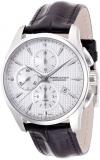
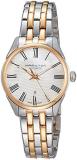
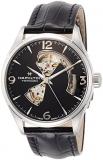
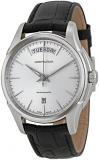
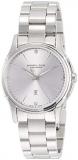
The Hamilton Jazzmaster Viewmatic Auto H32515555 presents a 40mm polished stainless steel case at roughly 10.8mm thick, a profile slim enough to slip beneath a shirt cuff while still carrying real wrist presence. That balance of dimensions is the first clue to what this watch is: a dress-leaning automatic built for daily rotation rather than occasional display.
The architecture of the Jazzmaster line has always favoured symmetry over spectacle. Where dive watches advertise depth ratings and chronographs advertise complexity, the Viewmatic makes its case through proportion, dial restraint, and an exhibition back that turns the movement itself into the decoration. That approach places it alongside other refined dress references built around understatement, much like a restrained Swiss dress watch from Raymond Weil, where restraint is treated as a design position rather than a compromise.
A Dial Built on Balance and Legibility
The silver-white dial draws on an Art Deco sensibility, with applied numerals and indices arranged in a 3-6-9-12 layout that anchors the eye at four points while leaving the remaining hours marked in slimmer baton form. It is a decision that gives the face structure without crowding it. A date window at 3 o’clock handles the practical function, and the inclusion of a day display on this reference adds a layer of utility that most three-hand dress watches skip entirely.
Hamilton’s design language here is deliberately quieter than the polished, high-contrast treatments found across many modern steel sports watches. There is no oversized bezel, no layered chapter ring, no competing texture. The dial works because the hands stay slim, the printing stays legible, and the finishing stays contained. Under a sapphire crystal, that restraint reads as confidence rather than bareness, and the sapphire itself is the right call for a watch intended to be worn rather than stored.
Wearers who usually gravitate toward tool-oriented faces may find the transition instructive. A bezel-heavy diver communicates through markings and luminous depth, whereas the Viewmatic communicates through negative space. Choosing between the two is less about quality than about which visual argument a wearer wants to make on the wrist each morning.
The H-10 Movement and What It Changes Day to Day
Powering the reference is Hamilton’s H-10 calibre, an automatic self-winding movement that has become the backbone of the brand’s accessible mechanical range. The practical headline is the extended power reserve associated with the H-10 platform, which allows the watch to be set aside for a stretch of days and picked up again without immediate resetting. For a watch worn in rotation with others in a collection, that reserve matters more than almost any specification on paper.
The movement also abandons the traditional regulator in favour of a free-sprung balance architecture, a configuration that reduces certain points of adjustment and can contribute to rate stability over time. None of this is exotic watchmaking, and it is not presented as such. It is, however, the kind of engineering that suits a watch designed to be reliable rather than dramatic.
Finishing on the movement is visible through the exhibition case back, with bridges and rotor treated to a level of decoration appropriate to the price position. The display back is a meaningful inclusion at this tier, because it reminds the wearer that the watch is mechanical every time it is turned over. That connection carries more weight than the specification sheet suggests, and it is the reason many buyers move from quartz to automatic in the first place.
- Calibre: Hamilton H-10 automatic, self-winding
- Case: 40mm polished stainless steel, approximately 10.8mm thick
- Crystal: Sapphire
- Dial: Silver-white with applied numerals and date at 3 o’clock
- Water resistance: Suitable for daily contact with water and light splashes
- Case back: Exhibition, showing the decorated movement
Case dimensions deserve separate attention. At 40mm with a thickness just under 11mm, the watch sits in territory that suits a wide range of wrists without tipping into oversized proportions. Lug spacing and case curvature determine how a watch actually feels far more than the diameter figure alone, and the Viewmatic’s relatively compact thickness is what allows it to disappear under a cuff. This is a real advantage for anyone who wears a shirt or jacket to work and does not want a watch that snags on fabric or sits proud of the wrist.
Where It Fits Against the Wider Dress Watch Field
The affordable dress automatic segment is crowded, and buyers comparing within it usually weigh the same handful of factors: movement provenance, dial execution, case finishing, and how convincingly the watch handles both office and evening wear. Swiss mechanical movements at this price point narrow the field considerably. The Viewmatic’s proposition rests on offering a Swiss automatic with classic styling and a display back, without the steep premium charged by heritage-first houses.
Comparisons with other Swiss dress-leaning references are natural, though the priorities differ. Some formal-focused models tend toward a more overtly streamlined silhouette, while the Hamilton carries a slightly more architectural dial via its applied numeral layout. Neither is more correct; the distinction matters to a buyer deciding whether the watch should read as pure eveningwear or as something flexible enough for a Tuesday afternoon meeting.
It is also worth situating the Viewmatic within Hamilton’s own catalogue. The brand’s identity was built partly on American railroad and military timekeeping, and that utilitarian inheritance occasionally surfaces in its field and pilot ranges. The Jazzmaster line deliberately turns away from that history toward mid-century elegance. Buyers who want the brand’s tool-watch side will look elsewhere in the collection, and that clarity of purpose is a strength rather than a limitation.
Strap Options, Versatility, and Ownership Costs
The reference is offered on leather, and leather is the correct default here. A slim dress case with a silver-white dial pairs naturally with a dark brown or black strap, and the standard lug width means aftermarket options are easy to source. Swapping to a mesh bracelet or a textured calfskin changes the character of the watch considerably, which extends its usable range across formal and smart-casual wardrobes without requiring a second purchase.
Ownership economics are favourable for a mechanical watch. The H-10 platform is widely serviced, and the absence of complications beyond the day and date keeps long-term maintenance straightforward. Water resistance covers handwashing and rain but should not be read as swimming capability. Buyers who want genuine water sports capability are shopping in a different category, and competitors built around screw-down crowns and rated depth figures serve that need properly.
Accuracy expectations should be calibrated realistically. The H-10 is a robust workhorse movement rather than a chronometer-certified calibre, and daily deviation in the range typical for this class is normal. For most wearers, the combination of a multi-day power reserve and automatic winding means the watch stays running without fuss, which is the practical outcome that matters more than laboratory precision figures.
Who Should Consider the Viewmatic Auto
The clearest fit is the buyer who wants a first serious mechanical watch with a dress orientation, values a Swiss automatic with a display back, and prefers a dial that will still look composed a decade from now. It also suits someone assembling a small collection who needs a restrained option for formal occasions that does not duplicate the role of a sports watch already in the box.
It is a less obvious choice for buyers who prioritise brand recognition above design, or who need a single watch to handle swimming, hiking, and black-tie events. No mechanical dress watch does all of those well, and the honest framing is that the Viewmatic excels in the environments where a slim case and a clean dial are assets. Paired with a robust everyday beater, it covers the ground that casual watches cannot.
On the wrist, the watch reduces to a simple proposition: a proportioned steel case, a legible silver dial, and a mechanical movement you can watch working through the back. That combination has kept the Jazzmaster Viewmatic Auto relevant in a market increasingly distracted by connected functionality, and it is likely to keep doing so for wearers who measure value in decades rather than update cycles.