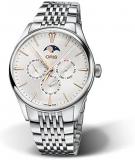
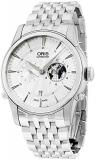
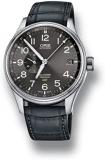
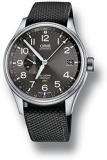
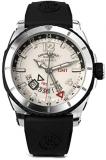
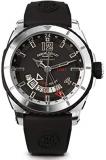
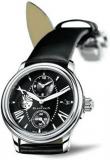
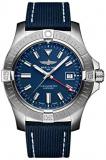
The Oris Aquis GMT Date pairs a 43.5 mm stainless steel case with a blue dial and a 24-hour bezel, giving travelling divers a mechanical tool watch that tracks two time zones at once. Its automatic movement, 300-metre water resistance, and screw-down crown place it firmly in the professional dive watch category, while the GMT complication extends its usefulness far beyond the water.
The architecture of the Aquis GMT deserves close attention because it solves a problem that many dual-time watches ignore. The GMT function is not a decorative add-on here; it is integrated into the same case architecture that Oris uses for its dedicated dive models.
How the GMT Complication Actually Works
A GMT watch displays a second time zone using an additional hour hand that completes one full rotation every 24 hours. On the Oris Aquis GMT Date, this hand is paired with a 24-hour scale printed on a ceramic bezel insert. Instead of the standard 60-minute dive bezel found on conventional Aquis models, the bezel carries a 24-hour scale with a 60-minute segment worked into its outer track.
This dual-purpose bezel design is worth understanding. The 24-hour markings allow the wearer to set a second time zone, while the 60-minute scale retains the elapsed-time tracking that divers require. The result is a bezel that does two jobs without compromising either one. For a pilot, traveller, or diver who crosses time zones, that combination removes the need to choose between a dedicated dive watch and a dedicated travel watch.
The 24-hour hand on this reference operates independently, meaning it can be adjusted without disturbing the position of the main hour and minute hands. That matters for anyone who lands in a new city, resets the local time, and still wants to know what time it is back home.
Case, Water Resistance, and Case Architecture
The stainless steel case measures 43.5 mm in diameter, 13.1 mm in thickness, and 50 mm from lug to lug. Those dimensions give the watch real wrist presence without sliding into oversized territory. The case is pressure-resistant to 30 bar, which corresponds to 300 metres of water resistance, a rating that exceeds the requirements of recreational scuba diving.
Several structural details support that rating:
- Screw-down crown: Seals the winding and setting mechanism against water ingress.
- Ceramic bezel insert: Resists scratches and fading far better than aluminium alternatives.
- Case back: Secured to maintain the 30-bar pressure rating across the full case assembly.
- Integrated lug design: The Aquis line’s signature lug-free silhouette reduces snag points and reinforces case rigidity.
While the design language and overall water resistance rating align with The Oris brand’s broader dive watch philosophy, the extended lug-to-lug measurement of 50 mm means smaller-wristed wearers should try the watch before committing. The integrated bracelet helps distribute the weight evenly, but the footprint is genuinely substantial.
An extendable clasp on the stainless steel bracelet allows quick adjustment over a wetsuit sleeve, a practical feature for divers who transition between bare wrist and neoprene.
Dial Legibility and Everyday Wearability
The blue dial carries applied indices and hands treated with luminous coating, ensuring readability in low light. A date window sits at the 3 o’clock position, adding daily practicality without disrupting the dial’s balance. The interplay between the blue dial surface and the ceramic bezel insert creates a tonal depth that reads differently depending on lighting conditions.
With its blend of a 300-metre depth rating, ceramic bezel, and dual time zone capability, this model occupies a space that heritage-inspired Swiss dive watches approach from a different angle, prioritising a single time zone and a simpler dial layout. Choosing between the two approaches depends on whether travel versatility or traditional dive watch minimalism matters more to the individual wearer.
On the wrist, the Aquis GMT behaves like a modern sports watch first and a travel companion second. The sweep of the automatic movement is visible through the transparent case back, and the bracelet’s brushed and polished surfaces hold up well against daily knocks.
Movement and Swiss Automatic Engineering
Inside the case, a Swiss Made automatic movement drives the hours, minutes, seconds, date, and independently adjustable 24-hour hand. Self-winding mechanisms of this type convert wrist motion into stored energy through an oscillating weight, eliminating the need for batteries and sustaining the watch indefinitely as long as it is worn regularly.
The GMT module adds mechanical complexity because it requires additional gearing to drive a hand that rotates at half the speed of the standard hour hand. That engineering is precisely why GMT watches occupy a distinct tier within automatic watchmaking, and it connects the Aquis GMT to a broader lineage of Swiss GMT tool watches that established the dual-time format as a serious category rather than a novelty.
Accuracy specifications will vary by individual movement and usage conditions, and Oris does not publish a COSC certification claim for this reference. Owners should expect standard automatic performance, with servicing recommended at the intervals prescribed in the owner’s manual.
The Aquis Family Context
The Aquis GMT sits within the wider Aquis collection, a line that covers a broad range of sizes, colours, and materials. The collection now measures 39 mm at its smallest and includes ten quartz and four automatic models at this size, speaking to how Oris has scaled the Aquis architecture across different price points and wrist sizes.
Despite spanning multiple configurations, the Aquis family maintains the same core design cues: a unidirectional bezel, an integrated bracelet or strap, and a screw-down crown. Buyers who find the 43.5 mm GMT too large can look toward the smaller automatic references, which share the same movement philosophy minus the second time zone.
The design language also invites comparison with chronograph-led Swiss sports watches, though the two solve different problems. A chronograph measures elapsed intervals; a GMT tracks a second time zone around the clock. The Aquis GMT chooses the latter, which makes it the more rational pick for frequent travellers.
Who Should Consider This Watch
The Oris Aquis GMT appeals to a specific set of buyers rather than to a general audience. The clearest fit is the diver or watersports enthusiast who also travels across time zones and wants a single watch that handles both. The 300-metre rating means it is overqualified for surface swimming and entirely capable of recreational scuba use.
A second audience is the frequent flyer who values automatic mechanical timekeeping over quartz or smartwatch alternatives. The independent 24-hour hand makes layover time checks simple, and the ceramic bezel resists the scratches that travel and airport security trays inflict on softer bezel materials.
Buyers who rarely leave their home time zone and only need elapsed-time tracking may still prefer the standard Aquis diver. In that case, the extra cost and dial complexity of the GMT variant adds a function that goes unused, and a 60-minute bezel is the more efficient tool.
Ownership Considerations
As a Swiss automatic watch, the Aquis GMT involves ongoing ownership costs that quartz watches avoid. Mechanical movements require periodic servicing, and the recommended interval is typically several years of regular wear. The bracelet will also show surface scratches over time, which is normal for stainless steel and can be refinished during servicing.
The ceramic bezel, by contrast, holds its appearance with minimal attention. Water resistance should be tested whenever the case is opened, and the screw-down crown must be fully tightened before any water exposure to preserve the 30-bar rating.
For travellers who would rather set local time from a second hand position than from phone notifications, the mechanical GMT remains a self-contained solution. It never needs charging, never loses signal, and never asks for a software update. That independence is part of the enduring appeal of this category.
Judged against fashion-forward interpretations of Swiss watchmaking, the Oris Aquis GMT occupies a more technical position, positioning the dual time zone function as the primary reason to own the watch. It is a legitimate companion for a dive trip that ends on another continent, or for a commuter whose daily schedule spans two time zones.
A Mechanical Instrument for Two Time Zones
The case for the Oris Aquis GMT rests on the coherence of its engineering. A 24-hour ceramic bezel, an independently adjustable GMT hand, 300 metres of water resistance, and a Swiss automatic movement are not features bolted together for marketing purposes. They each reinforce the others: the diving credentials support the travel function, and the GMT complication makes the dive-watch format more versatile without diluting it.