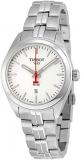
The Tissot PR 100 derives its name from three engineering commitments: precise, robust, and resistant. First introduced in the early 1980s, the line has stayed in continuous production for four decades, and references such as the 40mm T1504101104100 illustrate why. A 316L stainless steel case, a scratch-resistant sapphire crystal, and a Swiss quartz movement form the technical core, while an interchangeable quick-release bracelet system adds a level of ownership flexibility uncommon at this price point.
For anyone weighing a first serious Swiss watch against the endless noise of fashion pieces, this reference occupies a rare position: it carries genuine horological credibility without demanding the ritual or the servicing costs of a mechanical calibre.
Why the PR 100 Endures Where Trends Fade
The watch industry cycles through oversized cases, skeleton dials, and brightly coloured ceramics, yet the PR 100 has quietly outsold most of them. That longevity is not accidental. The design language stays deliberately restrained: a slim bezel, balanced lugs, and a dial whose proportions feel considered rather than decorated. The result reads as a dress watch at a dinner table and a tool watch at a desk, which is precisely the brief many buyers never manage to articulate.
Functional experimentation defines the Tissot Touch Collection, yet the PR 100 succeeds by doing the opposite. It removes complexity and polishes what remains. A parallel exists in the Tissot Heritage collection, which revisits archive references, but the PR 100 never needed a revival because it never left production.
Swiss Quartz Reliability in Daily Practice
Swiss quartz movement is the specification most often glossed over by enthusiasts and most valued by owners. Unlike an automatic calibre, it holds accuracy to within a handful of seconds per month, requires no winding ritual, and tolerates being left in a drawer over a weekend without losing meaningful time. For someone who rotates between several watches, that matters more than the romance of a rotor.
The practical payoff extends to servicing. A quartz module has fewer moving parts, so maintenance intervals stretch considerably compared to mechanical equivalents, and a battery change is a routine errand rather than a workshop booking. The trade-off is the absence of the sweeping seconds hand and the tactile engagement of a winding crown, which is a genuine consideration for buyers who view a watch as an object of mechanical interest rather than pure instrumentation.
Materials and Construction Under Scrutiny
316L stainless steel appears across the range, and for good reason. The alloy resists corrosion from sweat and humidity far better than the plated brass used in budget watches, and it takes a brushed or polished finish without flaking over time. On a watch worn daily against a shirt cuff and a keyboard, that durability determines how the case looks after three years rather than three weeks.
The scratch-resistant sapphire crystal is arguably the most consequential upgrade over entry-level alternatives. Mineral glass accumulates micro-abrasions from door handles, seatbelts, and desk edges, and those hairlines eventually dull the dial beneath them. Sapphire shrugs off nearly all of it, keeping the dial legible and the watch looking newer for longer.
- Case diameter: 40mm, a size that suits most wrist circumferences
- Case material: 316L stainless steel
- Crystal: Scratch-resistant sapphire
- Movement: Swiss quartz
- Bracelet: Interchangeable quick-release system
The quick-release bracelet is an underrated detail. Swapping between a steel bracelet for the office and a leather strap for the weekend normally requires spring bar tools and a steady hand, which is exactly the friction that stops people from changing straps at all.
Sizing, Proportion, and Wrist Presence
At 40mm, the PR 100 occupies the centre of the modern sizing spectrum, sitting comfortably between the 36mm dress references of previous decades and the 44mm sport cases that dominated the 2000s. On a wrist measuring between 16cm and 19cm, it presents a clean profile with visible dial area but without overhang at the lugs. That balance is what makes it viable as a one-watch solution rather than a rotation filler.
Buyers comparing it against Swiss contemporaries often arrive at similar conclusions about proportion-led design. A Tissot Heritage reference makes a stronger vintage statement, while daily-wear buyers focused on legibility frequently gravitate toward the Tissot brand for its consistent approach to restrained, functional dials.
Dial Legibility and Finish Options
The dial itself follows classical rules: applied indices, a discreet date aperture, and hands that are long enough to reach the chapter ring rather than stopping short. Applied markers catch light at the edges, which adds depth without the visual clutter of printed numerals. Colourways range from sober black and silver to anthracite and blue, giving buyers a way to shift the character of the watch without changing its architecture.
Water Resistance and Everyday Exposure
The R in the name stands for resistant, and the rated water resistance covers rain, hand washing, and accidental splashes without concern. It is not a dive specification, and no one should treat it as one, but it comfortably handles the incidental moisture that undoes poorly sealed fashion watches within a season.
The Brand Context Behind the Reference
Tissot has been producing watches in the Swiss Jura region since 1853, and that manufacturing continuity shapes what the PR 100 is: a mass-produced Swiss watch built to an industrial standard rather than a luxury one, but held to Swiss quality controls throughout. Buyers researching comparable Swiss categories frequently cross-reference alternatives such as the IWC collection, though those occupy entirely different tiers of the market. The PR 100 competes on discipline rather than prestige.
That positioning has practical consequences. The collection shares components across many references, which keeps replacement parts available and servicing straightforward years after purchase. A watch that can be maintained cheaply stays wearable longer, and that calculation rarely appears in launch reviews but matters enormously to owners in year five.
Who the PR 100 Is Actually For
The clearest candidates are people who want one versatile watch rather than a collection. Someone who wears a single timepiece across office days, dinners, and travel benefits from a design that refuses to look out of place in any of those settings. The quartz movement supports that lifestyle: no setting ritual, no winding anxiety, no rotating watch box required.
It also suits buyers making a deliberate step up from fashion watches. The transition costs little in style terms but delivers meaningful upgrades in material honesty: sapphire instead of mineral glass, stainless steel instead of plating, and a Swiss movement instead of an unbranded module.
Those who prioritise mechanical involvement, meanwhile, tend to look elsewhere within the brand’s catalogue or toward automatic references, since the appeal of the PR 100 is efficiency rather than horological theatre.
The collection continues to represent something increasingly uncommon in Swiss watchmaking: an honest specification sheet at an accessible point, without the marketing embellishment that usually accompanies it. When a design has remained in continuous production for four decades, the argument for it has already been settled by the people wearing it.