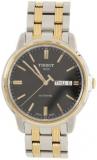
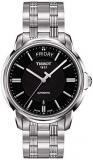
The Tissot 1853 women’s watch takes its name from the year Charles-Felicien Tissot and his son Charles-Emile established their workshop in Le Locle, Switzerland. That single date, stamped across the dial of every reference in the family, signals something specific to anyone who knows Swiss watchmaking: this is a piece rooted in a documented manufacturing lineage rather than a seasonal fashion cycle. The 1853 women’s line translates that heritage into a compact, jewellery-adjacent format built for smaller wrists.
What separates this family from generic dress watches is the discipline behind its proportions. Case diameters generally sit between 26 mm and 34 mm, dials favour restrained finishes over ornamentation, and the overall silhouette is engineered to disappear under a cuff rather than dominate the wrist. For buyers weighing a first Swiss watch against a fashion-brand alternative, the 1853 makes a case built on production credibility.
Swiss Watchmaking Heritage Behind the 1853 Name
Tissot’s own historical record places its founding in 1853, when the father-and-son partnership began producing pocket watches in Le Locle. The business expanded internationally within decades, and the 1853 designation used on watches today functions as a direct reference to that origin. It is not a marketing invention; it is a date the brand has carried through more than 170 years of continuous movement production.
That continuity matters in practical terms. Tissot states that its watches are Swiss made, a designation governed by Swiss law and requiring specific percentages of Swiss manufacturing value. The 1853 women’s family inherits that production discipline, and buyers are purchasing output from a company that has supplied chronometer-certified calibres elsewhere in its catalogue, not a licensed fashion label.
Case Design, Materials and Proportions
Most 1853 women’s references use stainless steel cases, with several variants applying PVD coating in yellow or rose gold tones. PVD delivers a warm, jewellery-like appearance while keeping the underlying case material resistant to corrosion. The brand’s willingness to push slenderness is visible across its women’s offering, where case sizes as small as 19.5 mm appear on models designed around minimal wrist presence.
Finishing typically alternates between polished surfaces and brushed flanks. This contrast catches light along the bezel and lugs while reducing visible scuffing on the sides, a detail that matters for daily wear. Sapphire crystal covers the dial on the majority of current references, and Tissot describes this material as scratch-resistant. Solid, engraved case backs keep the profile thin and protect the quartz calibre inside.
Dial Craftsmanship and Readability
Dials in this family favour restraint. Sunray-brushed finishes in silver, mother-of-pearl, blue and champagne shift colour as the wrist moves, giving visual depth without relying on gem setting. Applied indices and slim hands keep the layout legible at a glance, and Roman numeral options appear on more classical references for buyers who prefer a traditional face.
Certain variants add diamond markers at the hour positions. Tissot sources these stones through documented supply chains, and the resulting sparkle is subtle rather than theatrical, keeping the watch appropriate for daytime wear. Whatever the dial treatment, the core function remains consistent: clear hour and minute indication with date display on many references, and no crowding of the face.
Movement and Everyday Reliability
Most 1853 women’s references run on Swiss quartz movements. Quartz brings three practical advantages to a dress watch: accuracy within a few seconds per month, minimal servicing requirements, and a slim movement profile that allows the case to stay under roughly 7 mm on many variants. Tissot positions quartz as a way of delivering Swiss precision to buyers who want a dependable daily watch rather than a mechanical object requiring winding and periodic regulation.
Where a mechanical heart is preferred, the brand offers automatic references elsewhere in its women’s collections, and Tissot’s official product pages describe these calibres as combining precision with emotion. For the 1853 family specifically, the quartz route keeps ownership simple: replace the battery at recommended intervals, observe the water-resistance rating, and the watch performs without further intervention.
- Movement: Swiss quartz, with automatic options in adjacent collections
- Crystal: Scratch-resistant sapphire on most current references
- Water resistance: Typically rated for everyday contact, suitable for hand washing and rain
- Strap options: Stainless steel bracelets, leather, and in some cases two-tone combinations
Strap and Bracelet Choices
Strap selection changes the character of the watch more than any other single element. A steel bracelet with a folding clasp gives a 1853 reference a polished, slightly sporty-casual presence that works with tailoring and knitwear. Leather straps, usually in black, brown or pastel tones, push the watch toward formal and occasion wear. Two-tone bracelets that pair steel with gold-tone centre links replicate a classic jewellery watch formula associated with mid-century Swiss design.
Interchangeability is part of the appeal. Buyers who own one case can rotate straps seasonally, swapping leather for steel when summer humidity makes leather less comfortable. The lug widths used across the range are standard, which makes sourcing third-party straps straightforward and keeps the watch adaptable over years of ownership.
Sizing, Wearability and Daily Comfort
Small case diameters are not a compromise; they are the design premise. A 28 mm or 30 mm case sits within the wrist’s natural width, avoiding the lug overhang that makes oversized watches uncomfortable for slimmer wearers. Thinness reinforces this. When a watch sits under a cuff’s edge and does not catch on sleeves, it is more likely to be worn regularly, and regular wear is the point of a versatile dress piece.
Weight also plays a role. Steel cases in this size range keep the watch light enough to forget about during a working day, and solid case backs distribute pressure evenly. For those exploring the broader catalogue, The Tissot brand’s output spans sport, heritage and classical lines, which means a buyer can match case size and styling to personal preference rather than accepting a single silhouette.
Styling Context and Occasions
The 1853 women’s watch performs best when treated as understatement. With a white shirt and dark trousers, a stainless steel reference reads as a quiet professional accessory. With an evening dress, a mother-of-pearl dial or diamond-set variant supplies just enough gleam without competing with jewellery. Because the design references classical codes rather than seasonal trends, the watch does not date the way bolder fashion pieces can.
This versatility also explains the model’s presence in gift-giving. When size, taste and occasion are uncertain, a Swiss-made watch in the 30 mm range with a neutral dial is a relatively safe, lasting choice, and the 1853 name carries a heritage signal that is easy to explain and verify.
Where the 1853 Fits in the Tissot Lineup
Tissot organises its women’s offering across classical, sport-chic and jewellery-oriented lines. The 1853 women’s family sits closest to the classical end, prioritising slim cases, refined dials and traditional proportions. Buyers who want a sportier profile can look to references including the Tissot T-Sport collection, while those drawn to archival design cues will find the Tissot Heritage series, which leans more explicitly retro. Each line shares the brand’s manufacturing standards; they differ mainly in stance, water resistance and dial treatment.
Ownership costs remain modest by Swiss watch standards. Quartz calibres require only periodic battery service, sapphire crystal resists everyday scratches, and steel bracelets can be refinished. The practical result is a watch that can be worn for years without demanding attention, which is precisely what many buyers want from a first or only Swiss piece.
A Lasting Choice for the Discerning Wearer
A watch named after its maker’s founding year carries a certain obligation, and the 1853 women’s family meets it by staying faithful to the values that built Tissot’s reputation: measured proportions, dependable movements, and finishing that reads as considered rather than flashy. It is not designed to shout. It is designed to be worn often, passed down, and trusted. For anyone seeking a Swiss women’s watch that balances heritage with everyday practicality, the 1853 line makes a persuasive case.