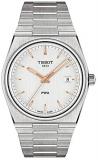
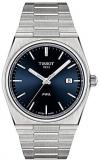
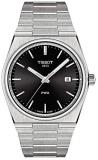
The Tissot PRX Chronograph Blue measures 42 mm across a tonneau-shaped 316L stainless steel case, and its vertically brushed blue dial separates it from the flatter sunray finishes used elsewhere in the PRX line. The model sits within a family that began as a quartz-only design exercise in 1978 and returned in 2021 as one of the most recognisable integrated-bracelet watches at its price point.
From 1978 Archive to Modern Chronograph
The original PRX of 1978 arrived during a period when case makers were experimenting with flat, angular profiles and bracelets that flowed into the case without visible lugs. Tissot revisited that template decades later, keeping the slim bezel and the wide, brushed surfaces that give the design its period feel. The chronograph variant adds two shaped pushers at 2 and 4 o’clock, plus a pair of counters on the dial, without disturbing the silhouette.
The result is a watch that reads as a 1970s object first and a modern tool second, which explains why it appeals to buyers who want vintage proportions but not vintage maintenance.
Shoppers who follow the Tissot Touch Collection alongside the sport-focused models tend to group the PRX with the design-led side of the range rather than the technical families, and that framing is accurate: the PRX has always been a style statement first.
The A05.H31 Movement and Its 65-Hour Reserve
Inside the 42 mm case runs the A05.H31, a Swiss automatic chronograph calibre built around a 60-second central chronograph seconds hand and two sub-dials, one at 12 o’clock for 30 elapsed minutes and one at 6 o’clock for 12 elapsed hours. Tissot quotes a power reserve of up to 65 hours, which means the watch will still be running on Monday morning after being set down on Friday evening.
That figure matters more than it first appears. A standard 40-hour movement forces the wearer to reset and re-time the watch after a weekend off the wrist, and on a chronograph that also means re-zeroing the counters. Sixty-five hours removes most of that friction.
The calibre is visible through a see-through caseback, framed by a mineral or sapphire aperture depending on the specific reference. Bridges are decorated at an entry-luxury level rather than a haute horlogerie one, which is appropriate for the price bracket.
Blue Dial: Why the Brushed Finish Changes Everything
The blue reference is the one to look at closely. Where other PRX dials use a sunray brush that radiates outward from the centre, the chronograph blue uses a vertical brushed finish, a linear grain running top to bottom across the dial surface.
- Texture: vertical brushing creates a deeper sense of dimension under angled light
- Depth: the finish shifts in tone as the wrist rotates, giving the watch a darker, moodier character than its sunray siblings
- Legibility: applied indices and printed numerals stand out cleanly against the reduced glare
The engraved, railway-style minute track and squared 12 o’clock marker reinforce the period reference without becoming pastiche. Applied hour indices catch light from multiple angles, and the baton hands carry luminous material that stays usable in low-light conditions.
The package is rounded out by a flat, anti-reflective sapphire crystal, 100 metres of water resistance, and an integrated stainless-steel bracelet that tapers into the case with a butterfly clasp. Buyers who dislike the absence of a quick-release system on the older reference will find the bracelet sizing more forgiving than expected once adjusted.
Anyone weighing the chronograph against a sport-focused reference from the Tissot T-Sport collection will notice the PRX’s extra pushers push the case feeling slightly heavier, which is normal for a mechanical chronograph and worth trying on before committing.
Chronograph Blue Versus Three-Hand PRX
The obvious alternative is the time-and-date PRX 40 mm, which offers the same case language in a smaller package and runs either a quartz or an automatic movement. The differences worth weighing are not cosmetic.
| Feature | PRX Chronograph Blue | PRX Three-Hand Automatic |
|---|---|---|
| Case diameter | 42 mm | 40 mm |
| Movement | Automatic chronograph (A05.H31) | Automatic, time and date |
| Power reserve | Up to 65 hours | Around 80 hours on some movements |
| Dial finish | Vertically brushed blue | Sunray blue |
| Crystal | Sapphire, anti-reflective | Sapphire, anti-reflective |
| Water resistance | 100 m | 100 m |
| Case back | See-through | See-through |
| Bracelet | Integrated steel, butterfly clasp | Integrated steel, butterfly clasp |
| Chronograph function | Yes, 30-minute and 12-hour counters | No |
| Typical wrist presence | Larger, dressier with two counters | Slimmer, more understated |
| Best for | Chronograph collectors, period design fans | Everyday wear, first automatic purchase |
| Reference examples | T1374271101101, T1374271109100 | T1374101104100 |
The table makes one decision easy: if a chronograph function is part of what draws you to the watch, nothing in the three-hand lineup replaces it. If not, the smaller 40 mm case wears considerably less visually and suits a wider range of wrists.
How the Blue Chronograph Fits Into the Wider Market
Integrated-bracelet steel sport watches occupy a crowded segment in the early 2020s. The PRX made its name by undercutting most of that competition on price while keeping a Swiss automatic movement and sapphire crystal as standard. The chronograph variant complicates that story slightly, because the added complexity lifts the watch into a different discussion.
Against quartz chronographs at a similar cost, the A05.H31 offers mechanical winding and a see-through back. Against cheaper mechanical chronographs, the PRX offers the integrated bracelet design and the Tissot service network. It is a compromise position rather than a dominant one, and buyers should treat it that way.
The movement itself comes from a family of modular chronograph calibres that have become familiar across Swiss mid-tier brands. The layout, with a 30-minute counter at 12, a 12-hour counter at 6, and no running seconds on the dial, is the standard bicompax arrangement, and anyone who has handled a mechanical chronograph before will feel immediately at home with the pusher action.
Wearing and Living With the PRX Chronograph
At 42 mm with a thick-ish profile for its category, the chronograph wears closer to a 43 or 44 mm three-hand watch on a smaller wrist. The bracelet is well-articulated and tapers nicely into the clasp, so the visual mass sits across the top of the wrist rather than hanging. Owners report the clasp engagement feels solid for a butterfly system.
The vertical brush on the blue dial becomes less obvious under direct sunlight and more obvious in indoor lighting, which means the watch reads differently depending on where it is worn. That behaviour is typical of brushed dials and should be considered a feature rather than a flaw.
Chronograph servicing is the main ownership cost to factor in. A mechanical chronograph carries more moving parts than a time-only watch and generally sits at a higher price point for a full service. Buyers who plan to keep the watch for a decade or longer should budget for that, particularly if the pushers are used regularly.
Who Should Consider the Blue Chronograph
This reference suits three broad groups. First, buyers who specifically want a mechanical chronograph from a Swiss brand without moving into four-figure pricing territory. Second, buyers drawn to the 1970s integrated-bracelet aesthetic but who want something more distinctive than the standard blue three-hand. Third, existing PRX owners who want a second variant in the same design language with a meaningfully different wrist presence.
The vertical brushed blue dial distinguishes the chronograph from the rest of the collection more than the extra pushers do. Anyone weighing the blue chronograph against a comparable reference should lead with that dial finish, because it is the single element that cannot be duplicated elsewhere in the lineup.
Of course, anyone cross-shopping the wider integrated-steel category, including the Tissot Heritage collection, will notice that Tissot’s design identity runs deep enough to reward looking beyond one sub-line. The PRX chronograph is a specific answer to a specific question, not the whole of what the brand offers.
For those who want to see how the PRX sits alongside the rest of the catalogue, the Tissot brand’s broader output places the chronograph in context against dress references, dive models and connected watches, which makes the design-led positioning of the PRX easier to judge.
The choice ultimately comes down to whether the wearer values period-correct proportions, a brushed blue dial and a Swiss automatic chronograph movement enough to accept a slightly larger footprint. On those terms, the PRX Chronograph Blue delivers exactly what it promises: a 1970s silhouette rebuilt with modern materials and a movement built to run for more than two days off the wrist.