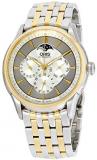
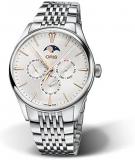
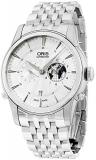
The Oris Artelier family spans case sizes from 38mm to 43mm, pairing multi-piece stainless steel construction with dial finishes that range from grained centres to smooth exterior rings. It is a collection built on a simple premise: mechanical watchmaking presented in its most wearable, understated form. For buyers who want Swiss engineering without dive-watch bulk or chronograph clutter, the Artelier line offers a direct answer, and understanding where each reference sits within the range is the first step toward choosing well.
The Artelier occupies a particular position among Swiss dress watches. It is not the thinnest, nor the most decorated, nor the most expensive option in its bracket. What it offers instead is a coherent design language, slim bezels, generous dial apertures, and case proportions that sit close to the wrist, combined with movements that Oris develops and assembles at its H枚lstein facility. That combination of accessible pricing and genuine in-house mechanical substance is what keeps the collection relevant against alternatives from a Swiss maker known for independent calibre production and beyond.
What Defines the Oris Artelier Design Language
The Artelier’s visual identity rests on restraint. Cases are multi-piece stainless steel with polished and brushed surfaces, and the bezel is kept deliberately minimal so the dial dominates the wrist presence. Recent references, including the redesigned Artelier Date 38mm, measure roughly 10.9mm in thickness with a lug-to-lug of about 44mm, figures that translate into a watch that slides under a shirt cuff without resistance.
Dial architecture is where the collection distinguishes itself. The Artelier Complication, for instance, uses a multi-textured layout: a grained centre section surrounded by a smoother outer ring, a treatment that creates depth without adding visual noise. Applied indices and slim hands keep legibility high while preserving the formality the category demands. It is a design approach that rewards close inspection rather than announcing itself from across a room.
In-House Calibres at the Heart of the Collection
The technical story is defined by calibres such as the Calibre 113. This is a hand-wound movement measuring 34.00mm in diameter (15 lignes) with a frequency of 21,600 vibrations per hour, or 3 Hz. Hand-winding is a deliberate choice in a dress watch context: it keeps the case profile thinner than an automatic winding system would allow and creates a daily ritual of interaction with the movement. Oris pairs this calibre with a 43.00mm case in the Artelier Calibre 113, a reference positioned at the upper end of the range.
Across the broader Artelier line, the emphasis stays on mechanical honesty. There are no quartz options, no battery hatches, and no shortcuts in the movement architecture. This matters for buyers who view a dress watch as a long-term object rather than a disposable accessory. The mechanical approach also aligns the Artelier with the wider Swiss tradition, where a slim hand-wound or automatic calibre is considered the correct answer for formal wear.
Case Sizes and How to Match Them to a Wrist
Oris has responded to the shift toward more wearable proportions by offering the Artelier across a practical size spread. At the smaller end, 38mm references suit wrists in the 15cm to 17cm range and read as classic dress watches. At 39mm, the size used for the redesigned Artelier Complication, the watch gains a touch more wrist presence while remaining firmly in formal territory. The 43mm Calibre 113 sits at the opposite extreme, better suited to larger wrists or buyers who prefer a more contemporary, statement-adjacent silhouette.
Because the Artelier uses a slim bezel, the dial appears larger than the nominal case diameter suggests. A 38mm Artelier can therefore wear closer to a 40mm watch with a thicker bezel, which is worth factoring into a decision if trying the watch in person is not possible. Lug-to-lug measurements, such as the 44mm figure of the Artelier Date 38mm, provide the most reliable guide to how a watch will sit on the wrist.
Strap and Bracelet Options
Most Artelier references are delivered on leather straps, which reinforce the formal character of the line. A well-chosen strap, typically in black, dark brown, or blue, keeps the watch appropriate for business and evening wear. Some references are also offered on metal bracelets, which push the watch toward a sportier, more everyday register while retaining the slim case profile. Buyers who intend to wear the Artelier regularly in both settings may find that a quick-release strap system, where available, adds meaningful flexibility.
Dial Variants Across the Range
Dial options within the Artelier family span white, silver, blue, and grey tones, often with different finishing treatments. The grained-centre, smooth-outer-ring construction used on the Complication is one example; other references use sunray brushing or simple matte finishes. Each choice changes the watch’s character: a sunray silver dial catches light and adds energy, while a matte white dial reads as strictly formal. This variety means two Artelier references can feel like entirely different watches despite sharing a case architecture.
How the Artelier Compares With Rival Dress Watches
The dress watch segment is crowded, and the Artelier’s positioning becomes clearer in comparison. Against the Frederique Constant collection, the Artelier competes on movement independence, since Oris builds its own calibres while many rivals in the same price band rely on outsourced 茅bauches. Buyers who value in-house engineering as a criterion will find this difference meaningful.
Compared with entry points from the Omega collection, the Artelier sits at a lower price point while offering comparable case finishing and a similar commitment to mechanical movements. Omega’s strength lies in its co-axial escapements and METAS certification; Oris counters with hand-wound simplicity and a broader range of case sizes. Neither approach is objectively superior, but the Artelier’s lower entry cost and slimmer cases will appeal to buyers who prioritise wearability and value over technical certification.
For those weighing a dress watch against more recognisable nameplates, a reference such as the Omega Seamaster represents a different proposition entirely, a dive watch lineage rather than a formal line. The 43mm Artelier Calibre 113 is closer in size to some Seamaster models but opposite in intent, and the choice ultimately reflects whether the buyer needs water resistance or refined proportions.
Buying Considerations and Long-Term Ownership
A dress watch is judged differently from a tool watch. Water resistance is typically modest, so the Artelier is not a candidate for swimming or heavy outdoor use. What matters instead is the quality of the movement, the comfort of the case on the wrist, and how the design ages. On all three counts, the Artelier is built for long ownership: hand-wound and automatic calibres can be serviced indefinitely, the stainless steel case resists daily wear, and the restrained design is unlikely to look dated in a decade.
Buyers should also consider the service interval. Mechanical movements require periodic maintenance, and the simplified architecture of calibres like the Calibre 113, a hand-wound movement with a straightforward gear train, tends to be service-friendly. That lowers the long-term cost of ownership compared with more complex complications, and it keeps the watch in rotation for years rather than relegating it to a drawer.
- Case materials: Multi-piece stainless steel with polished and brushed finishing
- Available sizes: 38mm, 39mm, and 43mm diameters
- Movements: Hand-wound and automatic mechanical calibres, including the Calibre 113
- Dial treatments: Grained, sunray, and matte finishes across colour variants
- Typical strap options: Leather and metal bracelets depending on reference
- Positioning: Swiss mechanical dress watches in the accessible-to-mid luxury bracket
The wider Swiss landscape offers many formal options. Brands such as Omega Constellation models occupy a similar space with their own design signature, while the Longines collection approaches dress watchmaking from a heritage-driven angle. The Artelier’s counterpoint is its focus on slim cases, in-house movements, and a design vocabulary that avoids ornamentation. That consistency across the range is what makes the collection understandable at a glance and dependable over time.
For a generation of buyers who came to watches through smart devices and are now looking for something mechanical, the Artelier offers a natural transition. It asks for daily winding or the motion of a wrist to keep running, and in return it delivers a kind of engagement that a battery-powered device cannot replicate. A dressed-down suit, a slim case, and a movement visible through an exhibition back, the Artelier makes that combination feel deliberate rather than nostalgic, which is precisely why the line continues to hold its ground in a category defined by tradition.