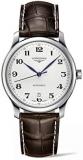
The Longines Master Collection 190th Anniversary marks a rare milestone: nearly two centuries of continuous watchmaking from a single Swiss maison. The commemorative pieces pair stainless steel cases with self-winding calibres, applied indices, and dial finishes that reference the brand’s reserved aesthetic rather than chasing spectacle.
Founded in 1832 in Saint-Imier, Longines has maintained an unbroken production record that few houses can match. The Master Collection arrived in 2005 as a deliberate return to classical dress-watch proportions, and the 190th anniversary editions extend that philosophy with movements that run on silicon balance springs.
What Defines the 190th Anniversary Editions
The anniversary references stay close to the Master Collection template: round stainless steel cases, slender bezels, and dials executed in silvered or textured finishes. Applied hour markers and leaf-shaped hands keep legibility high without ornamentation, and an exhibition case back exposes the movement finishing.
Case sizes span roughly 38.50 mm to 40.00 mm, a range that suits both slimmer and broader wrists. Water resistance is rated at 3 bar, which covers hand washing and rain exposure but not swimming. The sapphire crystal on both sides resists scratches and preserves dial clarity over years of wear.
- Movement: Self-winding mechanical, 25,200 vibrations per hour (3.5 Hz)
- Power Reserve: Up to 72 hours
- Balance Spring: Silicon, anti-magnetic and temperature-stable
- Case Material: Stainless steel
- Water Resistance: 3 bar (30 metres)
- Case Sizes: 38.50 mm and 40.00 mm
The silicon balance spring deserves particular attention. Unlike traditional alloy springs, silicon is impervious to magnetic fields, a practical advantage in environments filled with laptops, phones, and speakers. It also resists corrosion and normal temperature swings, which supports consistent rate performance between services.
Movement Architecture and Finishing
The calibre inside these references is a modern automatic with a 72-hour power reserve, meaning the watch can sit on a bedside table from Friday evening to Monday morning without losing time. The oscillating weight, bridges, and jewel settings are visible through the case back, finished with Geneva stripes and blued screws.
That balance of technical substance and restrained decoration is where the Master Collection differentiates itself. The movement is not designed to impress with skeletonisation or openworked plates; it is designed to keep time reliably while rewarding a closer look.
Wearing Experience and Strap Options
On the wrist, the 38.50 mm and 40.00 mm cases sit close to the arm thanks to modest thickness and curved lugs. Alligator leather straps and polished steel bracelets are both available, each finished to match the case’s brushed and polished surfaces. The result is a watch that reads as formal without feeling fragile.
For daily wear, the leather strap softens quickly and the deployant clasp reduces strain on the material. The steel bracelet version adds heft and suits warmer climates where leather can degrade faster. Either configuration slips under a shirt cuff without catching.
Where It Fits in a Broader Collection
Buyers weighing a classical dress watch against sportier alternatives should consider how each piece will actually be worn. The Longines Master Collection is built for offices, dinners, and ceremonies rather than dive sessions or track days, and its design language reflects that focus.
That said, the wider world of Swiss watchmaking offers instructive comparisons. Dive-oriented lines like the Omega Seamaster bring higher water resistance and bolder cases to the table, while the Master Collection stays firmly in dress territory with slimmer profiles and quieter dials. Neither approach is better; they simply serve different routines.
The same logic applies when comparing complications. A dual-time traveller’s watch such as the Rolex GMT-Master II addresses frequent flyers with a 24-hour hand and rotating bezel, whereas the Longines anniversary pieces prioritise clean dials and unobtrusive timekeeping. Choosing between them comes down to whether a second time zone will genuinely be used.
Collectibility and Long-Term Ownership
Anniversary references tend to attract collectors because they mark a fixed point in a brand’s history. The 190th anniversary Master Collection models carry dial details and case back engravings that distinguish them from standard production, which supports their appeal in the secondary market.
Ownership costs also matter. A mechanical watch with a 72-hour reserve and silicon components requires servicing less frequently than older designs, and stainless steel cases tolerate daily wear without showing every knock. Over a decade of use, that durability translates into a lower total cost than many buyers expect from Swiss mechanical watchmaking.
For anyone assembling a small, considered collection, the anniversary Master Collection works as a cornerstone dress piece. It pairs naturally with a sports watch and a rugged everyday option, filling the formal slot without competing for wrist time against either.
Why This Milestone Matters
Very few watch brands reach a 190th anniversary, and fewer still do so while producing entirely in-house movements at accessible price points. The Master Collection 190th Anniversary is less a victory lap than a statement of continuity: the same aesthetic discipline that defined Longines in the nineteenth century, expressed through twenty-first-century materials and manufacturing.
That continuity is the real story. The watches are not trying to reinvent dress watchmaking; they are demonstrating that classical proportions, honest mechanics, and thoughtful materials remain a valid answer for anyone who wants a watch to outlast trends. For collectors who value restraint over novelty, the 190th anniversary Master Collection offers exactly that.