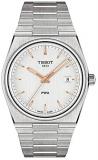
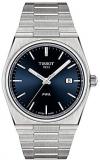
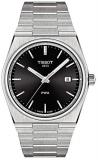
The Tissot PRX light green dial sits within a lineage that reaches back to the late 1970s, when watchmakers began experimenting with angular cases and bracelets that flowed directly from the case middle rather than attaching at traditional lugs. That era produced a handful of silhouettes that still feel modern today, and the PRX revives one of them with a color palette that reads as contemporary rather than nostalgic. The green itself is not a flat olive or a saturated lime; it is a soft, shifting shade that appears almost silver under overcast skies and reveals a deeper character in direct sunlight. That chameleon quality is central to why this particular variant has earned attention, and it is worth examining the model as a complete package rather than treating the dial color as a standalone novelty.
Case Architecture And The Integrated Bracelet Concept
The PRX case is built around a tonneau-style profile, meaning the sides curve gently outward rather than following a simple round shape. Depending on the reference, it is offered in either a 40mm or 35mm diameter, both fabricated from 316L stainless steel, a grade chosen for its resistance to corrosion and its ability to take a sharp polish without becoming brittle. The bezel is flat and relatively narrow, which maximizes the visual area of the dial and gives the watch a wider presence on the wrist than its nominal diameter might suggest.
One of the more technically interesting aspects of the case construction is the integration between the case and the bracelet. There are no traditional lugs here; instead, the bracelet flows directly out of the case middle, and Tissot has engineered the end links to sit flush against the case flanks. This is not merely an aesthetic decision. A flush joint reduces the number of snag points and distributes the weight of the watch more evenly across the wrist, which matters for a steel bracelet watch that will spend most of its life in daily rotation rather than inside a display case.
Dial Finish And Why The Green Works
The dial on this variant uses a sunray brushing technique, in which fine radial lines are cut into the metal before the color lacquer is applied. Light hitting the surface scatters along those lines, producing the shifting brightness that sunray dials are known for. The green tone sits somewhere between sage and seafoam, and because it is applied over a brushed base rather than a matte one, the color never reads as flat or painted-on.
Applied Indices And Legibility
The hour markers are applied rather than printed, meaning they are individual metal components fixed to the dial surface. This adds a small amount of depth and creates a subtle shadow effect that printed markers cannot replicate. A date window sits at the 3 o’clock position, framed cleanly without disrupting the symmetry of the remaining markers. The hands are faceted and finished in polished steel, which keeps them legible against the green backdrop without the heavier look that luminous-filled hands sometimes produce on a dress-oriented dial.
Crystal And Caseback Details
Protection comes from a scratch-resistant sapphire crystal with an antireflective coating, a combination that keeps glare manageable while resisting the everyday scratching that mineral glass is prone to. Several references in the light green family also feature a see-through caseback, which exposes the movement and adds an element of mechanical interest for anyone who enjoys watching a rotor spin.
Movement Options Across The Light Green Range
The light green dial is not tied to a single movement. Tissot builds this colorway across both automatic and quartz references, which changes the ownership experience considerably depending on which version is chosen.
| Feature | Automatic Reference | Quartz Reference |
|---|---|---|
| Movement Type | Swiss automatic, self-winding | Swiss quartz, battery-powered |
| Power Reserve | Up to 80 hours | Battery-dependent |
| Caseback | See-through | Solid |
| Maintenance | Service interval measured in years | Periodic battery replacement |
| Wearing Ritual | Winds through wrist motion | Set and wear |
| Water Resistance | Up to 100 metres | Up to 100 metres |
The automatic version carries a power reserve of up to 80 hours according to Tissot’s published specifications, which places it at the higher end for this price segment and means it can be set down on a Friday evening and still be running on Monday morning. That figure comes from a mainspring design that stores more energy than a conventional spring without adding bulk to the movement. The quartz alternative removes that mechanical element entirely in favor of lower maintenance and immediate accuracy, and it will appeal to anyone who wants the same silhouette without thinking about winding or service intervals.
Sizing, Weight, And Wearability
The 40mm version weighs approximately 138 grams in its automatic configuration, while quoted weight for the 35mm automatic comes in at roughly 104 grams. Those numbers matter because integrated-bracelet watches tend to distribute weight differently than standard lugged designs. Because there are no protruding lugs and the bracelet sits tight to the case, the watch tends to stay centered on the wrist rather than sliding toward the hand.
Both sizes use Tissot’s interchangeable quick-release bracelet system, which allows the factory bracelet to be swapped for a strap without tools. That single detail changes the long-term usefulness of the watch considerably, because it means the same case can be pushed toward a dressy look with a leather strap or a casual one with the original steel bracelet. Reaching further into the brand’s lineup, the engineering approach behind this case shares DNA with models explored in the Tissot Heritage collection, where vintage references are revived using current manufacturing standards.
Water resistance is rated to 100 metres, which covers swimming and showering but should not be read as a diving rating. The crown on the automatic references is a push-pull design rather than a screw-down type, so owners are advised to keep it fully seated before any contact with water.
How The Light Green Fits Within The PRX Line
The PRX has expanded well beyond its initial blue-dial launch into a spectrum of colors and finishes, and the light green sits in a useful middle ground. It is more distinctive than black or white without being as loud as a bright yellow or coral. That balance is why this particular shade tends to work with both business-casual and weekend wardrobes.
Coordinating With Existing Collections
Green dials have become more common across the industry in recent years, and for anyone comparing silhouettes across different sports models, the brushed steel background used here sits comfortably alongside designs found in the Tissot T-Sport collection, where case finishing follows a similar technical logic. The PRX’s own identity remains distinct because of its integrated bracelet and flat bezel, which set it apart from conventional round sports watches.
The choice between 40mm and 35mm deserves attention before committing to a purchase. The 40mm reads as a moderate but present size on average wrists, while the 35mm leans unisex and works especially well on smaller wrists or for anyone who prefers the proportions of vintage-era watches. Neither size is an afterthought; both use the same case architecture and finishing standard.
Ownership Considerations And Long-Term Value
An automatic PRX in this colorway is likely the more interesting long-term purchase for collectors, largely because of the 80-hour reserve and the see-through caseback. Quartz versions remain the more practical choice for someone buying a single watch that needs to be picked up and worn without attention. Both carry a two-year warranty and both use the same sapphire crystal and 316L steel construction, so the decision really comes down to how much the wearer values mechanical character versus low-fuss convenience.
The green dial itself should also be evaluated under real-world conditions rather than product photography. Sunray green shifts noticeably with lighting, and many owners find it reads more subdued indoors, which makes it a good choice for anyone worried that a colored dial will feel too bold in a professional setting. For those who want to explore the broader range of finishes and case sizes built on this same platform, the full Tissot catalog offers a useful reference point for comparing dial options side by side.
The PRX light green ultimately works because it does not treat color as a gimmick bolted onto a standard template. The dial finish, case proportions, and movement options were all designed to support one another, and the result is a watch that honors the integrated-bracelet era while remaining entirely at home in the present day.