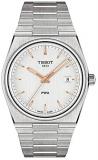
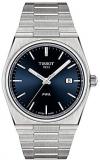
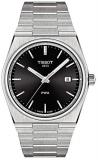
The Tissot PRX Blue Quartz carries a 40 mm tonneau-shaped case that measures just 10.4 mm thick, a profile that lets the watch slide under a shirt cuff while still delivering the wrist presence of a genuine design statement. The cushion-style case and flat-link bracelet borrow directly from the integrated-bracelet language of the late 1970s, a period when watch designers began treating the case and bracelet as a single continuous object rather than two separate components. Few modern quartz watches translate that brief into something this wearable at this price point.
For anyone building a collection that moves between office, weekend and evening without changing straps, the blue dial variant deserves serious attention. The colour is not a flat, printed blue but a sunburst finish that shifts from deep navy to a brighter metallic tone as light crosses the surface. That treatment gives the PRX an adaptability that pairs naturally with the wider Tissot brand’s design heritage while holding its own identity within it.
Design Language Rooted in the Integrated Bracelet Era
The defining gesture of the PRX is integration. The lugs are not separate protrusions welded onto a round case; they are formed as part of the case body, and the bracelet attaches flush to that geometry. This is the detail that separates the PRX from conventional quartz watches at similar prices. When the bracelet meets the case without a visible gap, the silhouette reads as one continuous ribbon of steel circling the wrist.
The case is executed in 316L stainless steel, a grade chosen for its corrosion resistance and its ability to take a crisp brushed finish. The top surfaces are brushed, while the bevels and bracelet edges are polished, creating contrast that catches light without becoming flashy. The bezel is a simple flat ring that frames the dial rather than competing with it. Case length is listed at 39.5 mm, which keeps the watch balanced on smaller wrists despite the 40 mm width.
Dial Architecture and Readability
The blue sunburst dial is applied with faceted baton indices that sit slightly raised above the surface, catching light along their edges. The hands are similarly faceted, with a slim seconds hand that sweeps rather than ticks, a small but meaningful detail in a quartz watch. A date window at 3 o’clock is framed cleanly and does not interrupt the symmetry of the hour markers. Legibility in low light depends on the polished surfaces rather than luminous paint, so the PRX is better understood as a design-led everyday watch than a night-time tool.
Case Proportions and Wrist Feel
At 10.4 mm thick, the case avoids the slab-sided look that plagues many budget integrated designs. The bracelet tapers gently toward the clasp and uses removable links secured by pins, so sizing is straightforward for most wrists. The absence of protruding lugs means the watch does not overhang the wrist edge, and the relatively short case length helps the 40 mm width wear closer to a 38 mm round watch in practice. That combination makes the blue dial version unusually easy to recommend across a range of wrist sizes.
Swiss Quartz Movement and Everyday Ownership
Inside the case sits a Swiss quartz three-hand movement running on a 1.55-volt battery. The choice of quartz is central to the PRX proposition rather than a compromise: it keeps the case thin, removes the need for periodic servicing, and delivers timekeeping accuracy that mechanical watches at this price cannot match. For a watch intended to be worn daily and set down without ceremony, that reliability is the point.
The movement’s simplicity also keeps the ownership experience frictionless. There is no winding routine, no positional variance to consider, and no service interval measured in years of mechanical wear. A battery change every few years is the main maintenance event. The trade-off is the absence of the sweeping mechanical seconds hand and the tactile engagement that some collectors value, which is why the PRX works best as one part of a wider collection rather than a single do-everything watch.
Water resistance is rated to 10 bar, equivalent to 100 metres. That figure covers hand washing, rain, swimming in shallow water and general daily exposure without concern. It does not make the PRX a dive watch, and the push-pull crown should not be operated underwater, but the rating is generous for a slim dress-sport hybrid and removes a common anxiety from daily wear.
How the PRX Blue Quartz Fits Into a Collection
The PRX is often described as an entry point into integrated-bracelet design, and that framing is useful when deciding whether it belongs in a collection. It occupies the space between a pure dress watch and a sports watch, which means it can cover formal and casual contexts without looking out of place in either. The blue dial makes it slightly more relaxed than the silver or black variants, which suits business-casual wardrobes particularly well.
Within the Tissot range, the PRX sits apart from the brand’s sports-focused lines. Where instrument-driven models including the Tissot Touch Collection prioritise outdoor functionality and the T-Sport family leans toward active use, the PRX is fundamentally a style object with reliable timekeeping. That distinction matters for buyers deciding whether to add it alongside a rugged daily watch or as the dressier option in a two-watch rotation.
Collectors who appreciate the PRX’s retro-modern approach often find themselves drawn to heritage-inspired designs more broadly, and the Tissot Heritage collection offers a useful reference point for how the brand revisits its own archives. The PRX is not a reissue of a specific historical reference, but its design vocabulary belongs to the same conversation about 1970s case geometry and bracelet integration.
Size Options and Choosing the Right Fit
Tissot produces the PRX in three case sizes: 40 mm, 35 mm and 25 mm. The 40 mm version is the most versatile for average to larger wrists and is the reference most commonly associated with the blue quartz variant. The 35 mm model, with a 9.6 mm thickness and a case length of 34.6 mm, suits smaller wrists or anyone who prefers a more vintage-proportioned look. The 25 mm option moves the PRX into jewellery territory and is best understood as a separate proposition rather than a scaled-down version of the same watch.
- Case material: 316L stainless steel
- Case width: 40.00 mm
- Case length: 39.50 mm
- Case thickness: 10.40 mm
- Water resistance: 10 bar (100 m)
- Movement: Swiss quartz, three hands
- Battery voltage: 1.55 V
- Dial: Blue sunburst with faceted indices
Buyers weighing the 40 mm against the 35 mm should focus on case length rather than width alone. A 39.5 mm lug-to-lug measurement on the 40 mm version means it sits within the wrist footprint of many 38 mm round watches, while the 35 mm version reads noticeably smaller and more classical. Trying both on, or measuring an existing watch’s case length, is the most reliable way to choose.
The Case for a Design-Led Quartz Watch
The PRX Blue Quartz makes a specific argument: that a watch can be affordable, battery-powered and still taken seriously as a design object. Its value comes from proportion and finish rather than complication. The integrated case and bracelet, the sunburst blue dial, and the slim 10.4 mm profile work together to produce a watch that looks considered from across a room and remains comfortable through a full day of wear.
That combination explains why the model has become a reference point for anyone exploring integrated-bracelet watches without moving into luxury pricing. It rewards buyers who care about how a watch sits and reads on the wrist, and it asks little in return beyond a battery change every few years. For a first serious watch, a gift, or a versatile addition to an existing rotation, the blue dial PRX Quartz delivers a clear and honest proposition: Swiss timekeeping wrapped in one of the most coherent case-and-bracelet designs available at its level.