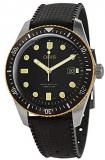
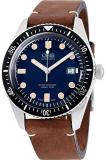
The Oris Chronos Limited Edition arrives as a 200-piece run built on the Divers Sixty-Five platform, and its most immediate signature is a dial finished in a pale ice blue that shifts between cool grey and soft sky tones depending on the light. Behind that restrained exterior sits the Calibre 400, an in-house automatic movement with a five-day power reserve and a reported accuracy tolerance of -3/+5 seconds per day. The combination of a vintage-leaning case profile with thoroughly modern movement technology is what defines this release.
The watch is a collaboration piece, produced with the team behind Chronos magazine, and every element has been considered against the logic of a daily-worn dive watch rather than a display-case curiosity. Case diameter is listed at 38mm with a 19mm interhorn width, a pairing that keeps the watch balanced on smaller and average wrists while still allowing a substantial bracelet presence. Water resistance is rated to 10 bar, or 100 metres, which covers swimming and surface water sports without pretending to be a saturation diving instrument.
A Case Sized for Daily Wear, Not for Spec Sheets
Case dimensions drive more purchase decisions than almost any other specification, and the 38mm figure here is deliberate. Oris has built the modern Divers Sixty-Five family around case sizes that echo mid-century proportions, when dive watches were tool-first objects worn close to the wrist and shielded from snagging by a compact profile. The stainless steel case carries lugs spaced at 19mm, a width that restricts strap swapping slightly compared with 20mm or 22mm standards but allows the bracelet to taper elegantly toward the clasp.
The sapphire crystal protects a dial that is otherwise left uncluttered, and a sapphire display back exposes the movement. This is a meaningful choice for a dive watch at this price point, because it turns a sealed tool into something that rewards a second look. The case back does not compromise the stated 10 bar rating, and the overall construction follows the pattern Oris has used across the Calibre 400 generation of Divers Sixty-Five references.
- Case diameter: 38.00mm stainless steel
- Water resistance: 10 bar (100 metres)
- Interhorn width: 19mm
- Crystal: Sapphire with sapphire display case back
- Production: Limited to 200 pieces
Anyone who has followed a heritage-led Oris dive watch range will recognise the design DNA: sloping bezel edges, faceted lugs and a dial that reads cleanly at a glance. The Chronos edition does not reinvent that vocabulary. It sharpens it with a colour palette that feels closer to glacial water than to tropical reef.
Calibre 400 and the Case for Five-Day Autonomy
The movement is the headline technical argument. Calibre 400 is Oris’s in-house automatic, running at 28,800 vibrations per hour with 21 jewels and a stop-seconds function for precise time setting. Its 120-hour power reserve means the watch can sit off the wrist from Friday evening to Wednesday morning and still show the correct time when picked back up, which reduces the friction that often pushes owners toward a winder.
Accuracy is stated as -3/+5 seconds per day, a tolerance band that places it within chronometer territory without the certification premium. Incabloc shock protection guards the balance assembly against the knocks that a daily wearer inevitably collects, and the manufacture offers an extended service interval recommendation tied to the movement’s anti-magnetic and low-friction design. Centre hands for hours, minutes and seconds carry the fine timing device, keeping the dial layout symmetrical and legible.
What the Long Reserve Actually Changes
Power reserve figures are easy to quote and harder to translate into ownership experience. A five-day movement removes the mental overhead of a 38 to 40 hour calibre. It also makes rotation practical: a three-watch collection where one piece holds five days of autonomy can be worn on a genuinely casual schedule without constant resetting. For travellers who leave a watch in a drawer between trips, the practical difference between 40 hours and 120 hours is the difference between a stopped watch and a running one.
The Display Back Trade-Off
Exposing the movement through sapphire adds visual value and lets the rotor and bridges be inspected, but it also serves as a reminder that this is a lifestyle dive watch rather than a sealed professional instrument. Buyers comparing against purpose-built saturation diving equipment should treat the 10 bar rating as a clear statement of intended use. Buyers comparing against other 38mm everyday automatics will find the view worth the compromise.
Ice Blue Dial and Legibility Under Real Conditions
Colour is the detail that separates this reference from the core Divers Sixty-Five line. The ice blue surface works because it stays desaturated. Applied indices and hands carry luminous compound that contrasts strongly against the pale background, so low-light reading does not depend on the dial colour at all. In daylight the effect is cool and slightly matte rather than glossy, which keeps the watch from reading as jewellery.
Paired with a stainless steel bracelet, the palette shifts toward formal and office wear. Swapped onto a rubber or leather strap at the 19mm lugs, it becomes a warm-weather casual piece. That range is precisely what the Divers Sixty-Five concept was built for: a watch that can go from a desk to a shoreline without an intermediate stop at a safe. Readers weighing different styling directions may find useful points of comparison in including the Breitling Superocean Heritage catalogue, which occupies adjacent territory in the retro-dive segment.
Dial text is restrained. Applied markers sit on a clean field, and the date function is handled without dominating the layout. The overall effect is a dial that photographs well but was clearly designed to be read at an angle with a quick glance, which is the actual job description of a dive watch face.
Where 200 Pieces Sits in the Market
Limited production of 200 units online creates a specific kind of scarcity. It is small enough to sell through quickly among collectors who follow Oris collaboration releases, yet not so small that the piece becomes unobtainable outside auction channels. Scarce reference numbers tend to hold interest precisely because the underlying platform, the Calibre 400 Divers Sixty-Five, is a well-understood and genuinely wearable watch rather than a speculative object.
Positioned against the broader field of 38mm and 40mm steel automatics, the Chronos edition competes on movement specification first. A five-day in-house calibre with a stated -3/+5 seconds per day tolerance is a strong argument at any price, and pairing it with a sub-40mm case broadens the audience considerably. The ice blue dial then does the emotional work that specifications cannot.
Shoppers who prefer a bolder wrist presence sometimes look toward top Rolex Day-Date references for an entirely different proposition in case size and material language, though the two serve very different purposes and price brackets. Within its own segment, the Chronos edition avoids feature bloat and concentrates its value on the movement, the case proportions and the colour story.
Servicing, Ownership and Long-Term Practicality
An in-house movement brings an ownership consideration that buyers should weigh honestly. Service work generally routes back to the manufacturer or an authorised centre, and costs reflect the calibre’s architecture rather than a generic third-party swap. The compensation is a movement designed with extended intervals in mind and a parts supply controlled by the brand that built it. For a limited edition of 200 pieces, that continuity is arguably worth more than the flexibility of independent servicing.
The 10 bar rating, sapphire crystal and 19mm lug width together define a realistic wear pattern: swimming, showering and everyday exposure are comfortably inside the design envelope. The bracelet adds weight and presence, while the lug spacing keeps alternative straps within reach. It is a configuration that rewards a single-watch owner as readily as a collector rotating through a dozen references.
The Verdict on a Quiet Collaboration Piece
Collaboration watches often lean on loud visual cues to justify their existence. The Oris Chronos Limited Edition takes the opposite route. Its distinguishing features, a pale ice blue dial and a 200-piece production run, are understated, and the substance sits in the Calibre 400 with its 120-hour reserve and tight accuracy tolerance. That inversion is the watch’s real character: a limited edition that behaves like a considered everyday tool.
For a buyer who values a 38mm case, in-house engineering and a dial that stands apart without shouting, this reference makes a coherent case. It respects the Divers Sixty-Five lineage while demonstrating how far the platform has travelled since its revival. Two hundred examples will not circulate long, and the ones that stay on wrists will likely be worn rather than stored, which is the most honest compliment a dive watch can receive.