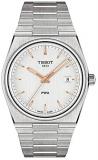
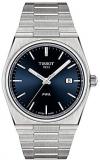
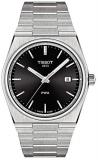
The Tissot PRX light blue dial variant centers on a 40 mm stainless steel case with a slender 10.93 mm profile, a lug-to-lug length of 39.50 mm, and a 12 mm lug width that together produce one of the most balanced wrist footprints in the accessible sports-chic segment. Rather than treating color as a last-minute trim decision, this reference builds its entire identity around a pale, cool-toned blue surface that shifts between steel-grey and sky-blue depending on how light strikes the dial. That single choice repositions a familiar silhouette and gives collectors a reason to look again at a shape that has become genuinely ubiquitous.
The integrated bracelet remains the defining architectural gesture. Its flat links flow directly from the case without traditional lugs, a construction language borrowed from the steel sports watches of the 1970s. On this reference, the brushed and polished surfaces alternate in a rhythm that keeps the profile visually light despite the solid steel build. The result is a watch that reads formal in a meeting room and relaxed with a linen shirt, without any hardware change in between.
A Dial That Changes Character With the Light
Pale dials are unforgiving. Every flaw in finishing, every uneven application of lacquer, shows up under direct light. The light blue surface here is finished to produce a soft gradient rather than a flat wash, and applied indices sit above it with polished edges that catch daylight at an angle. Hands are faceted and lumed, so legibility holds up when the dial itself recedes into shadow.
This matters more than it might seem. Blue is the most crowded color category in accessible watchmaking, and most entries lean either navy or electric. A desaturated ice blue occupies a narrower space. It pairs with grey tailoring, washed denim, and warm skin tones in ways that deeper blues often do not, and it keeps the watch from looking like a piece of office equipment.
- Case dimensions: 40.00 mm width, 39.50 mm length, 10.93 mm thickness
- Lug width: 12.00 mm, integrated bracelet fitment
- Case material: 316L stainless steel
- Crystal: Sapphire, protecting the dial from daily abrasion
- Water resistance: Rated to a pressure equivalent of 100 m on comparable references
Inside the Case: Quartz Precision and Low Maintenance
The PRX line spans several movements, and the quartz three-hand configuration is the one that keeps the case thin and the ownership experience frictionless. A 1.55 volt battery drives the mechanism, which means no winding ritual, no service intervals measured in hundreds of dollars, and no positional variation to think about. For a watch designed to be worn constantly and set down without ceremony, that is the correct engineering answer.
The trade-off is honest. There is no exhibition case back here, no rotor sweeping past a decorated bridge, no mechanical narrative to tell at a dinner table. What the quartz architecture delivers instead is a 10.93 mm case that slides under a cuff, consistent accuracy across months of wear, and a price structure that leaves room for a second or third watch in the drawer. Buyers who want the integrated-bracelet look without the servicing overhead of an automatic find the logic persuasive.
How the PRX Fits Within the Broader Tissot Range
Tissot has built a catalog that runs from archive-driven dress pieces to motorsport-inspired chronographs, and the PRX sits in a distinct lane. Pieces drawn from the brand’s back catalogue, including the Tissot Heritage line, lean on mid-century case shapes and vintage dial codes, while the PRX takes its cues from a later decade: the 1970s steel sports boom, when bracelets became structural and dials went flat and graphic. Understanding that split helps a buyer decide whether they want nostalgia rendered faithfully or nostalgia reworked for current proportions.
The sizing story also deserves attention. The same design language exists in a 35 mm case with a 34.60 mm length, a 9.60 mm thickness, and a lighter 97 g presence on the wrist. That smaller reference is not a downsized afterthought; it uses the same dial philosophy and integrated construction, which means wrist size becomes the primary decision variable rather than a compromise. Slim wrists and traditionally feminine sizing preferences both land naturally on the 35 mm, while the 40 mm suits average-to-larger wrists and those who prefer a more assertive wrist presence.
Sapphire, Steel, and the Practicality of Daily Wear
A sapphire crystal is the single most consequential durability decision on a watch at this level. It resists the scratches that dull mineral glass within a year of desk work, car door handles, and jacket zippers. Combined with 316L stainless steel, a grade chosen for corrosion resistance and takes a polish well, the external package is built for the long haul rather than the display case.
Water resistance rated to 100 m changes behavior in small ways. Washing hands, walking through rain, swimming in a pool, and wearing the watch through a humid summer all become non-events. The bracelet’s integrated fitment and the case’s caseback sealing do the work here, and the absence of a screw-down crown at this price point is a fair engineering compromise rather than an oversight, since the intended use is urban and aquatic-adjacent rather than diving.
The Light Blue Dial as a Wardrobe Decision
Color choice in watches is usually framed as taste. In practice it is closer to logistics. A pale blue dial works because it sits between neutral and statement: it does not disappear against a white shirt the way a silver dial does, and it does not demand matching the way a bright red or green would. It also photographs unusually well, which matters in an era when a wrist shot travels further than a spec sheet.
That versatility extends across seasons. In summer, the pale tone reads cool and casual against short sleeves and lighter fabrics. In winter, it provides a subtle point of contrast beneath a dark coat sleeve, exactly where a monochrome steel watch would vanish. For buyers who keep a small collection and want each piece to earn its slot, that dual-season performance is a concrete argument rather than a marketing one.
Who Should Consider This Reference
Three buyer profiles map cleanly onto the light blue PRX. The first is the person entering serious watch ownership who wants an integrated-bracelet design without stretching into luxury pricing, and who values sapphire and steel over mechanical complexity. The second is the established collector looking for a low-maintenance daily wearer that contrasts with dive watches and chronographs already in rotation. The third is the style-driven buyer who treats the watch as part of an outfit and wants a dial color that photographs and pairs unusually well.
Those who should look elsewhere are equally clear. Anyone who wants to feel a rotor move, who enjoys the ritual of winding, or who considers an exhibition case back essential will find the quartz configuration unsatisfying. Likewise, buyers with very small wrists should evaluate the 35 mm variant before committing to the 40 mm, because the integrated design cannot be softened with an aftermarket strap the way a standard lug watch can.
Design Lineage and Why the Shape Endures
The integrated steel sports watch emerged in the 1970s as a response to changing tastes: thinner cases, geometric dials, and bracelets treated as part of the case rather than an accessory. That formula has been revived repeatedly because it solves a real problem. A watch that flows from case to bracelet looks intentional from every angle, with no visual break at the lugs and no gap where a strap would normally attach.
The PRX light blue takes that inherited geometry and applies restraint. The pale dial keeps the emphasis on form rather than decoration, the applied indices give the surface enough depth to avoid looking printed, and the alternating brushed and polished bracelet finishes supply visual interest without color contrast. It is a design that rewards a second look rather than demanding a first one, and that quality tends to age better than louder alternatives in the same category.
Owning and Living With the Watch
Long-term satisfaction with an integrated bracelet watch depends on fit. The links are solid and taper toward the clasp, which distributes weight evenly across the wrist and prevents the rotating-slab sensation that cheaper bracelets produce. Because the bracelet cannot be swapped for leather or rubber, getting the sizing right at purchase is the single most important practical step. Most owners find that removing one or two links and adjusting the clasp position produces a close, stable fit.
Maintenance is minimal by design. A quartz movement needs a battery replacement every few years, a wipe with a microfiber cloth keeps the sapphire clear, and occasional rinsing removes skin oils from the bracelet’s inner surfaces. There is no service schedule to track and no accuracy drift to correct. For a watch intended to be worn hard and forgotten about, that simplicity is the point rather than a limitation.
The Broader Case for a Pale Blue Everyday Watch
Watch collecting has spent the last decade celebrating bigger complications, louder dials, and increasingly elaborate finishing. The counter-current, quieter and more durable, favors watches that simply work: accurate, protected by sapphire, resistant to water and scratches, and attractive enough to wear every day without deliberation. The light blue PRX belongs firmly to that second tradition, a position reinforced by the wider Tissot brand’s focus on everyday-oriented steel references.
Its value proposition rests on proportions rather than promises. A 40 mm case with a compact 39.50 mm length wears smaller than the number suggests, the 10.93 mm thickness keeps it clear of cuffs, and the dial color gives it a distinct identity without tying it to a single season or outfit. Those who choose it are buying a design solution that happens to be well engineered, and that combination is what keeps a watch on a wrist long after the novelty of a purchase has faded. For readers weighing this reference against sportier alternatives, chronograph-led lines like the Tissot T-Sport range offer a useful point of contrast in case size and dial treatment.