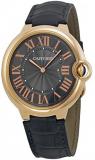
The Cartier Santos-Dumont traces its origins to 1904, when Louis Cartier designed a wristwatch for his friend Alberto Santos-Dumont so the Brazilian aviator could read the time without releasing the controls of his aircraft. More than a century later, the collection retains that founding brief in a case that measures just 7.3 mm in thickness on the large steel model, with external dimensions of 43.5 mm by 31.4 mm. It is a quietly radical object: a rectangle among circles, a pilot’s instrument refined into a dress watch, and one of the earliest purpose-built wristwatches produced for a private client rather than a military contract.
A Design Language Set by the Case, Not the Dial
The Santos-Dumont is defined first by its silhouette. The rounded rectangle, the visible screws aligned to the bezel edges, and the Roman numerals that follow the curve of the dial are all elements that have survived with remarkably little modification. On the large model, the case is rendered in steel with a matching steel ardillon buckle, and the crown is finished in blue, a small chromatic signature that links the modern piece to the maison’s broader design vocabulary.
Proportions matter more here than in most dress watches. At 31.4 mm across and 43.5 mm lug to lug, the large model wears closer to a compact round watch than the numbers suggest, because the rectangular footprint leaves the wrist edges free. The 7.3 mm thickness allows the case to sit almost flush under a shirt cuff, which is precisely the behaviour a formal watch should deliver. A smaller variant measures 27.5 mm wide and 38.5 mm lug to lug, and an extra-large interpretation stretches to 46.6 mm by 33.9 mm at 7.5 mm thick, giving buyers three distinct wrist presences within one aesthetic.
Sapphire, Water Resistance and the Everyday Realities
Cartier fits the Santos-Dumont with a square-shaped sapphire crystal, a detail that suits the geometry of the case rather than defaulting to a circular window. Water resistance is rated to 3 bar, roughly 30 metres, which places the watch firmly in the dress-watch category rather than the sports category. That rating is adequate for rain, handwashing and the incidental splash, but it is not a specification intended for swimming or diving.
This distinction is worth stating plainly, because the Santos-Dumont is sometimes grouped with sportier steel watches on account of its exposed screws and industrial detailing. The engineering, however, points elsewhere. The thin case, the leather strap options and the 3 bar rating all describe a watch built for civilised daily wear, not for the pool. Buyers who want a Cartier case with genuine water sports capability should look to the broader Santos line, which offers models with substantially higher resistance ratings.
Reading the Dial as a Composition
The dial layout repays close attention. Roman numerals are elongated and curved to sit concentrically within the rectangular frame, and the railway minute track follows the same perimeter. Rather than filling the centre with complications, the design leaves generous open space, which is what gives the watch its airy, unhurried character. Hand types remain slender and proportionate to the case, avoiding the oversized batons that can make rectangular dials feel crowded.
That restraint is a deliberate design philosophy rather than a limitation. The Santos-Dumont is not a complication showcase; it is an exercise in proportion and negative space. For readers who enjoy tracing how a maison translates a historic reference into a contemporary piece, the depth of the Cartier brand’s catalogue provides useful context, showing how the same visual codes appear across Tank, Santos and Ballon Bleu families without collapsing into repetition.
- Large model: 43.5 mm x 31.4 mm, 7.3 mm thick
- Small model: 38.5 mm x 27.5 mm lug to lug
- Extra-large model: 46.6 mm x 33.9 mm, 7.5 mm thick
- Water resistance: 3 bar, approximately 30 metres
- Crystal: Square-shaped sapphire
- Strap option: Navy blue alligator leather with steel ardillon buckle
How the Santos-Dumont Fits Into a Collection
Positioned against other steel dress watches, the Santos-Dumont occupies a specific niche: it offers a rectangular case with genuine historical provenance at a price point below the maison’s precious-metal references. That combination makes it a natural first Cartier for buyers who want the design language without the gold-case premium, and a sensible addition for collectors seeking a shape that breaks the monotony of a round-watch rotation.
The strap configuration influences the character considerably. Navy blue alligator leather with a steel ardillon buckle reads formal and slightly nautical, and it pairs well with tailoring. Because the case is thin, the watch does not dominate the wrist, which means it works as an understated companion rather than a statement piece. Buyers who prefer a more technical look can contrast the Santos-Dumont with bracelet-forward designs such as the TAG Heuer Carrera collection, which occupies a sportier register while preserving a comparable commitment to legible dial design.
Movement, Maintenance and Ownership Expectations
Cartier supplies the Santos-Dumont in both quartz and mechanical versions depending on the reference, and that choice shapes the ownership experience. A quartz movement brings low maintenance and consistent accuracy, while a mechanical calibre adds the tactile engagement that many enthusiasts prize. Prospective buyers should confirm the movement type of a specific reference before purchase, since the collection spans both approaches across its size variants.
Servicing follows the usual expectations for a thin dress watch: periodic maintenance, careful handling of the crown, and avoidance of prolonged water exposure. The sapphire crystal resists scratching well, and the steel case tolerates daily wear, but the 3 bar rating means the watch should be removed before swimming. Strap replacement is straightforward thanks to the ardillon buckle arrangement, and leather straps should be rotated to manage sweat and humidity during summer months.
The Rectangular Argument in a Round-Watch Market
Most dress watches on the market default to a circular case, which makes the rectangle a meaningful differentiator. The Santos-Dumont exploits that difference without drifting into novelty: the shape is historically grounded, the detailing is disciplined, and the dimensions are tuned for comfortable wear rather than for visual impact. The result is a watch that reads as considered rather than loud, and that quality tends to age well as tastes shift.
For anyone building a collection around classical forms, the Santos-Dumont functions as a quiet counterpoint to round references. It also demonstrates how a maison can preserve a century-old idea while refining the execution: thinner cases, sapphire crystals, and strap options that suit contemporary wardrobes. Readers exploring alternatives in the same conceptual territory, from chronograph-led designs to heritage-inspired dials, may find useful comparisons in the Breitling Transocean line, which approaches elegance from a different technical direction.
What to Verify Before Choosing a Reference
Because the Santos-Dumont spans three principal sizes and multiple movement types, a purchase decision should begin with wrist measurement rather than photography. The large model suits wrists that sit in the middle of the range, while the small model favours narrower wrists and the extra-large interpretation caters to those who want a more pronounced rectangular footprint. Thickness differences between the references are marginal, but the perceived size difference on the wrist is substantial.
Buyers should also confirm the strap and buckle configuration, the crystal type, and the water resistance rating for the exact reference under consideration. These details vary less within the Santos-Dumont family than across the wider Santos line, but they still determine how the watch behaves in daily use. Verified specifications from the maison remain the reliable source for dimensions, materials and resistance figures, and they should take precedence over retailer summaries when the two disagree.
The enduring appeal of the Santos-Dumont lies in its refusal to overreach. It does not claim to be a sports watch, a complication masterwork or a trend piece. It offers a historically significant case shape, a balanced dial, and proportions engineered for the cuff of a shirt. That focused brief is precisely why the model continues to hold its place in the maison’s catalogue, and why it remains a compelling argument for the rectangle in an industry that so often defaults to the circle.