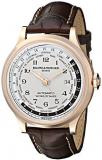
The Tissot PRX Gold Automatic carries a 40 mm gold-tone case that traces its lineage directly to the angular, tonneau-shaped sports watches that defined 1970s Swiss case design. That silhouette is not a styling flourish; the barrel-shaped profile and integrated lug geometry were originally engineered to protect the crown and stabilize a heavy bracelet against the wrist, and the PRX retains that functional logic beneath its polished exterior. A yellow-toned dial and matching gold-tone case work together to make this one of the more distinctive references in the Tissot collection, a range that also spans dive watches, dress models, and motorsport chronographs.
Understanding the appeal of this particular model means separating two things: the specific mechanical reference and the family it belongs to. The PRX Gold Automatic sits at the intersection of heritage revival and everyday practicality, and that positioning explains why it has become a focal point for buyers who want a mechanical watch with a bold visual identity rather than a safe, understated dress piece.
A Case Built from 1970s Geometry
According to Tissot, the PRX 40 mm reference measures 39.50 mm in case length, 40.00 mm across the case width, and 10.93 mm thick, with a 12.00 mm lug width. Those figures matter more than they might appear at first glance. A 40 mm diameter is a genuinely unisex size, and the 10.93 mm thickness keeps the watch from sitting too tall under a shirt cuff, even with the integrated bracelet fitted snugly. The 39.50 mm lug-to-lug span is short for a 40 mm watch, which means the case sits comfortably on smaller wrists without overhanging the edge.
The integrated bracelet is central to how the case wears. Unlike a conventional strap-to-lug connection, the PRX bracelet flows into the case without a visible gap, distributing the watch’s mass evenly around the wrist. This construction is more demanding to manufacture because the bracelet links must be machined to tolerances that keep the line of the case continuous. The reward is a silhouette that reads as a single object rather than a case with a strap attached, a quality that has kept the original 1970s formula relevant across five decades.
The gold-tone finish adds another layer. Rather than a precious-metal case, this reference uses a gold-colored treatment over a steel base, which preserves the metal’s structural resilience while delivering the warm, reflective character associated with gold watches. That choice also keeps the watch at a price point closer to steel references, making the gold aesthetic accessible without crossing into solid-gold territory.
The Automatic Movement and 80-Hour Reserve
The automatic winding system inside the PRX Gold Automatic is the technical centerpiece of the reference. Tissot states that the family offers 80 hours of power reserve, a figure that sets it apart from most entry-level automatic movements, which typically manage 38 to 42 hours. Practically, an 80-hour reserve means the watch can be set down on a Friday evening and still be running on Monday morning, eliminating the repeated reset-and-wind ritual that plagues shorter-reserve automatics.
That extended reserve implies a mainspring design and going-train layout built for efficiency rather than merely adequate run time. A longer reserve generally requires either a longer, thinner mainspring or a more efficient gear train, and the watchmaker’s solution affects the torque delivered to the escapement as the spring unwinds. Balancing that curve is the hard part of movement design, and an 80-hour specification suggests the regulation has been tuned to keep rate deviation reasonable across the full reserve rather than just in the first day.
The mechanical approach also changes ownership. An automatic movement has no battery to replace, no charging schedule to maintain, and no electronics to update. The trade-off is that accuracy depends on position, temperature, and activity, and the watch benefits from periodic servicing. For buyers weighing this reference against the quartz PRX variants, the decision often comes down to whether the visible engineering and the sweep of the seconds hand justify the higher price and maintenance commitment of a mechanical caliber. For those seeking mechanical precision in other styles, the Tissot Heritage collection draws on a different side of the archive with vintage-inspired dials and smaller case profiles.
Dial, Bracelet, and Daily Wearability
The yellow-toned dial is where the PRX Gold Automatic makes its clearest statement. Applied indices sit at the hour positions, with a date aperture at 3 o’clock that keeps the dial symmetry intact rather than crowding the layout. The hands are faceted and slim, consistent with the 1970s design brief that favored minimal obstruction over luminous bulk. The result is a dial that reads cleanly in daylight but relies on ambient light rather than heavy lume for nighttime visibility, a trait common to dress-adjacent sports watches of the era.
The bracelet uses a distinctive link pattern with a wide central column flanked by narrower outer links, a design motif that echoes the case’s angular contours. Links are brushed on the flat faces and polished on the bevels, a finishing combination that keeps the gold tone from appearing flat or overly brassy. Water resistance is rated in the water-resistant pressure range Tissot publishes for the model, sufficient for hand washing and light rain but not intended for swimming or diving. That is an important expectation to set: the PRX is styled like a sports watch, but its water resistance classification reflects its dress-sport category rather than any dive capability.
Wearability also depends on the clasp and weight distribution. The bracelet’s taper and the flush clasp design keep the closure from protruding on top of the wrist, and the moderate case thickness means the watch slides under a cuff without catching. For buyers who rotate among a few watches, this is the kind of design detail that determines whether a piece stays in frequent rotation or spends most of its life in a drawer.
Positioning Within the Broader Market
Comparing the PRX Gold Automatic to alternatives is instructive for anyone shopping in the integrated-bracelet category. At one end of the spectrum sit Omega Constellation watches, where polished claws and a distinctive bezel treatment achieve a similarly architectural look at a considerably higher price. At the other end, the wide-ranging TAG Heuer selection includes models such as the Carrera, which follows a cleaner, more traditional round-case path rather than the tonneau geometry of the PRX.
The table below sets the PRX Gold Automatic against two common touchstones for this style of bracelet-integrated watch, focusing on the attributes that most affect daily use and long-term ownership.
| Attribute | Tissot PRX Gold Automatic | Omega Constellation |
|---|---|---|
| Case material | Gold-tone finish on steel base | Steel and gold, or full gold options |
| Case design | Tonneau-shaped integrated case | Round case with claws bezel details |
| Movement type | Automatic with 80-hour reserve | Automatic (varies by reference) |
| Power reserve | Up to 80 hours | Typically 50 to 60 hours |
| Water resistance | Pressure-resistant, dress-sport level | Higher ratings on many references |
| Bracelet integration | Flush integrated bracelet | Integrated bracelet with claws motif |
| Typical ownership tier | Accessible Swiss mechanical | Premium luxury positioning |
The clearest takeaway from that comparison is not that one watch wins, but that the two serve different buying briefs. A shopper seeking Swiss mechanical performance with a statement gold finish and a manageable outlay tends to gravitate toward the PRX formula. A shopper prioritizing prestige trim, higher water resistance, and the cachet of a flagship luxury name tends to accept the premium tier. Anyone exploring dress-sport alternatives should also consider classically styled dress watches, which trade integrated bracelets and sporty cases for round profiles and conservative dials.
Who Should Consider the PRX Gold Automatic
This reference suits buyers who want a mechanical watch with a defined aesthetic rather than a neutral one. The gold tone and yellow dial make it a deliberate accessory, appropriate for a wedding, a milestone celebration, or anyone whose wardrobe leans toward tailored, vintage, or elevated casual. It is a poor fit for someone who needs a single do-everything watch for swimming, trail running, and black-tie dinners; the water resistance and dress-sport styling rules out serious water activity, and a gold finish draws attention in contexts where understatement matters.
For collectors building a rotation, the PRX Gold Automatic occupies a distinct slot: the affordable mechanical statement piece. It positions alongside steel-and-gold references without demanding full precious-metal pricing, and the 80-hour reserve makes it genuinely convenient for a watch that might only be worn twice a week. For buyers comparing finishes within the same family, the steel and two-tone PRX variants offer the same case architecture with more subdued aesthetics, making them a logical alternative for anyone who likes the geometry but not the gold.
The Value of Reviving a Form
The PRX Gold Automatic ultimately asks a question that has defined watch collecting for decades: what is the relationship between a historical form and its modern execution? The case shape was state of the art in the 1970s, engineered for a specific era of manufacturing and taste, and its revival depends not on nostalgia alone but on the mechanical content underneath. An 80-hour automatic, a comfortable integrated bracelet, and a finish that reads as deliberate rather than decorative give the reference a reason to exist beyond its retro silhouette. For anyone drawn to the angular confidence of the golden era but unwilling to surrender modern reliability, this watch makes a coherent, considered case for itself.