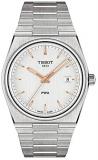
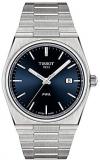
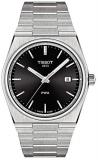
The Tissot PRX Green Automatic carries a dark green honeycomb-textured dial that shifts character under different light, framed by a slim, tonneau-shaped steel case and an integrated bracelet. That combination of a textured green face and a flat-linked bracelet places the watch in a lineage that stretches back to the late 1970s, when integrated steel sports watches first became a design language of their own.
The PRX formula is straightforward: a case and bracelet that read as a single continuous form, a dial that rewards a closer look, and an automatic movement with practical day-to-day endurance. According to Tissot, the Powermatic 80 movement inside the 40mm reference delivers up to 80 hours of power reserve, which means the watch can sit on a desk from Friday evening to Monday morning and still be running when it is picked up again.
For buyers comparing this model against everything else in the segment, three dimensions shape the decision: the case and bracelet ergonomics, the dial’s material finish, and how the movement’s specifications translate into real ownership. Each receives attention below, alongside the trade-offs that come with a 40mm integrated case and the versions Tissot offers at 35mm and 40mm.
A Case and Bracelet Built as One Object
Measured by Tissot’s own figures, the 40mm PRX uses a case width of 40.00mm, a case thickness of 10.93mm, and a lug width of 12.00mm, with a total weight of roughly 130 grams depending on the exact reference. Those numbers matter because integrated-bracelet watches live or die on how the case flows into the links, and the PRX handles the transition with a stepped profile rather than an abrupt seam.
The bracelet uses flat, wide links that echo the case’s facets, tapering slightly toward the clasp. The absence of conventional lugs means no strap swaps, no quick-release spring bars, and no third-party leather options without an adapter. That is a genuine limitation worth stating plainly: buyers who enjoy changing straps regularly will find the PRX less flexible than a standard lug watch.
- Case width: 40.00mm, with a 35.00mm alternative in the range
- Case thickness: 10.93mm on the 40mm version
- Lug width: 12.00mm at the bracelet junction
- Water resistance: rated to 100 meters (10 bar)
- Crystal: sapphire, with anti-reflective treatment
Water resistance up to 100 meters covers swimming and showering without drama, which is more than many dress-leaning integrated designs offer. The PRX is a desk-to-dinner object, not a field instrument, and that intent shapes every proportion on the case.
The Green Dial and Its Honeycomb Texture
The dark green dial on reference T1374071109100 is not a flat sunray. Tissot uses a honeycomb texture across the surface, so light breaks into a grid of small highlights instead of a single fan of rays. Applied indices sit raised above that texture, and the date window at 3 o’clock is framed cleanly enough that it does not interrupt the pattern.
Green has become one of the most crowded dial colors in accessible horology, which raises the bar for differentiation. The PRX answer is texture rather than saturation: the color stays deep and slightly grey-leaning indoors, then lifts toward emerald in direct sun. Matching the dial to a shirt or jacket is therefore less about the exact shade and more about how the watch behaves across a day of changing light.
Legibility holds up well. The hands are faceted and partially luminous, the indices are narrow enough to keep the dial from feeling busy, and the texture does not muddy the contrast between hands and background. Buyers who want a green dial but dislike busy patterns will find this one calmer in person than in product photography.
Powermatic 80: What 80 Hours Actually Changes
The automatic movement is Tissot’s Powermatic 80, a caliber family designed around an extended mainspring and a regulated escape. The headline figure is 80 hours of power reserve, which roughly doubles the weekend-proof threshold of a conventional 38 to 42 hour movement. In practice, that changes the ownership rhythm: the watch can rotate with others in a collection and still keep time without a winder.
Tissot also fits the PRX with a sapphire crystal and an exhibition case back on this reference, so the automatic winding mechanism and rotor are visible. Compared with a quartz PRX, the automatic version carries a thicker case profile and a higher price, but it removes battery service from the ownership equation entirely.
For readers who follow the brand’s wider catalog, this movement philosophy runs through several families, and the same engineering bias toward mechanical, serviceable construction appears across the Tissot brand’s core collections. The PRX inherits that approach: a long interval between interventions and a movement built to be worn daily rather than stored.
35mm or 40mm: Choosing the Right Proportions
Tissot offers the green-dial PRX in two case sizes, and the choice matters more than the spec sheet suggests. The 35mm reference, T1372071109100, weighs around 104 grams and reads as a unisex dress piece on most wrists. The 40mm version wears larger than its width implies because the integrated bracelet extends the visual line of the case across the wrist.
Wrist size is the practical guide. On wrists below roughly 6.5 inches, the 35mm sits closer to a classic dress watch proportion, while the 40mm spreads across the wrist and emphasizes the bracelet. Above 7 inches, the 40mm balances better and the honeycomb dial gets more room to register. Neither size is objectively correct, and Tissot’s decision to offer both is a meaningful part of the model’s appeal.
Thickness and water resistance are shared across sizes, so the decision comes down to visual mass rather than capability. The 35mm keeps the same 100 meter rating and sapphire crystal, which means smaller-wristed buyers are not penalized with a downgraded specification.
How the PRX Sits in the Wider Market
The PRX competes in the same conversation as other steel sports watches with integrated bracelets, most of which sit at far higher price points. Its argument is not that it matches those watches on finishing depth or movement complexity, but that it delivers the same design language with a Swiss automatic movement and a textured green dial at an accessible tier.
Within that comparison, the honest trade-offs are straightforward. Finishing on the bracelet links is machine-brushed and polished rather than hand-finished, and the clasp is a stamped fold-over rather than a milled component. Those choices keep the price down without affecting the daily experience much, but buyers who inspect case flanks under a loupe will notice the difference against luxury references.
Where the PRX leans contemporary, the Tissot Heritage collection trades period-correct detailing for a modern case profile and a movement built around a long service interval. The green automatic also invites comparison with other green-dial steel watches across the broader market, from dress-oriented pieces to sports chronographs. Its distinction is the combination of a textured face, integrated bracelet, and 80-hour movement in one package, rather than excellence in any single category.
Buyers who want the same integrated-bracelet silhouette with a sportier, chronograph-led character can look at the Tissot T-Sport line, which shares the brand’s case-making approach while shifting the emphasis toward timing functions and bolder dial layouts.
Who Should Consider This Watch
The PRX Green Automatic suits buyers who want a mechanical watch that works with a blazer and a t-shirt equally well, and who value a distinctive dial texture over a flat sunray finish. It rewards people who appreciate the 1970s integrated-bracelet lineage but want modern water resistance, sapphire, and a long power reserve.
It is less suitable for strap collectors, for anyone who needs a thin dress watch under a cuff, or for buyers who prioritize tool-watch features like high water resistance for diving or multiple time zones. The date window and 100 meter rating cover everyday needs, but this is not a travel or dive instrument.
The green dial adds a layer of personality that the standard silver and blue versions do not, and it photographs differently from how it wears. Trying it on under natural light remains the best test, since the honeycomb texture is the element that decides whether the watch feels lively or quiet on a given wrist.