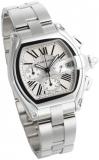
The Tissot PRX Automatic Chronograph carries a stepped, tonneau-inspired case whose brushed and polished planes shift character under different light, a direct callback to the integrated-bracelet sports watches that defined the late 1970s. Where the three-hand PRX established the silhouette, this chronograph variant expands it with a tri-compax dial layout and a pusher-equipped profile, positioning it as a distinct proposition within the broader Tissot collection.
The architecture that matters most sits under the dial. Tissot equips this reference with an A05.H31 automatic chronograph movement, a calibre built around a column wheel and vertical clutch layout rather than the modular cam-and-lever construction common at this price point. That distinction has practical consequences: the chronograph hand starts without the visible stutter typical of cheaper mechanisms, and the seconds hand can run continuously without measurably draining amplitude.
A Case Built on the 1970s Integrated Ideal
The PRX case measures 42 mm across and relies on a flat, wide bezel that sits nearly flush with the mid-case. Lugs are not separate components at all; the bracelet flows directly into the case flanks through a single articulated link, a construction that demands tighter tolerances than conventional strap fittings. Brushed surfaces dominate the top planes, while narrow polished chamfers trace the case sides, creating a two-tone effect that reads differently on the wrist than in product photography.
Thickness is the number worth scrutinizing. Chronograph movements with column wheels add height, and this watch sits noticeably taller than the 10.93 mm three-hand PRX 40 mm. The trade-off is deliberate: the additional depth houses the chronograph works while keeping the caseback relatively flat, so the watch settles against the wrist rather than tipping on its edge.
Dial Layout and Legibility
The tri-compax arrangement places running seconds at nine, a 30-minute counter at three, and a 12-hour or small-seconds register at six depending on the variant. Applied indices are faceted and lume-filled, and the hands carry Super-LumiNova inserts that remain usable in low light without glowing like a dive instrument. A tachymeter scale is printed on the chapter ring rather than engraved into the bezel, which keeps the case profile slim and the dial visually uncluttered.
Sunburst finishing on the dial base gives the surface a subtle radial grain, and the date aperture at 4:30 preserves the symmetry of the register layout. That positioning is a small detail most buyers only notice after wearing the watch for a week, but it prevents the disruption that a date window at three would cause to the minute counter.
The A05.H31 Movement and What It Delivers
Tissot states that the Powermatic 80 family, from which this chronograph calibre derives its base architecture, achieves accuracy of roughly minus five to plus five seconds per day in its elaborated form. The chronograph module sits on top of that regulated base, and the manufacturer specifies the A05.H31 for both timekeeping and chronograph functions without a separate power reserve indicator on the dial. Real-world owners should expect approximately 60 hours of autonomy when the chronograph is left disengaged, which means a watch taken off on Friday evening will still be running on Monday morning.
The vertical clutch is the component that separates this movement from entry-level alternatives. Because the chronograph and running seconds are coupled through discs rather than meshing gears, the chronograph can be started while the watch is running without any jump in the seconds hand, and leaving the chronograph engaged does not degrade timekeeping accuracy. Column wheel actuation gives the pushers a crisp, defined click rather than a mushy travel, a tactile quality that surfaces most clearly during everyday timing tasks, like the way the pusher responds when tracking a commute segment or a kitchen interval.
- Movement: Automatic chronograph, A05.H31 base
- Power reserve: Approximately 60 hours
- Chronograph control: Column wheel with vertical clutch
- Case: 42 mm tonneau-style, integrated bracelet
- Water resistance: Suitable for daily wear and light water contact
- Crystal: Sapphire with anti-reflective coating
The exhibition caseback reveals the movement’s finishing, which is industrial rather than artisanal: brushed bridges, a signed rotor, and restrained use of perlage. For a watch at this price segment, that is a reasonable trade of decorative hand-finishing for the mechanical integrity of a column wheel chronograph.
Bracelet, Wearing Experience, and Size Considerations
The integrated bracelet is the defining tactile feature. Links are single-piece with a thin profile, tapering modestly toward a butterfly clasp that sits nearly flush with the underside of the wrist. Because the first link is articulated, the bracelet drapes immediately rather than flaring outward, which is why the 42 mm case reads smaller on the wrist than its dimensions suggest. Owners with wrists below roughly 16.5 cm should attempt a fitting before committing, since the fixed end-links offer no adjustment at the case junction.
The chronograph’s added height is the most common point of feedback among wearers. Under a shirt cuff, the pushers and crown guards catch fabric more readily than a three-hand PRX. For office wear, the profile is manageable; for formal attire with closely tailored cuffs, the three-hand variant remains the more discreet choice.
How It Fits Within the Broader Tissot Lineup
The PRX chronograph occupies a specific niche. It is not a motorsport tool watch in the vein of the Tissot T-Sport line, and it is not a heritage reissue in the manner of the Tissot Heritage models. Its competition is internal and external simultaneously: buyers weighing a chronograph against the standard PRX automatic are essentially choosing between mechanical complexity and slim wearability.
Against external rivals, the column wheel movement is the differentiator. Many chronographs near this price rely on cam-actuated modular movements that function adequately but lack the tactile precision of a column wheel. The PRX does not advertise this as an exclusive feature, but it is the specification that informed buyers use to separate it from the crowd.
Dial Variants and Practical Collecting Advice
Tissot has released the chronograph across several dial executions, including blue, black, and silver-toned sunburst finishes, along with at least one two-tone case option. Because the bracelet is visually dominant, dial choice matters less than case finish when building a coherent rotation: a steel-on-steel configuration pairs with almost anything, while two-tone versions narrow the wardrobe match considerably.
The recommendation for undecided buyers is to prioritize the movement over the colorway. Dial finishes can be lived with; a chronograph that feels imprecise every time the pusher is pressed cannot. That is why the vertical clutch specification deserves more weight than promotional imagery suggests.
On the secondary market, the automatic chronograph holds a following distinct from the quartz PRX variants, largely because the mechanical offering represents the top of the line rather than an entry point. Buyers should verify service history, as chronograph servicing costs more than three-hand maintenance and should factor into a five-year ownership calculation.
Who Should Consider This Watch
This chronograph suits the buyer who wants a mechanical complication with genuine technical substance, accepts a taller case in exchange for that hardware, and prefers an integrated bracelet design over traditional lugs. It also works for the collector assembling a rotation around a specific era aesthetic rather than brand prestige.
It is less suitable for those needing genuine water sports capability, since the chronograph pushers and case construction are designed for daily exposure rather than diving. It is likewise a poor fit for anyone who prioritizes a thin profile above all else, because the chronograph’s proportions are an unavoidable consequence of its mechanism.
The PRX Automatic Chronograph ultimately stands as evidence that a mid-range Swiss watch can carry serious horological hardware without retreating into conservatism. Its value lies in what happens when the top pusher is pressed: a clean, immediate engagement that reflects the column wheel inside, and a reminder that accessible chronographs do not have to feel compromised.