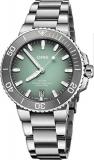
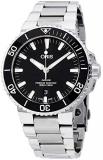
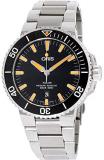
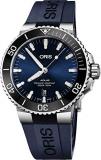
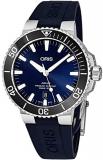
The Oris Aquis Date 43.5 mm pairs a multi-piece stainless steel case with a ceramic minute-scale bezel and a domed sapphire crystal, a specification set that places it firmly in the professional dive-watch category rather than the lifestyle end of the spectrum. That combination of materials and proportions has made the 43.5 mm reference one of the most discussed sizes in the Aquis lineup, sitting between the more compact 39.5 mm variant and the larger 45.5 mm edition.
A Case Built Around Water, Not Around Trends
Dive watches live or die by their case architecture, and the Aquis Date approaches the problem from the inside out. The 43.5 mm case measures roughly 12 mm in thickness with a lug-to-lug distance of about 50 mm, figures that matter more than the diameter alone when judging how a watch sits on the wrist. A 43.5 mm case with a 50 mm span wears larger than the number suggests, yet the relatively slim profile keeps it from crowding the cuff of a shirt.
Water resistance is rated to 300 metres, a figure achieved through a screw-down crown, a screw-in case back and gasket engineering that Oris has refined across successive Aquis generations. The bezel uses a ceramic insert for the minute scale, which resists the fading and scratching that plague aluminium inserts over years of exposure to salt water, sand and sunlight. Sapphire crystal domed on both sides with anti-reflective coating on the interior protects the dial while maintaining the slightly vintage curvature that collectors associate with serious tool watches.
Proportions and Wrist Presence
The Aquis Date line spans 42 configurations across 39.5 mm, 41.5 mm and 43.5 mm case sizes, and the 43.5 mm version occupies the upper-middle ground. Buyers with wrists of roughly 17 cm and above typically find the proportions balanced, while smaller wrists may prefer the 41.5 mm option. The integrated lugs, a signature Aquis design element, mean the watch sits closer to the wrist than a conventional lug design would allow at the same diameter, mitigating some of the visual bulk.
Bezel Action and Everyday Handling
The unidirectional rotating bezel is the interface a diver touches most often, and the Aquis design uses a prominent grip pattern that remains usable with wet fingers or gloves. The ceramic insert provides a glossy depth that reads clearly underwater and under low light, and the lume pip at the zero marker is positioned for quick alignment. These are small engineering decisions, but they separate a bezel designed for actual timing tasks from one included mainly for appearance.
Two Movements, Two Different Owners
The 43.5 mm Aquis Date is offered with more than one engine, and understanding the difference is central to choosing the right reference. The standard Aquis Date runs on a conventional automatic movement with a power reserve in the region of 38 hours, a familiar and well-supported specification for daily wear. The Aquis Date Calibre 400 variant changes the calculus substantially.
Oris Calibre 400 delivers a 120-hour power reserve through twin barrels, meaning the watch can be set aside for several days and still be running when it returns to the wrist. The movement is also specified as highly anti-magnetic, rated to approximately 2,250 gauss, which matters in an era when laptops, phones and magnetic closures surround the wearer. According to Oris, the Calibre 400 carries a recommended service interval of ten years, a claim that shifts the long-term ownership cost calculation in the buyer’s favour.
- Standard Aquis Date: conventional automatic movement, roughly 38-hour reserve, lower entry price
- Aquis Date Calibre 400: twin-barrel automatic, 120-hour reserve, anti-magnetic to about 2,250 gauss
- Shared platform: 43.5 mm steel case, ceramic bezel insert, 300 m water resistance
The practical consequence is a decision between two ownership models. The standard movement suits buyers who wear one watch consistently and value a lower initial outlay. The Calibre 400 suits buyers who rotate several watches, travel frequently or simply want fewer reasons to reset the time and date. Neither choice is a compromise on the case; the difference sits entirely under the dial.
Dial Legibility and the Date Complication
The Aquis Date dial follows a functional hierarchy. Applied indices with luminous fill sit at the hours, a broad luminous handset dominates the centre, and the date aperture at six o’clock balances the layout without interrupting the symmetry of the markers. On the black dial reference, the contrast between the dark ground and the luminous elements is high enough that legibility survives dim restaurant lighting as readily as it does the shaded side of a reef.
The date function is the one concession to daily office life, and its placement at six o’clock keeps the dial cleaner than a three o’clock window would. For buyers who spend most of their week at a desk and only part of it near water, this is the detail that makes the Aquis Date a viable single-watch solution rather than a weekend specialist. The same logic appears across the broader dive-watch segment, where models such as those in the Omega Seamaster family have long combined professional depth ratings with everyday wearability.
How the 43.5 mm Aquis Date Compares
Positioning the Aquis Date requires looking at both its depth rating and its price band, because the two do not always travel together. Several established dive watches offer comparable water resistance at higher price points, while entry-level alternatives often stop at 200 metres or substitute mineral crystal for sapphire.
Against the Breitling Superocean collection, the Aquis Date trades brand recognition for a ceramic bezel insert and a movement with a longer service interval on the Calibre 400 version. Against the Tissot T-Sport dive models, the Aquis Date sits at a higher price but offers a more substantial case construction and a movement architecture designed for longer intervals between servicing. The Aquis Date does not attempt to compete on heritage marketing; it competes on specification density per dollar.
Buyers weighing the Aquis Date against chronograph-focused sports watches should note that a dive bezel measures elapsed time in one direction and in minutes, while a chronograph measures to the second. Those shopping for a racing-inspired alternative might look at the TAG Heuer Carrera line, though the comparison highlights a category difference rather than a like-for-like contest. The Aquis Date’s bezel is a timing tool for a specific job, and it performs that job without complication stacking.
Wearing It: Strap Options and Long-Term Ownership
The Aquis Date is typically supplied on a stainless steel bracelet with an integrated design that follows the case lines, or alternatively on a rubber strap for diving use. The bracelet’s integration means third-party strap swaps are limited, a trade-off inherent to the Aquis architecture. Buyers who enjoy changing straps frequently should factor this into the decision, while those who prefer a single secure fit will find the integrated bracelet reassuring.
Long-term costs divide along movement lines. The standard automatic movement follows conventional service intervals, typically every four to six years depending on use. The Calibre 400’s ten-year recommended interval, as stated by Oris, reduces the frequency of servicing and the associated cost over a decade of ownership. For buyers planning to keep the watch for many years, that difference can offset a meaningful portion of the price gap between the two versions.
Case finishing is another longevity factor. The multi-piece stainless steel case uses a mix of brushed and polished surfaces, and brushed finishes hide the fine scratches that accumulate on any daily-worn watch. The ceramic bezel insert, unlike aluminium, will not fade under UV exposure, so the watch’s appearance after five years of summer wear remains close to how it left the factory.
Who Should Buy the 43.5 mm Aquis Date
The 43.5 mm case suits buyers with medium to larger wrists who want a dive watch with genuine water resistance rather than a desk-diver aesthetic. Those who swim, snorkel or dive regularly will use the 300-metre rating and the bezel as intended. Those who work in offices will find the case slim enough for a shirt cuff and the date function useful. Buyers who rotate watches and dislike resetting them should prioritise the Calibre 400 version. Buyers who want the lowest entry into the Aquis platform and wear one watch daily can choose the standard movement without giving up case quality.
Prospective owners comparing the Aquis Date against other steel sports watches may also consider how the Aquis fits a collection anchored by a dress piece. The wider catalogue from the Oris brand’s stable of aviation and motorsport references shares the same value-driven engineering philosophy, and buyers building a multi-watch rotation often find the Aquis Date serves as the durable anchor piece around which less rugged watches are arranged.
The Case for Engineering Over Hype
The Aquis Date 43.5 mm makes its argument through measurable specifications: 300 metres of water resistance, a ceramic bezel insert, sapphire crystal with anti-reflective coating, and in the Calibre 400 version, a 120-hour power reserve and anti-magnetic protection rated to about 2,250 gauss. These are numbers a buyer can verify against published specifications rather than claims that require faith. For a diver or a daily wearer who wants a tool watch that also looks appropriate at a desk, the Aquis Date 43.5 mm delivers its value in the case, the crystal and the movement rather than in the logo on the dial, which is precisely the kind of engineering-led proposition that rewards informed buyers over time.