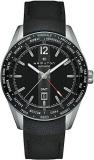
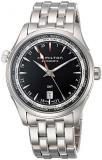
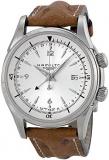
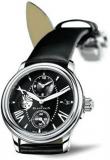
The Hamilton Khaki GMT line traces its origins to a practical demand: pilots and field personnel needed to read two time zones at a glance without sacrificing legibility or toughness. That mandate shaped a family of watches built around a 24-hour hand and a rotating bezel, and it continues to define the collection today.
What distinguishes the Khaki GMT from a generic travel watch is the way Hamilton integrates aviation and naval references into a single design language. The Hamilton collection spans military-inspired field models and dive-ready nautical pieces, and the GMT variants sit at the intersection of both disciplines.
Two Bloodlines: Khaki Aviation and Khaki Navy
The Khaki GMT family is not a single template but two distinct branches, each shaped by a different environment. Understanding the split is the first step toward choosing the right reference.
The Aviation X-Wind GMT Chrono
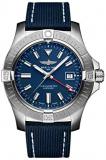
The Khaki Aviation X-Wind GMT Chrono Quartz, reference H77922141, places a 46mm stainless steel case around a Caliber G10.962 quartz movement. Its functions combine a GMT hand, chronograph registers, and a date window, all rendered on a blue dial. The oversized case is a deliberate choice: cockpit instruments favor scale and contrast over subtlety, and the X-Wind line has long carried that logic into wristwear.
A quartz chronograph of this size suits pilots who need split-second timing and a second time zone without winding a movement before takeoff. The 46mm diameter also gives the sub-dials room to remain readable under quick glances, which matters more in a cockpit than on a desk.
The Navy Scuba GMT Automatic
The nautical branch takes a different route. The Khaki Navy Scuba Auto GMT 43mm, reference H82555130, houses a Caliber H-14 automatic movement in a stainless steel case measuring 43mm across and 13.9mm thick, with 300m of water resistance. A screw-down crown supports that rating, and the black dial keeps the presentation sober.
The bronze variant, reference H82565930, shares the 43mm case and 30-bar water resistance but swaps steel for bronze, a material that develops a patina over time. Both models offer a power reserve of up to 80 hours, which means the watch can sit on a desk from Friday evening to Monday morning and still be running.
How the GMT Complication Works in Practice
A GMT watch displays a second time zone through an additional hour hand that completes one revolution every 24 hours against a 24-hour scale. On the Navy Scuba GMT, that scale is printed on the dial and paired with the external bezel, so the wearer can track a third zone by rotating the bezel independently.
This arrangement is more useful than it first appears. A traveler can set the local hour hand to the destination time on landing, keep the GMT hand on home time, and use the bezel to calculate a third city for a conference call. Divers benefit from a different application: the elapsed-time bezel remains available for bottom-time tracking, with the GMT hand reserved for surface intervals or support-team coordination.
The automatic Caliber H-14 in the Navy Scuba models drives all of this without a battery. The 80-hour reserve is generous for the price bracket, and it reflects Hamilton’s broader approach of fitting proven movements into tool-watch cases rather than chasing complications for their own sake.
Case, Crystal, and Wearing Experience
Hamilton specifies sapphire crystals across the Khaki GMT references, a choice that resists scratching in the environments these watches are built for. The Navy Scuba’s 43mm case and 13.9mm thickness sit within the range most wrists can wear daily, while the 21mm lug width on related Khaki Navy references keeps strap changes straightforward.
The 300m water resistance on the steel Scuba GMT places it in genuine dive-watch territory, not merely splash-resistant territory. Screw-down crowns and caseback construction support that figure, and it means the watch can be worn for swimming, snorkeling, and recreational diving without hesitation.
Weight and balance differ between the steel and bronze versions. Bronze cases tend to feel warmer on the wrist and visually soften as they oxidize, which appeals to collectors who want a watch that records its own history. Steel remains the lower-maintenance option and pairs more easily with bracelets and formal straps.
Design Language and Historical Context
Hamilton’s military heritage informs the Khaki family’s design decisions: matte or low-sheen finishes, high-contrast dials, and hands that remain legible in poor light. The GMT models extend that vocabulary rather than departing from it.
The 24-hour hand is typically distinguished by a contrasting color or an arrow tip, a convention that dates to mid-century pilot watches where quick orientation mattered more than decorative flourishes. The Khaki GMT follows this convention, keeping the GMT indication immediately identifiable without cluttering the dial.
This restrained approach contrasts with how some Swiss houses treat travel complications. Where a dress-oriented GMT might bury the 24-hour scale in applied indices, the Khaki keeps it bold and functional, consistent with a field-watch philosophy.
Choosing Between the Khaki GMT References
The decision between the aviation and nautical branches comes down to use case and wrist presence.
- Khaki Aviation X-Wind GMT Chrono (H77922141): 46mm steel case, quartz chronograph, GMT plus date, blue dial. Best for pilots, frequent flyers, and anyone who values chronograph utility over automatic mechanics.
- Khaki Navy Scuba Auto GMT 43mm (H82555130): 43mm steel case, automatic Caliber H-14, 300m water resistance, 80-hour reserve. Best for divers and travelers who want one watch for both.
- Khaki Navy Scuba Auto GMT Bronze (H82565930): 43mm bronze case, automatic, 30-bar water resistance. Best for collectors who want a patina-developing case and a warmer aesthetic.
Buyers who prioritize movement tradition will gravitate toward the automatic references, while those who want chronograph timing and a larger wrist presence will find the X-Wind more appropriate. Neither choice is a compromise; they serve different briefs within the same family.
Where the Khaki GMT Sits in the Broader Market
The dual-time tool watch segment is crowded, with options ranging from entry-level quartz pieces to luxury automatics. The Khaki GMT occupies a middle ground: it offers Swiss-made automatic movements, genuine dive-watch water resistance on the Scuba models, and sapphire crystals without moving into the price territory of prestige houses.
For context, travelers who want a more dress-oriented dual-time watch often look at references such as the Rolex GMT-Master II, which operates at a very different price and positioning. The Khaki GMT is not a substitute for that category; it is a different proposition built around field and dive utility.
Similarly, the aviation chronograph space includes strong alternatives from other Swiss makers. Enthusiasts comparing pilot-oriented chronographs sometimes examine options like TAG Heuer cockpit-inspired designs, though those typically emphasize racing heritage rather than dual-time navigation.
The Khaki GMT’s specific combination of a 24-hour hand, dive-grade water resistance on the Scuba, and a sub-50mm case size keeps it relevant to a broad set of buyers: overland travelers, recreational divers, field engineers, and collectors who want a tool watch with a genuine functional rationale.
Maintenance, Straps, and Long-Term Ownership
Automatic GMT movements require periodic servicing, typically every five to seven years depending on wear. The 80-hour power reserve on the Navy Scuba models means the movement stays wound during normal weekly wear, reducing the need for a watch winder.
Strap compatibility matters for a tool watch, and the Khaki GMT references accept standard-width straps that owners can swap without proprietary tooling. A steel bracelet suits daily office wear, a rubber or NATO strap suits diving and swimming, and a leather strap softens the watch for travel. The bronze reference rewards owners who embrace visible aging; the steel references reward those who prefer a consistent appearance.
Sapphire crystal and 300m water resistance reduce the two most common sources of accidental damage, which makes the Navy Scuba GMT a practical long-term purchase rather than a display-piece.
Final Thoughts on the Khaki GMT
The Hamilton Khaki GMT succeeds because it treats the dual-time complication as a tool rather than an ornament. The aviation branch delivers chronograph utility and cockpit-scale legibility; the nautical branch delivers automatic mechanics, serious water resistance, and a case size that works across daily and recreational contexts.
For travelers and outdoor users who want a single watch capable of tracking home time, local time, and a third zone, the Khaki GMT offers a coherent answer. The reference choice then becomes a matter of environment and aesthetic preference, not a question of capability.