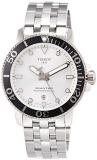
The Tissot Seastar 1000 is defined by a set of specifications that place it firmly in the professional dive watch category: a 300-meter water resistance rating, a scratch-resistant sapphire crystal, and a Swiss automatic movement with up to 80 hours of power reserve. These are not decorative claims. They are measurable capabilities that determine how the watch performs in and around water.
Available in case diameters of 40 mm, 43 mm, and 45.5 mm, the Seastar 1000 is designed to accommodate a range of wrist sizes without compromising its tool-watch identity. The case is constructed from 316L stainless steel, a grade chosen for its corrosion resistance and structural integrity in marine environments. Every reference in the line shares the same core architecture: a screw-down crown, a screw-down caseback, and a unidirectional rotating bezel for tracking elapsed dive time.
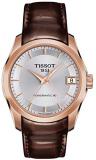
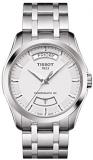
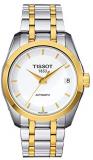
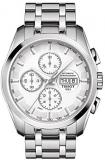
For anyone exploring the Tissot brand’s full range, the Seastar 1000 represents its most focused expression of dive watch engineering, sitting alongside dress-oriented lines and chronograph families within the broader catalog.
Sapphire Crystal and Bezel Construction
The crystal on the Seastar 1000 is sapphire, a material rated 9 on the Mohs hardness scale, second only to diamond. This makes it highly resistant to scratches from sand, rock, and everyday contact. Several references in the line feature a double-sided antireflective coating, which reduces glare when reading the dial in bright sunlight or underwater where light refraction can obscure legibility.
The bezel configuration varies by reference. Some models use an aluminium bezel ring, while others are fitted with a ceramic bezel ring. Aluminium offers a matte, vintage-inspired appearance that develops character over time. Ceramic provides greater scratch resistance and color retention, holding its appearance longer under heavy use. The choice between the two comes down to whether the wearer prioritizes traditional dive watch aesthetics or long-term surface durability.
Both bezel types are unidirectional and ratcheted, rotating counterclockwise only. This is a safety standard in dive watch design: if the bezel is accidentally bumped during a dive, it can only move in the direction that shortens the measured elapsed time, never lengthens it, keeping the diver on the conservative side of their decompression schedule.
Swiss Automatic Movement and Power Reserve
At the center of the Seastar 1000 is a Swiss automatic movement, visible through a see-through caseback on certain references. The movement delivers up to 80 hours of power reserve, meaning the watch continues running for more than three days after being taken off the wrist. This is a practical advantage for a dive watch that may be worn on weekends and stored during the workweek, as it eliminates the need to reset the time and date each time the watch is picked up.
The self-winding mechanism draws energy from the natural motion of the wearer’s wrist, removing the need for battery replacements entirely. The rotor spins with movement, transferring energy to the mainspring, which then releases it at a controlled rate through the escapement. This is the same fundamental system used across mechanical watchmaking, refined over decades of engineering.
The see-through caseback adds a dimension of mechanical appreciation that closed-caseback dive watches cannot offer. Observing the rotor oscillate and the balance wheel beat is a reminder that the watch is a miniature mechanical engine, not a sealed black box.
Size Options and Wearability
Tissot offers the Seastar 1000 in three case diameters, each targeting a different wrist profile and wearing preference.
- 40 mm – Suited to wrists measuring roughly 6.0 to 7.0 inches. This size maintains the visual proportions of a dive watch without overwhelming smaller frames.
- 43 mm – The middle ground, fitting wrists from approximately 6.5 to 7.5 inches. It is the most versatile option in the lineup.
- 45.5 mm – Designed for larger wrists (7.0 inches and above) or for wearers who prefer a more prominent, oversized presence on the wrist.
Weight varies by reference, with the 43 mm model listed at 180 grams. That figure reflects the heft of the stainless steel case and bracelet, a characteristic that many dive watch enthusiasts associate with solid construction and durability. The case and bracelet are typically finished with a combination of brushed and polished surfaces, giving the watch visual depth without excessive ornamentation.
For those who appreciate the engineering-led approach behind this line, the Tissot T-Sport collection places the Seastar within the brand’s broader sport and performance-oriented families.
Water Resistance and Dive-Ready Features
The Seastar 1000 is rated to 300 meters (1,000 feet), which is where it takes its name. This rating is achieved through several interdependent design elements working together. The screw-down crown seals the winding stem entry point against water intrusion. The screw-down caseback compresses a gasket that creates a watertight seal along the rear of the case. The sapphire crystal is seated with its own gasket, and the case itself is machined to tolerances that prevent deformation under pressure.
Unlike digital dive computers or fitness trackers that simulate water resistance through electronic sealing, the Seastar 1000 achieves its rating through mechanical engineering alone. There are no sensors that could be compromised by water exposure. A 300-meter rating exceeds the needs of recreational scuba diving, which typically occurs at depths under 40 meters, but the additional margin translates to peace of mind and long-term reliability even as gaskets age.
It is worth noting that water resistance is maintained through gaskets and seals that can degrade over time, particularly if the crown is operated while wet or if the watch is exposed to hot water, which can cause gasket expansion and contraction. A routine pressure test every few years, performed by a qualified watchmaker, ensures the rating remains valid.
Dial Legibility and Everyday Usability
Dive watches live or die by their legibility. The Seastar 1000 uses large applied indices filled with luminescent material, providing high contrast against the dial surface. The hands, typically sword or baton style depending on the reference, are similarly treated with lume. In low-light conditions, the dial becomes a legible instrument rather than a decorative object.
The date window, present on most references, is positioned at 3 o’clock and features a white or black background that blends with the dial, depending on the specific model. A date complication may seem mundane, but for a daily-wear dive watch, it eliminates the need to consult a phone or separate calendar. The Seastar 1000 balances tool-watch simplicity with modern daily practicality.
Certified by a 2-year warranty, the watch is supported by Tissot’s service network, which is a consideration for buyers who plan to keep the watch for years rather than treat it as a disposable accessory.
Positioning Within the Dive Watch Landscape
Tissot has a history of producing accessible Swiss-made watches that do not compromise on core specifications. The Seastar 1000 fits this philosophy: a Swiss automatic movement, a sapphire crystal, and 300-meter water resistance at a price point that sits below many comparable Swiss dive watches from heritage brands.
For anyone who values mechanical engineering alongside the hybrid functionality found in the Tissot Touch Collection, the Seastar 1000 demonstrates how a traditional dive watch format can remain relevant without adding digital complications.
The watch also works as a daily driver for people who never set foot in the water. The robust case, scratch-resistant crystal, and 80-hour power reserve make it practical for office environments where a daintier dress watch might feel fragile. It pairs equally well with a wetsuit and a button-down shirt.
A Functional Tool With Long-Term Appeal
The Seastar 1000 is not designed to be a fashion statement, and that is precisely its strength. Its purpose is clear: provide accurate timekeeping in demanding environments while maintaining the mechanical integrity that Swiss watchmaking is known for. The combination of a 316L stainless steel case, a screw-down crown and caseback, a 300-meter water resistance rating, and an 80-hour automatic movement produces a watch that meets its stated specifications without embellishment.
Available in multiple case sizes and bezel materials, the line offers enough variation for different wrist sizes and aesthetic preferences while retaining a consistent mechanical foundation. Whether the intended use is recreational diving, water sports, or simply wearing a well-built automatic watch that can handle whatever the day brings, the Seastar 1000 operates within a clear set of engineering constraints and performs reliably within them.