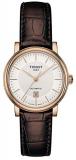
Tissot uses an 18K gold alloy composed of roughly 75 per cent pure gold, balanced with silver and copper to achieve both structural integrity and a warm, deep lustre. That specific ratio is not an arbitrary choice; it is the result of decades of metallurgical refinement, allowing the cases to hold their shape over years of daily wear while retaining the rich colour that only a high gold content can deliver. For buyers evaluating a precious-metal watch, understanding what goes into the alloy is the first step toward recognising value that extends far beyond the surface.
The Composition And Character Of 18K Gold
In its pure form, 24K gold is too soft for a watch case that must resist knocks and daily friction. By combining 75 per cent pure gold with 12.5 per cent silver and 12.5 per cent copper, the resulting 18K alloy reaches a Vickers hardness that comfortably handles regular use while preserving the colour saturation that distinguishes real gold from gold-plated alternatives.
The copper content introduces a subtle warmth to the final hue, preventing the alloy from appearing washed out or pale under natural light. Silver, meanwhile, contributes a slight brightness, and the interplay between the two elements gives every case a slightly different character depending on the polishing direction and the ambient light at any given moment. This variability is not a flaw; it is a signature of a material that behaves like a living surface, responding to its surroundings rather than appearing flat and manufactured.
Inside The Gold Collection: Models And Movements
The range of gold watches Tissot produces spans several distinct families, each defined by different design priorities. Case diameters generally fall between 33.7mm and 41mm, with the smaller sizes leaning toward classic dress-watch proportions and the larger ones adopting a more contemporary presence. The Tissot Goldrun Gold 38mm, referenced as T9224101602100, uses an 18K gold case paired with a Swiss Quartz movement, while the Tissot Goldrun Hesalite Gold 33.7mm, model T71340121, offers a more compact alternative with the same precious-metal construction.
- Case material: 18K yellow gold, with 316L stainless steel variants available in selected models
- Case sizes: 33.7mm, 38mm, 39.3mm, and 40-41mm across the collection
- Crystal: Scratch-resistant sapphire on the Goldrun models
- Movement: Swiss Quartz or Swiss Automatic, depending on the reference
- Certification: COSC chronometer certification on selected Le Locle models
The automatic calibres within the gold range share their architecture with the movements found in Tissot’s Heritage line, a connection that matters for collectors tracking internal consistency across collections. The winding mechanisms, escapements, and finishing standards follow a unified design language, which means a Tissot automatic in a gold case performs with the same reliability as its steel counterpart. The difference lies entirely in the case material, not in the mechanical integrity of the movement.
How 18K Gold Changes The Wearing Experience
Weight is the first tactile difference. An 18K gold case adds noticeable heft compared to stainless steel, particularly in the 40-41mm sizes. That weight distributes across the wrist in a way that feels substantial without being cumbersome, and it changes how the watch sits during movement. Where a steel case might shift slightly on the wrist, the added mass of gold tends to keep the watch planted, reducing rotation during everyday activities.
Thermal conductivity also plays a role in the sensory experience. Gold warms quickly to skin temperature and stays there, unlike steel, which can feel cold for longer after the watch is put on. For anyone who has worn both materials, this difference is immediate and contributes to a perception of comfort that is difficult to quantify but easy to notice.
The aesthetic behaviour of the metal deserves separate attention. Polished 18K gold reflects light differently from polished steel; the reflections carry a yellow warmth rather than a white intensity. On dialled surfaces with applied indices, this creates a subtle glow around the edges of the case that is particularly visible in low evening light. The overall effect is a watch that reads as formal without shouting, which aligns with the design philosophy behind the Tissot T-Sport line, where integration and restraint take precedence over visual drama.
Maintenance And Long-Term Ownership
Gold is a softer metal than steel, which means the case will accumulate fine surface scratches over time. This is not a defect; it is a characteristic of the material that every gold watch owner eventually encounters. The scratches can be removed through professional polishing, though each polishing session removes a microscopic layer of gold, so over-polishing is something to avoid. The goal is not to keep the case in mint condition indefinitely but to manage wear so that the watch retains its proportions and sharpness of edge over decades.
Cleaning can be done at home with a soft cloth and lukewarm water, provided the watch has adequate water resistance. The gold itself does not tarnish or corrode, but the silver and copper in the alloy can react with sulphur compounds found in some environments, which is why a simple wipe-down after wearing helps maintain the original colour. For deeper restoration, a qualified watchmaker can restore the polish without compromising the case geometry if the work is done conservatively.
Positioning Within The Luxury Watch Landscape
Dress watches from other Swiss makers often use gold as a statement of exclusivity, pushing prices into a bracket that excludes many buyers. The Tissot approach is different. The brand applies the same 18K alloy across multiple price tiers, from the Goldrun quartz models to automatic pieces with chronometer certification, making precious-metal ownership accessible without diluting the material specification. This strategy positions Tissot as a bridge between accessible Swiss watchmaking and the elevated territory typically reserved for heritage maisons. Collectors exploring alternatives might also look at pre-owned precious-metal pieces from houses such as Frederique Constant watches, which occupies a similar value proposition within the entry-luxury segment and offers useful market context.
Understanding what 18K gold actually is, how it behaves on the wrist, and why it commands a price premium over steel allows a buyer to evaluate a gold watch on its own merits rather than on brand reputation alone. A Tissot gold watch delivers the material, the movement architecture, and the Swiss build quality in a package that remains within reach. For anyone who values substance over status, that combination is difficult to overlook.