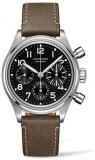
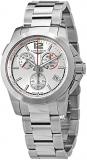
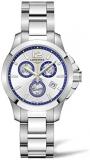
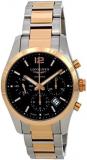
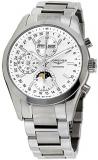
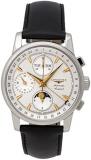
The Longines Big Eye takes its nickname from one unmistakable feature: a 30-minute chronograph counter deliberately larger than its two companions on the dial. This asymmetry is not a styling whim. It descends from cockpit instruments where elapsed-minute readings mattered more than split-second precision, and it gives the watch a face that is instantly recognizable across a crowded room.
Officially catalogued as the Longines Avigation BigEye, the reference sits within the brand’s aviation-inspired family. According to Longines, the automatic watch measures 41.00 mm in diameter, beats at 28,800 vibrations per hour, and delivers a power reserve of up to 66 hours. Those figures place it firmly in modern daily-wear territory while preserving the proportions of mid-century pilot chronographs.
A Dial Built Around One Dominant Register
Most chronographs distribute three sub-dials evenly, creating a balanced if somewhat predictable layout. The Longines Big Eye breaks that symmetry by enlarging the counter at three o’clock, which tracks elapsed minutes. The smaller registers at six and nine o’clock handle running seconds and chronograph hours respectively.
The practical consequence is immediate. When timing a descent, a holding pattern, or a simple interval, the wearer reads the large central hand against a wide, high-contrast scale rather than squinting at a miniature dial. Legibility was the design brief, and the watch answers it without adding visual noise.
Fans of the Longines brand’s wider catalogue will recognize the same heritage-first approach across its collections, and this model shows how archival cues translate into a modern case size. The dial keeps its vintage proportions: applied numerals, a railway-style minute track, and syringe-shaped hands filled with luminous material.
Two Case Materials, One Shared Architecture
Longines offers the Avigation BigEye in more than one execution, and the choice of material changes the watch’s personality more than the specification sheet suggests.
- Stainless steel reference L2.816.4.53.2: 41.00 mm case, 28,800 vph automatic movement, up to 66 hours of power reserve, water resistance to 3 bar
- Titanium reference L2.816.1.93.2: 41.00 mm case, same movement and power reserve figures, water resistance to 3 bar, listed by Longines at $4,400.00
Titanium reduces the weight on the wrist noticeably, which matters for a chronograph with a domed crystal and a multi-register dial. Steel, by contrast, brings a brighter polish and a more traditional presence under a shirt cuff. Both share the same 3 bar water resistance rating, a reminder that this is an instrument conceived for the cockpit rather than the dive boat.
That rating is worth stating plainly. Three bar corresponds to splash and rain resistance, not swimming. Buyers who split their time between the office and the open water should treat the Big Eye as a dress-adjacent tool watch and look elsewhere for a dive companion, such as the Omega Seamaster line.
Inside the Movement
The engine is an automatic chronograph calibre running at 28,800 vibrations per hour, or four hertz. That frequency is the modern standard for Swiss movements and gives the seconds hand a smooth, continuous sweep. The quoted power reserve of up to 66 hours means the watch can sit on a bedside table through a long weekend and still be running on Monday morning.
For a chronograph, that reserve figure is a genuine usability advantage. Many comparable movements stop short of the 60-hour mark, which turns a Friday-evening removal into a Monday-morning reset. Owners who rotate several watches will find the Longines easier to live with than its vintage inspiration, which required daily winding attention.
The case back is solid, as is typical for pilot chronographs of this style, so the movement is not on display. The reward is a cleaner, more historically faithful profile and slightly better protection for the mechanism inside.
Pilot-Watch Heritage and the Big Eye Archetype
Aviation watches of the 1930s and 1940s were built around a single question: can a pilot read this instrument at a glance in poor light? Oversized crowns, high-contrast dials, and enlarged minute counters all emerged from that constraint. The Big Eye layout appears in several mid-century military and civilian chronographs, and Longines draws on that lineage rather than inventing a new aesthetic.
The modern interpretation softens some of the original austerity. The case is polished rather than fully brushed, the crystal is domed, and the strap options lean toward leather rather than canvas. The result is a watch that references its sources without cosplaying as a museum piece.
Collectors who appreciate this kind of design lineage often trace it across brands. The Breitling Transocean series follows a comparable path, taking archival aviation and travel themes and repackaging them in contemporary case sizes.
Wearing the 41 mm Case
Forty-one millimetres is a considered middle ground. It is large enough to give the oversized register room to breathe, yet small enough to slip under a cuff without the case edges catching on fabric. Wrist presence comes from the dial’s visual hierarchy rather than from raw dimensions, which is why the watch reads bolder than its measurements suggest.
Lug-to-lug length is the figure that really determines comfort on smaller wrists, and this is where trying the watch in person matters. A 41 mm case with long lugs can overhang a slender wrist, while the same diameter with compact lugs sits flush. Buyers upgrading from a 38 mm field watch should expect a noticeable step up in visual weight, even if the numbers look modest on paper.
The syringe hands and applied indices are generously coated with luminous material. In low light, the large minute counter remains the brightest element, which is exactly the hierarchy the original cockpit instruments intended. Reading elapsed time in a dark room is straightforward, while the running-seconds sub-dial recedes into the background.
How It Fits Into a Rotation
The Big Eye works best as a second or third watch rather than the only one in the box. Its 3 bar rating and leather-first strap pairing make it a poor choice for swimming or heavy outdoor work, but an excellent one for travel, office wear, and weekend drives. The chronograph function is genuinely usable, not decorative, thanks to the legible minute register.
Versatility comes from the dial rather than the case. A dark dial with contrasting sub-registers dresses up under a blazer and relaxes with a knit sweater. Owners who want a single watch for everything will likely pair it with a second, more rugged piece; those building a small collection around mid-century design will find it anchors the dressier end.
Alternatives in the same conceptual space include hand-wound chronographs with vintage proportions and modern automatic chronographs with greater water resistance. The Longines sits between those camps, offering automatic convenience, a 66-hour reserve, and a dial layout that is difficult to confuse with anything else at its price point.
Finishing Details That Reward a Closer Look
Longines has a long record of producing watches with restrained finishing, and the Avigation BigEye follows that pattern. The case flanks carry brushed surfaces while the bezel and lugs are polished, creating a subtle contrast that catches light without shouting. The crown is oversized enough to operate with gloves, a nod to the pilot brief, and the chronograph pushers have a firm, deliberate action.
The dial printing is crisp, with the railway minute track rendered finely enough to survive macro photography. Applied numerals rather than printed ones add depth, and the hands are faceted so they catch light along their length. None of these details are unique to Longines, but together they push the watch above the level of a simple heritage reissue.
The brand’s broader catalogue shows a similar attention to proportion. The Frederique Constant collection takes a comparable approach, pairing traditional dial codes with modern case engineering and accessible automatic movements.
What the Big Eye Represents
The appeal of this chronograph is not a single headline specification. It is the coherence of the whole: a historical layout, a modern movement with a useful power reserve, a case size that works in daily life, and a dial that remains readable when conditions deteriorate. Longines has resisted the temptation to enlarge the case or add complications that would dilute the concept.
For anyone drawn to aviation watches but unwilling to accept a fragile vintage piece, the Big Eye offers a practical path into that tradition. It rewards owners who value legibility, proportion, and a design story that can be traced back to real instruments. Worn regularly, it makes the case that a watch can be both a tool and a pleasure to look at, and that the two purposes need not compete.