The Hamilton Khaki field line descends directly from watches the brand supplied to American soldiers, and the vintage-inspired references preserve that lineage in ways modern tactical designs rarely attempt. Hand-wound movements, matte stainless steel cases, and dial layouts borrowed from 1960s and 1970s service issue define the category. The result is a family of watches that reads as equipment first and accessory second, a distinction that has kept this corner of the Hamilton catalog relevant for collectors who want historical grounding without the fragility of an actual antique.
Understanding what separates a vintage-styled Khaki from a generic field watch begins with the specifics: case dimensions, movement architecture, dial typography, and the water resistance ratings that determine daily usability. Each of these elements carries historical precedent, and each is worth examining on its own terms. The broader Hamilton collection places the Khaki family at the center of its identity, and that positioning explains why the vintage references receive such careful attention to period detail.
Where the Khaki Vintage Design Language Comes From
Hamilton’s mid-century military contracts produced watches built to specification rather than to fashion. The requirements were blunt: legible dials in poor light, robust cases that survived field conditions, and movements that could be serviced in the theater. Hamilton states that its Khaki Pilot Pioneer Mechanical Chronograph revives the form and function of chronographs issued to military personnel, and that design philosophy flows down through the entire vintage-inspired range.
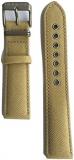
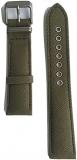
The visual signature is consistent across references. Black or dark dials with high-contrast white Arabic numerals dominate. Hands are broad and luminous, designed for split-second reading rather than aesthetic flourish. Cases are brushed rather than polished, a practical choice that hides scratches accumulated in the field. Straps historically ran to canvas and leather, though current production often ships on textile bands that echo the originals.
What separates this family from civilian field watches is restraint. There are no decorative bezels, no surplus complications, no applied logos competing with the numerals for attention. The dial layout follows a hierarchy established by function: hour markers first, branding second, and often reduced to a whisper. That discipline is the vintage character, more than any specific detail.
Movement Architecture in the Modern Vintage Khaki
The mechanical heart of the current Khaki Field Mechanical is the H-50 caliber, a hand-wound movement that Hamilton rates at 80 hours of power reserve. That figure is significant in a category where hand-wound movements often deliver 40 to 45 hours. An 80-hour reserve means the watch can sit unused across a long weekend and still be running on Monday morning, a practical benefit that removes the daily winding ritual from the category of chore.
Hand-winding itself is part of the appeal for a specific type of owner. The absence of a rotor keeps the movement thinner and the case profile closer to the original military references. There is also the tactile relationship: the daily or twice-weekly wind connects the wearer to the mechanism in a way automatic watches do not replicate. The H-50 is a modern caliber, not a reissued vintage movement, which means service intervals and parts availability reflect contemporary standards rather than the compromises required by genuine antiques.
- H-50 caliber: Hand-wound mechanical, 80-hour power reserve
- Case material: Matte stainless steel across the range
- Water resistance: 5 bar (50m / 164 ft) on the Khaki Field Mechanical 38mm reference H69439931
- Display: Three-hand layout with dark dial and high-contrast numerals
The choice of a matte case finish is not incidental. Polished surfaces photograph well but show every handling mark, and a field watch is bought to be worn hard. The brushed treatment on the Khaki case sides and bezel keeps the watch looking consistent over years of use, and it matches the low-sheen character of the original military issue pieces.
Case Sizes and the Question of Proportion
Vintage-inspired field watches face a genuine tension. Original military references were small by modern standards, often 33 to 36mm, because they were issued to conscripts of average build and worn on canvas straps. Current tastes favor larger cases, and Hamilton addresses the gap by offering multiple diameters within the Khaki family.
The Khaki Field Mechanical 36mm reference is the closest to period proportions, and Hamilton positions it as a direct descendant of a vintage model produced for U.S. Air Force navigators. The 38mm version, catalogued as H69439931, sits in the middle ground that suits most wrists without pushing into oversized territory. Larger variants exist across the range, but the smaller references carry the strongest vintage argument because the proportions match the historical record.
Case thickness matters as much as diameter here, and the hand-wound movement allows a slimmer profile than an automatic equivalent. On a textile strap, the watch sits close to the wrist and avoids the tendency of thicker field watches to catch on a jacket cuff. This is a practical consideration for anyone who wears a watch under a shirt sleeve rather than over it.
Dial Legibility and the Military Requirement
Military specification watches were evaluated on legibility in poor conditions, and the Khaki dial follows that brief. White numerals on a dark ground maximize contrast, and the font echoes the stenciled typography of mid-century equipment. Luminous compound on the hands and hour markers allows reading in low light, though the current paint formulations differ from the radium-based luminous used on genuine vintage pieces, which is a safety improvement rather than a compromise.
The three-hand layout with a central seconds hand is the standard configuration, and it is the right one for this design language. A date window, where present, is positioned to avoid disrupting the numeral symmetry, and the absence of a date on some references is itself a vintage-correct choice. Collectors of original military watches frequently prefer the no-date dial for its cleaner geometry.
Reading the dial at a glance is the entire point. The hour indices are distinct enough to separate at speed, the minute track is clear, and the hands are shaped to distinguish hour from minute without conscious effort. That sounds like a low bar until it is compared with dress watches where hands and indices blend together in all but ideal lighting.
Water Resistance, Straps, and Daily Usability
Hamilton rates the Khaki Field Mechanical 38mm at 5 bar, equivalent to 50 meters or 164 feet. That figure is honest rather than aspirational: it covers hand washing, rain, and accidental immersion, but it does not extend to swimming or diving. Anyone buying a field watch expecting aquatic capability should look elsewhere, and the Khaki range makes no claim to be a dive watch.
For daily wear, the rating is adequate. The watch handles the transitions between office, commute, and outdoor activity without complaint, and the matte case conceals the minor scuffs that accumulate over months of use. The textile strap, where fitted, is comfortable from the first wear and machine washable, though leather alternatives exist for owners who want a dressier presentation.
Strap changing is straightforward on references with conventional lugs, which encourages owners to experiment. A vintage-inspired field watch on a NATO strap is the canonical presentation, but a leather band shifts the same watch toward casual office wear. That versatility is a function of the design language rather than marketing, and it explains why the category remains popular among owners who want a single watch to cover multiple contexts.
How the Khaki Vintage Sits in the Broader Market
The field watch category has expanded considerably, and vintage-inspired military designs now appear at nearly every price point. The Hamilton Khaki family competes by combining authentic historical connection with modern manufacturing tolerances. The brand’s official history documents its wartime production, and that provenance is not available to every competitor claiming military inspiration.
Within the vintage category, the distinction that matters most is between watches that mimic aging and watches that reproduce a design brief. The Khaki does the latter. The proportions, the hand-wound movement, and the dial typography all trace to a specific historical requirement rather than a general affection for things that look old. That is a meaningful difference for collectors, and it is the reason the family maintains a stable position in the Hamilton lineup.
The Case for Choosing a Vintage-Inspired Khaki
A field watch is not the right purchase for every wearer. It lacks the sparkle of a dress piece, the specification sheet of a dive watch, and the complications that signal mechanical ambition. What it offers instead is coherence: every element serves legibility, durability, and serviceability, and that consistency is increasingly rare in a market driven by feature competition.
The mechanical versions carry an additional argument. The H-50 caliber’s 80-hour reserve means the watch is practical for owners who do not wear the same piece daily, and hand-winding establishes a ritual that many find more satisfying than the invisible work of a rotor. The 36mm and 38mm references respect period proportions in a way larger field watches cannot claim.
For anyone drawn to military history but unwilling to maintain a delicate antique, the Khaki Vintage family delivers the design language with contemporary build quality and service support. The Khaki asks a focused question of the field watch category and answers it with restraint: build the right watch to the right specification, once, and let the design speak without decoration.