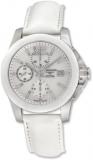
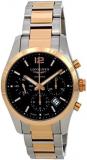
The Longines Ultra-Chron Automatic runs its balance wheel at 36,000 vibrations per hour, a figure that separates it from the majority of contemporary automatics ticking at 28,800 vph. That single specification shapes everything about the watch: its rate stability, its resistance to positional variation, and its appeal to buyers who read a spec sheet before they ever try a watch on. The Ultra-Chron name is not a marketing invention of recent years; it carries a lineage stretching back to the late 1960s, when Longines used it to designate chronometers certified for exceptional accuracy.
Longines positions the Ultra-Chron as a dive and sport watch rather than a pure desk diver, and the current catalogue supports that framing across two distinct case sizes. The 43 mm reference pairs a stainless steel case with a sapphire crystal and a 30 bar water resistance rating, while a more compact 37 mm variant sits alongside it with a 5 bar rating. Both share an automatic movement with a power reserve of up to 52 hours. Understanding how those figures translate into daily wear is the purpose of this guide, which examines the model from movement architecture through to wrist presence so that a purchase decision rests on evidence rather than impression.
A Movement Built Around Frequency
The central argument for the Ultra-Chron Automatic is mechanical. In its own technical literature, Longines notes that a standard mechanical automatic watch can deviate by as much as plus or minus 10 seconds a day, and that raising the oscillation frequency is one of the levers available to reduce that figure. A balance wheel beating 10 times per second settles into a more consistent rhythm than one beating 8 times per second, which helps the escapement recover faster from the small disturbances of daily wear, whether that is a door closing, a hand meeting a table edge, or the continuous motion of a wrist in traffic.
The Escapement and Rate Stability
Higher frequency does not come free. A faster-beating balance consumes more energy, generates more friction at the pallet fork and escape wheel, and places greater demands on lubrication and component tolerances. The engineering response in watches of this type is a movement built to sustain that pace over years rather than weeks. This is where the Ultra-Chron designation carries weight: it signals that the calibre has been specified around sustained precision rather than a bench measurement taken on delivery day. Buyers comparing this model against conventional divers should recognise that the premium pays for the regulating architecture, not for surface decoration.
Power Reserve and Winding Behaviour
With a reserve of up to 52 hours, the Ultra-Chron Automatic comfortably covers a weekend off the wrist without stopping. A wearer who removes the watch on Friday evening and puts it back on Monday morning will typically find it still running, which preserves the time and date without a reset. The automatic winding system keeps the mainspring topped up during normal wear, and the reserve figure gives a useful margin for anyone who alternates between several watches during the week. Practical ownership therefore depends less on daily vigilance and more on a simple habit: wear it, and it runs.
Case, Crystal and Water Resistance
The two current case formats serve different wrists and different routines. The 43 mm reference, finished in stainless steel with sapphire crystal, carries a 30 bar rating, a figure intended for actual immersion rather than incidental splash exposure. The 37 mm reference, also stainless steel with a sapphire crystal, is rated to 5 bar and offers a more restrained profile on smaller wrists. Neither case abandons the visual codes of the dive watch, but the sizing question matters more than the rating question for most buyers, because a watch that feels wrong on the wrist rarely gets worn into the situations where the rating would apply.
- Case material: Stainless steel across both references
- Crystal: Sapphire, offering scratch resistance in daily use
- Water resistance: 30 bar on the 43 mm; 5 bar on the 37 mm
- Power reserve: Up to 52 hours, automatic winding
- Movement frequency: 36,000 vibrations per hour
The sapphire crystal deserves particular attention for anyone weighing durability. It resists the scratches that accumulate on mineral glass over years of desk work, door handles, and pocket edges, keeping the dial legible long after the honeymoon period. Combined with the stainless steel case, the specification points to a watch designed to be worn rather than stored, which aligns with the broader tradition of tool-oriented pieces such as the Longines brand’s wider catalogue of heritage sports watches.
The Dial and Everyday Legibility
Longines lists a black dial across the 43 mm references, and the choice is deliberate rather than default. A dark dial creates maximum contrast against light-coloured hands and indices, which is precisely what matters when a watch is read at an angle, in poor light, or with a quick glance rather than a studied look. On a dive watch, legibility is not a decorative concern; it is the primary function of the dial layout, and a black surface with strong reflective markers serves that function better than a textured or sunburst finish that catches light at the expense of clarity.
The uncluttered approach also keeps the design anchored to its heritage. The original Ultra-Chron models of the late 1960s were conceived as precise instruments with clean, readable faces, and the current references preserve that restraint rather than layering on the complications that have crept into many modern sports watches. For a buyer who wants a watch that reads instantly and looks appropriate with a jacket as readily as with a wetsuit, the balance is well struck.
Where the Ultra-Chron Sits in the Market
The Ultra-Chron Automatic occupies a specific position: it is a heritage-informed dive watch with a technical movement, priced above entry-level automatics and below the precious-metal tier. Longines lists the 43 mm stainless steel reference at CHF 3,450, a figure that places it in direct conversation with other Swiss sports watches that trade on movement credentials. That price is not incidental to the proposition; it defines which buyers the watch is for. Someone seeking a first mechanical dive watch may find it a stretch, while someone who already owns a conventional 28,800 vph diver and wants something with a different mechanical character will find the argument coherent.
This positioning also explains why the model invites comparison with chronometer-rated sports watches from other houses, where accuracy claims are central to the pitch. The difference is that the Ultra-Chron leans on frequency and regulating architecture rather than on certification alone. For a collector building a small rotation around mechanical interest rather than brand signalling, that distinction is meaningful. Buyers weighing long-term ownership costs should also note that high-frequency movements can require attentive servicing intervals, a factor worth confirming with an authorised watchmaker before purchase.
Choosing Between the Two Case Sizes
The decision between 43 mm and 37 mm is largely anatomical, and it should be made on the wrist rather than from a specification table. The 43 mm version carries the stronger dive-watch presence and the higher 30 bar rating, making it the more natural choice for anyone who actually swims, snorkels, or simply prefers a substantial case. The 37 mm reference, with its 5 bar rating and more compact footprint, suits smaller wrists, formal contexts, and wearers who want the Ultra-Chron movement without the visual mass of a large dive case.
There is no universal answer here, and the existence of both references is itself a statement about how Longines reads its audience. The brand has long maintained multiple case sizes across its collections, and the current line-up reflects that habit of offering the same engineering in different proportions. Trying both sizes under the sleeve of a shirt and a jacket is the only reliable test, because a case that looks balanced on a bare wrist can sit awkwardly beneath a cuff, and vice versa.
Ownership, Servicing and Long-Term Value
A high-frequency automatic rewards consistent wear and periodic attention. The 52-hour reserve makes it easy to keep running, and the automatic winding system spares the owner the ritual of daily hand-winding. What it does ask in return is competent servicing at the intervals recommended for the calibre, ideally by a watchmaker familiar with fast-beating movements. Owners who treat servicing as an optional expense often discover that the cost of deferred maintenance exceeds the cost of doing it properly, particularly where lubrication breakdown accelerates wear at the escapement.
The sapphire crystal and stainless steel case reduce the everyday wear that drives premature intervention, which is a quiet advantage. A watch that resists scratches and shrugs off water exposure needs less remedial attention, and the Ultra-Chron is built along those lines. For a buyer thinking in decades rather than seasons, the combination of a durable exterior and a technically ambitious movement is a reasonable proposition, provided the servicing relationship is established early rather than after a problem appears.
Who the Ultra-Chron Automatic Is For
The clearest buyer for this watch is someone who already understands what movement frequency does and wants that quality in a wearable, heritage-rooted case. It suits the wearer who values a legible black dial, a sapphire crystal, and a stainless steel case that does not demand careful handling, and who prefers a mechanical explanation for a watch’s price over a marketing narrative. It also suits the collector who wants a dive watch that differs from the crowd of 28,800 vph automatics without moving into precious-metal territory.
It is less suited to the buyer who wants maximum water resistance in the smallest possible case, since the two references split those qualities rather than combining them, and less suited to anyone who prefers quartz convenience or smartwatch connectivity. Those are different products with different purposes, and the Ultra-Chron makes no attempt to compete on their terms.
The Ultra-Chron lineage matters because it connects a modern purchase to a period when Longines was building chronometers rather than lifestyle accessories, and the current automatic references carry that thread forward with a movement whose beat rate remains the most persuasive part of the story. For a watch buyer who reads specifications as a form of respect for the object, the Ultra-Chron Automatic offers a coherent answer to a simple question: what does a higher frequency actually buy you? In this case, it buys a more consistent rhythm on the wrist, a 52-hour reserve that fits real life, and a dive-watch exterior honest enough to match the engineering inside it.