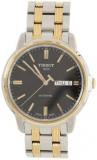
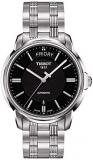
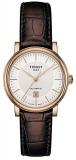
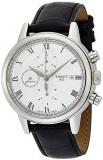
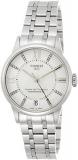
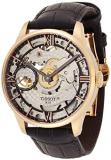
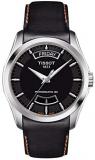
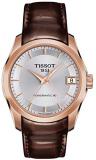
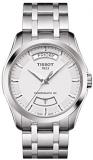
The Tissot PRX Automatic answers a specific gap in the modern watch market: the demand for an affordably priced, genuinely thin, integrated-bracelet sports watch that does not compromise on horological substance. While many brands reserve this stylistic language for precious metal limited editions, Tissot has engineered the PRX to deliver that same visual architecture in a 316L stainless steel package measuring just 40mm in diameter.
This model is not merely a stylistic exercise. By housing the Swiss automatic movement within a case that echoes the angular case designs of the late 1970s, Tissot creates a bridge between historical design codes and contemporary mechanical reliability. The result is a timepiece that functions as a daily wearer for the office, yet offers an engaging mechanical view through its see-through caseback.
The Architecture of the Integrated Bracelet
The defining physical characteristic of the PRX Automatic is its flat, tonneau-shaped case geometry. Unlike conventional round watches where the lugs curve downward to meet the strap, the PRX employs a rigid, integrated connection where the case flows directly into the first link of the bracelet. This design requires extremely tight tolerances; any misalignment between the case and bracelet would break the continuous visual line.
Tissot manages this transition with a satin-brushed finish on the case flanks and polished bevels that trace the top edges. The bracelet itself mirrors this finishing, alternating between wide brushed links and narrow polished intermediate links. This interplay of light and texture prevents the steel from appearing like a monolithic block, instead giving the watch a jewellery-like presence that suits both formal suiting and casual knitwear.
The practical benefit of this construction is comfort. Because the caseback is relatively flat and the bracelet’s first link articulates sharply downward, the watch sits low against the wrist bone. For those who prefer the feel of a classic luxury sports watch, the Tissot brand applies this ergonomic thinking consistently across its lines, from dive-inspired models to vintage re-editions such as the Tissot Heritage collection.
Powermatic 80 Movement: Engineering Autonomy
At the heart of the PRX Automatic sits the Powermatic 80 calibre, a movement that has shifted expectations for entry-level Swiss automatics. According to official Tissot specifications, this movement delivers a power reserve of up to 80 hours. This figure is significant not just for weekend wearability, but because it indicates a lower oscillation frequency and a redesigned mainspring barrel that reduces stress on the gear train.
The movement’s regulation is equally notable. Tissot states that the standard Powermatic 80 is regulated to a precision of plus or minus 7 seconds per day, with a base rate adjusted at plus 3 seconds allowing for a daily variation between minus 4 and plus 10 seconds. While this is not certified chronometer territory, these tolerances are tighter than many quartz alternatives and certainly sufficient for daily timekeeping.
From a technical perspective, the multi-function module found in Tissot Touch models gives way here to a purist approach. The PRX Automatic offers a date aperture at 3 o’clock and no other complications. This spareness is intentional; it keeps the dial symmetrical and allows the wearer to appreciate the movement through the sapphire crystal caseback without obstruction. For collectors who appreciate mechanical transparency, the anti-reflective coating on the front sapphire crystal also ensures the industrial finishing inside is visible under varied lighting.
Historical Context and Design Provenance
The “PRX” nomenclature is derived from two distinct concepts: “PR” for precise and robust, and “X” representing the Roman numeral for ten, alluding to the case’s intended water resistance depth of 100 metres. The original inspiration dates back to 1978, a period when the watch industry was experimenting with quartz technology and angular, futuristic case shapes.
Tissot has not simply reissued a vintage design; it has reinterpreted it using modern manufacturing standards. The 40mm case width is a deliberate middle ground. It provides enough surface area for legibility on larger wrists without overpowering slimmer wrists, a balancing act that many modern integrated bracelet designs fail to achieve.
Within the broader context of Swiss watchmaking, the PRX Automatic sits in a specific niche. It is more dressy than a dive watch but more robust than a traditional leather-strap dress watch. The PRX uses a flat sapphire crystal and cold steel to assert a modern, architectural point of view. It acknowledges history without being enslaved by it.
The Dial and Legibility Matrix
The dial of the PRX Automatic is defined by its horizontal brushed finish, often referred to as a sunray effect when viewed under directional light. In the blue and green variants, this texture creates a dynamic gradient that shifts from deep saturation at the edges to a brighter centre. The applied indices are faceted and polished, catching the light to ensure readability even at a glance.
A notable design decision is the absence of numerals. The dial relies entirely on baton markers with a double baton at 12 o’clock. The date window is subtly recessed and framed by a thin metallic border, integrating it into the dial rather than leaving it as a punched hole. This attention to detail is usually reserved for watches at much higher price points.
- Case Material: 316L stainless steel with brushed and polished finishing
- Crystal: Scratch-resistant sapphire with antireflective coating
- Caseback: See-through sapphire crystal
- Water Resistance: 100 metres (10 bar)
- Bracelet: Interchangeable quick-release system
The interchangeable bracelet system is a practical feature. It allows the wearer to swap the steel bracelet for a leather strap without tools. This adaptability means the PRX Automatic can transition from a boardroom aesthetic to a more relaxed weekend look, a quality that echoes the versatility enthusiasts admire in models like the TAG Heuer Carrera for different social settings. It is this chameleon-like quality that extends the watch’s utility far beyond a single purpose.
Wearing Experience and Market Positioning
On the wrist, the PRX Automatic has a substantial feel without being heavy. The bracelet articulates smoothly, and the butterfly clasp with push-buttons sits flush against the underside of the wrist. Because the case is just 10.9mm thick, it slides easily under a shirt cuff, a crucial consideration for those who wear formal attire daily.
The 40mm size is complemented by a relatively short lug-to-lug distance, which means the watch does not overhang the wrist even on smaller wrist sizes. This is a common pitfall in integrated bracelet designs, where the first link acts as a de facto lug. Tissot has mitigated this by keeping the case profile compact.
In terms of market positioning, the PRX Automatic occupies a space where few Swiss automatics reside. It competes not just with other steel sports watches, but with quartz alternatives from fashion brands. The difference is the Powermatic 80 movement and the sapphire crystal. These are tangible, long-term durability assets. While the initial purchase price is higher than a basic quartz PRX, the absence of battery changes and the inherent longevity of a mechanical movement represent a different value equation.
Precision in an Era of Disposability
The Tissot PRX Automatic represents a specific philosophy: that a watch can be a precision instrument and a style object without being a fragile heirloom. By coupling the high-accuracy, 80-hour Powermatic 80 calibre with a robust, 100-metre water-resistant steel case, Tissot creates a tool that is designed for daily continuity rather than occasional display. For the wearer who values the tactile engagement of an automatic movement but requires the durability of a modern sports watch, the PRX Automatic offers a coherent and technically sound solution that respects both the history of horology and the realities of contemporary life.