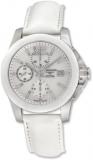
The Longines DolceVita traces its visual identity to a rectangular case profile that the brand first explored in the 1920s, an era when shaped watches openly challenged the round-case orthodoxy of European horology. That archival reference point gives the collection a distinct wrist presence, one that separates it from the endless field of circular dress watches.
Fewer and fewer houses commit to non-round case geometry in their core lines, which makes the DolceVita something of a rarity among contemporary Swiss dress watches. The Art Deco sensibilities behind its proportions stay legible in every reference, whether the watch runs on a quartz calibre or a self-winding mechanical movement.
A Rectangular Case Rooted in 1920s Design Language
Longines states that the DolceVita was inspired by a model from the 1920s, and that lineage shows in the elongated case proportions and stepped lugs. The design vocabulary belongs to Art Deco, a movement that favoured geometric clarity, symmetry, and restrained ornamentation over the flowing curves of earlier decorative styles.
Rectangular cases present real engineering challenges that round cases avoid. The movement must sit inside a confined, asymmetrical space, the crystal has to be cut and fitted precisely to prevent corner distortion, and the caseback must seal evenly along a non-circular perimeter. Longines meets these demands across several case dimensions, from compact ladies’ references measuring 23.30 x 37.00 mm to larger automatic models at 28.20 x 47.00 mm. Scratch-resistant sapphire crystal protects the dial on the references documented in the brand’s official catalogue, and water resistance is rated at 3 bar across the range.
Quartz and Automatic: Two Distinct Ownership Experiences
The DolceVita collection splits into two clear mechanical paths, and understanding the difference matters before choosing a reference. Quartz versions such as the L5.512.4.75.2 keep the case notably slim, which suits the rectangular profile particularly well. These references appeal to buyers who want a grab-and-go dress watch with minimal maintenance obligations. An alligator strap is fitted on this reference, paired with a white dial and stainless steel case.
Automatic references including the L5.757.4.71.0 and L5.757.4.71.6 house a self-winding movement with a power reserve of up to 45 hours, as specified by Longines. The silver flinqu茅 dial on these models introduces a textured surface that interacts with light differently from a flat finish, giving the rectangular case an extra layer of visual depth. Both automatic references measure 27.70 x 43.80 mm and use stainless steel cases.
The automatic route suits collectors who value mechanical craftsmanship and the tactile connection that comes with a sweeping seconds hand. The quartz route suits wearers who prioritise convenience and a thinner profile. Neither represents a compromise in design intent, since the rectangular case geometry remains consistent across both families.
Dial Finishes and Material Choices Across the Range
Longines markets the DolceVita as available in a wide range of materials and colours, and the catalogue bears this out. The silver flinqu茅 finish appears on automatic models, while quartz references offer white dials and other variants. Case materials extend to stainless steel and precious metal options, and strap choices include alligator leather in multiple tones.
- Quartz references: Slimmer case profiles, lower maintenance, accessible entry point
- Automatic references: 45-hour power reserve, silver flinqu茅 dials, mechanical movement
- Case sizes: From 23.30 x 37.00 mm to 28.20 x 47.00 mm
- Water resistance: 3 bar across documented references
- Crystal: Scratch-resistant sapphire
The breadth of the line means the DolceVita functions as a collection rather than a single watch. A buyer seeking a petite, jewellery-like piece will find references that fit that brief, while someone wanting a larger rectangular automatic with a textured dial can locate one within the same family.
How the DolceVita Positions Itself Among Swiss Dress Watches
The rectangular dress watch segment is small, dominated by a handful of historic names. The DolceVita competes on design authenticity rather than complication count or sporting capability. It is a watch with no dive rating, no chronograph, and no GMT function. Its proposition is purely aesthetic and horological, centred on the integrity of its proportions and the quality of its finishing.
Wearers who appreciate this category often explore it alongside other classic collections that value form over feature density. The dress watch tradition that the DolceVita belongs to overlaps with heritage-focused lines elsewhere in Swiss watchmaking, where case shape and dial execution carry more weight than spec sheets. For those drawn to refined, occasion-driven timepieces, Longines remains a natural reference point, while the rectangular purity of the DolceVita stays its own distinct statement.
Wearing the DolceVita: Fit, Proportion, and Occasion
Rectangular cases sit differently on the wrist than round ones. The 27.70 x 43.80 mm automatic references cover a significant vertical span along the forearm, which means lug-to-lug fit matters more than diameter might suggest. The compact quartz models at 23.30 x 37.00 mm sit closer to a traditional ladies’ watch footprint.
The slim profile of the quartz variants allows them to slide beneath a shirt cuff without resistance. Automatic models run thicker due to the rotor and mainspring assembly, yet remain within dress watch tolerances. Alligator straps on the documented references contribute to a formal presentation that pairs naturally with business attire and evening wear.
Water resistance at 3 bar means the watch handles splashes and rain but should not be worn for swimming. This is a consideration for buyers accustomed to sports watches who may need to adjust expectations. The DolceVita is built for the desk, the dinner table, and the theatre, not the pool.
Why the DolceVita Endures in a Round-Watch Market
The watch industry cycles through trends, yet the rectangular dress watch has maintained a persistent niche because it signals a deliberate choice. A wearer who selects a DolceVita over a round alternative is prioritising architectural form and historical reference over conformity. That intent is precisely what gives the collection its staying power.
Longines frames the DolceVita as a meeting point between heritage and contemporary wearability. As the brand continues to draw on its 1920s archive while accommodating modern case materials and mechanical reliability, the collection carries a design conversation forward. For anyone building a wardrobe of watches rather than accumulating devices, this piece occupies a role that few others fill with the same conviction.