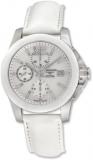
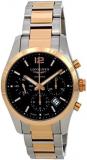
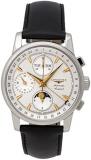
The Longines chronograph family centres on a simple proposition: a mechanical stopwatch function executed with Swiss discipline and a dial layout that remains readable at a glance. Longines has produced timing instruments since the early twentieth century, and the modern range carries that lineage forward through calibres that beat at 28,800 vibrations per hour, silicon balance-springs on selected references, and power reserves cited by the brand at roughly 66 to 68 hours on models such as the Spirit Chronograph and the Master Collection Chronograph.
That combination matters for anyone who actually uses the chronograph rather than simply admiring it. A pusher that engages cleanly, a reset that snaps back to zero without hesitation, and a sub-dial layout that can be read in peripheral vision are the details that separate a functional instrument from a decorative one. The Longines collection favours restraint in case geometry and clarity in dial design, which is why it has remained consistent across generations.
The Engineering Behind Longines Chronograph Movements
At the heart of the range sits a family of self-winding and manual-winding calibres built for durability. Longines states that several chronograph movements incorporate a monocrystalline silicon balance-spring, a component that improves resistance to magnetic fields and temperature variation. The practical effect is steadier rate-keeping in environments where a watch is exposed to laptops, speakers, and the general electromagnetic noise of daily life.
Actuation quality is equally deliberate. The pushers are tuned to deliver a tactile response that is neither vague nor stiff, and the vertical clutch or cam-actuated engagement on different references determines how the central seconds hand starts and stops. On flyback-equipped models such as the Spirit Pilot Flyback, a single push restarts the chronograph immediately, a function originally developed for pilots who needed to begin a new timing sequence without cycling through stop and reset.
Power reserve is another area where the Longines specification sheet reads well against segment expectations. A reserve in the region of 66 hours means the watch can be set down on a Friday evening and picked up on Monday morning still running. For owners who rotate several pieces, that margin removes the ritual of resetting the time and date before every wear.
Design Language and Case Architecture
Longines chronograph cases are predominantly stainless steel, with diameters typically falling between 39mm and 42mm. That range suits a broad span of wrist sizes without drifting into oversized territory. Case thickness is managed carefully given the complexity of a chronograph movement, and the resulting profiles slide under a shirt cuff without the bulk that plagues some competitors in the segment.
Finishing alternates between brushed flanks and polished bezels or lug surfaces. The transitions are executed cleanly, and sapphire crystal with anti-reflective treatment is standard across most references, keeping the dial legible from oblique angles. Water resistance varies by line: dress-oriented Master Collection chronographs are rated to 3 bar, which handles rain and handwashing but not swimming, while sport-focused references carry higher ratings that buyers should confirm for their specific reference.
Dial Layout and Legibility
The Spirit Chronograph uses a bi-compax arrangement, placing two sub-dials in a symmetrical layout with a date window that does not disrupt the balance. The Master Collection Chronograph Moonphase adds an astronomical display at 6 o’clock, layering a moonphase over the chronograph registers in a more formal package. Applied indices and polished hands create strong contrast, and luminescent treatment on the hands and markers supports low-light reading.
Materials and Surface Finishing
Beyond the case, Longines applies consistent finishing standards to bracelets and straps. Steel bracelets feature brushed links with polished centre elements, and leather straps are typically paired with deployant clasps on dress references. The overall impression is of a watch that has been specified to a price rather than down to one, with no obvious shortcuts in the visible surfaces.
Heritage and Market Positioning
Longines has been producing chronographs since the early twentieth century, and its archive includes the 13ZN and 30CH movements, both regarded as significant chapters in the development of the mechanical chronograph. The contemporary collection references that history through proportion and dial restraint rather than full vintage reissues, which keeps the watches wearable in a modern context.
Within the accessible Swiss chronograph segment, Longines sits alongside several established names. The Omega Speedmaster, also part of the Swatch Group, occupies a distinct cultural position tied to space exploration and a hand-wound tradition. Longines chronographs tend to emphasise everyday versatility and classical proportions instead, which makes them easier to wear across both business and casual settings.
Buyers comparing options should weigh movement type, case proportions, and dial complexity against their own habits. A manual-winding flyback calibre rewards daily interaction, while a self-winding movement suits those who prefer to set the watch and forget it. Neither approach is inherently superior; the decision comes down to how the owner intends to use the chronograph function.
Practical Ownership Considerations
Mechanical chronographs require periodic servicing, typically every five to seven years, to maintain lubrication and correct function of the chronograph mechanism. Longines maintains a global service network, and reference-specific user manuals outline operating procedures and care recommendations. Factoring servicing into the total cost of ownership is sensible for any mechanical watch in this price bracket.
Case size deserves attention during the buying process. A 42mm chronograph wears differently depending on lug-to-lug distance and case thickness, and trying a reference on the wrist remains the most reliable way to judge fit. Buyers who prefer a more compact profile may find the 39mm and 40mm references better suited to smaller wrists, while the larger options provide more dial presence.
Strap and bracelet choice also affects the wearing experience. A steel bracelet adds weight and a sportier character, while a leather strap lightens the watch and shifts it toward formal territory. Many owners alternate between the two depending on the occasion, which extends the versatility of a single reference.
Why the Longines Chronograph Remains Relevant
The collection endures because it does not chase short-lived trends. The designs are grounded in functional requirements: clear timekeeping, dependable chronograph operation, and comfortable wear across a range of situations. That consistency has kept the range relevant across decades and continues to attract buyers who value mechanical engineering over novelty.
For anyone assembling a collection, a Longines chronograph fills a specific role. It offers Swiss mechanical craftsmanship, a genuine timing function, and a design language that does not demand attention. The watches work equally well with a suit, a casual jacket, or a weekend shirt, which is a harder balance to strike than it appears.
The Longines chronograph range succeeds on fundamentals rather than spectacle. Robust movements, well-proportioned cases, and legible dials are not headline features, but they are precisely what make a chronograph useful over years of ownership. For buyers seeking a Swiss mechanical chronograph that balances heritage, performance, and value, the Longines collection remains a considered and rewarding choice.