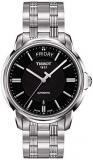
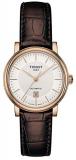
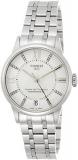
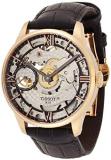
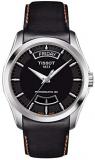
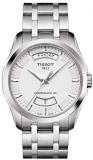
The Tissot 1853 automatic carries a founding year on the dial, and that single detail explains more about the watch than any specification sheet. Le Locle, 1853: the date marks when the maison moved from scattered cottage workshops into organised industrial production, standardising components and exporting reliable pocket watches at scale. A modern automatic wearing that number inherits a specific position in the brand’s own narrative, sitting closer to the core of what the company believes about itself than any trend-driven sub-line could.
That archival weight is precisely why the reference deserves a place on the shortlist of anyone assembling a first serious mechanical collection. The Tissot brand’s catalogue runs from entry-level quartz to heritage reissues, and the 1853 automatic occupies the point where history and everyday usability intersect most usefully.
What the 1853 Date Signals on the Dial
Very few watchmakers can print a founding year and have it mean something. When Tissot’s factory opened in 1853, Swiss watchmaking was mid-transition from hand-finished cottage work to organised industrial output. The 1853 inscription is therefore not decorative nostalgia; it is a compressed reference to a period of standardisation, when interchangeable components and scaled production made reliable watches attainable for a far wider public. Wearing the 1853 automatic is, quietly, wearing a piece of that industrial history on the wrist.
Founding-year references also tend to anchor a brand’s identity in a way that pure model names do not. A watch marked 1853 is placed, by its own maker, near the centre of the maison’s self-image rather than at the periphery of a seasonal trend.
Inside the Powermatic 80 Movement
The automatic calibre at the heart of the 1853 range is built around the Powermatic 80 architecture, a Tissot-developed family of self-winding movements engineered to extend running autonomy without inflating case thickness. The headline figure is an 80-hour power reserve, which means the watch can be set aside on a Friday evening and still be running accurately on Monday morning. Tissot’s own movement documentation states that the Powermatic 80 family delivers up to 80 hours of power reserve, and that extended window is the single most practical argument in favour of the calibre.
- Winding type: automatic, with a rotor driven by wrist motion and manual winding as a backup
- Power reserve: up to 80 hours per Tissot’s published movement specifications
- Frequency: a lower beat rate engineered to stretch autonomy between services
- Construction: Swiss-assembled, with an escapement designed for long-term stability
Conventional automatics at this price point typically deliver 38 to 42 hours of reserve, which forces owners into a nightly winding ritual or constant wear. Doubling that window changes the ownership experience: the watch becomes genuinely rotation-friendly, comfortable on a desk for a weekend, and forgiving of an occasional missed day on the wrist. It is a specification that quietly matters more than any decorative flourish.
Case Proportions and Wearability
Tissot’s published dimensions for automatic pieces in this family cluster around the 40 mm mark, with case thickness in the region of 11 to 12 mm and lug widths near 21 mm in the Gentleman references. Those numbers describe a watch that sits comfortably inside the modern universal-fit bracket: large enough to read clearly at a glance, slim enough to slide under a cuff, and proportioned so the lug-to-lug span does not overhang a standard wrist. The resulting silhouette prioritises balance over spectacle.
Case finishing alternates between brushed surfaces and polished bevels, a treatment that gives the watch visual depth without demanding attention. Water resistance on comparable Tissot automatic models is rated for everyday exposure rather than diving, a sensible match for a design intended for office, travel, and evening wear alike. The bezel is deliberately understated, letting the dial and the 1853 signature carry the identity.
Dial Design and Legibility
Dial architecture follows a conservative brief: applied indices, slim baton hands, and a clean outer track that frames the hour markers without clutter. Applied markers catch light along their polished edges, adding a subtle liveliness to the face without resorting to sunburst theatrics. The date window, where present, is integrated into the marker ring rather than dropped into an arbitrary position, keeping the dial’s symmetry intact.
Contrast between handset and dial is high, the minute track is clearly graduated, and the absence of oversized sub-registers means the primary time-telling function is unimpeded. It is a face designed for reading at a glance, not for photographing on a macro lens.
Strap and Bracelet Options
How the 1853 automatic is fitted to the wrist depends on the variant, but the two dominant approaches are leather and steel. Leather straps soften the watch’s formality and add warmth, while a brushed steel bracelet pulls the design toward sporty versatility and makes the piece feel more robust in daily use. The lug geometry across Tissot automatics accepts a broad aftermarket ecosystem, so owners can shift between dress and casual registers without changing watches. That flexibility is a meaningful practical advantage at this level.
Quick-release spring bars, where fitted, simplify the swap. Even without them, the standard widths used across the range mean replacement straps are widely available and comparatively inexpensive to source.
Where the 1853 Automatic Sits in the Tissot Line
The range functions as Tissot’s accessible entry into serious mechanical watchmaking. It occupies a distinctly traditional space, closer in spirit to dress-oriented references than to the sportier chronograph-heavy Tissot T-Sport, and it shares the historically minded design language of the Tissot Heritage line. Buyers weighing this model against siblings should think in terms of register: the 1853 leans formal and archival, while other collections lean technical or sporting.
Service costs and spare parts are also predictable, because the movement family is widely supported across the Swiss service network. Long-term ownership is therefore less of a commitment than the word automatic sometimes implies, and resale interest in clean, documented examples stays steady.
Buying Considerations and Verification
Because founding-year references attract a broad mix of genuine, refurbished, and unconvincing listings, buyers should verify the caseback reference number against Tissot’s published technical data before completing any purchase. Movement smoothness, the sweep of the seconds hand, and the crispness of the winding action are all reliable indicators of a healthy Powermatic calibre. Documentation and original packaging remain the most defensible markers of provenance. For collectors who value transparency, requesting a movement photograph is never an unreasonable ask.
A founding year with real industrial meaning behind it, a genuinely modern 80-hour movement, and a design brief that respects its own history rather than borrowing from whatever is fashionable this season: for a first mechanical watch, or a considered addition to a rotation, that combination is difficult to argue with.