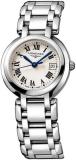
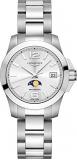
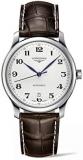
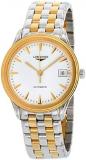
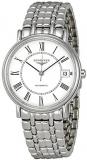
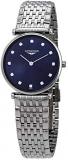
The Longines Prima Luna moonphase reference L8.126.5.79.7 measures 34.00mm across and combines a stainless steel case with an 18 karat yellow gold cap. That mix of metals, executed with a warm gold bezel against a cooler steel body, sets the tone for a series that Longines has positioned squarely in the women’s dress watch segment. The result is a watch that reads as formal without drifting into fragility.
Moonphase complications occupy a particular place in traditional watchmaking. Their display mechanism relies on a disc that advances one tooth per day through a reducing gear train, completing a full lunar cycle roughly every 29.5 days. Getting that progression to track the synodic month accurately with a mechanical movement demands careful ratio work in the calibre design. Watches of this type remain a niche product rather than a volume category, and few affordable examples pair the complication with a case this compact.
The Prima Luna line extends beyond this single reference. Longines offers the moonphase in several case materials and dial treatments, including opaline ivory dials and two-tone configurations, alongside time-and-date versions of the same platform. That breadth matters for buyers comparing dress watches, because the series supports both a simple everyday option and a more decorated moonphase model without changing the underlying case geometry.
Movement and Mechanical Specifications
The calibre inside the Prima Luna moonphase is a self-winding mechanical movement beating at 25,200 vibrations per hour. From a horological standpoint, that frequency represents a considered compromise: it sits above the common 21,600 vph rate used in many entry-level automatics, which improves the balance wheel’s resistance to positional variation, yet it remains below 28,800 vph, reducing wear on components and often extending service intervals.
A monocrystalline silicon balance-spring appears in the specification for the moonphase reference. Silicon has become one of the more consequential material developments in modern mechanical watchmaking, largely because it is diamagnetic and therefore immune to the timing drift that magnetised hairsprings cause. Silicon is also lighter than steel alloy and resists temperature-related elasticity changes, which helps rate stability across seasons. Its presence here positions the movement above what the case material mix alone might suggest.
Power reserve is rated up to 72 hours. Three days of autonomy means the watch can sit unworn over a weekend and still run accurately when picked up again, an advantage for anyone rotating several pieces. The movement drives a date indication in addition to the moonphase display, and Longines specifies water resistance to 3 bar. That rating covers handwashing, rain and splashes but does not accommodate swimming, which is consistent with the dress watch brief.
Crystal specification is worth flagging separately. The sapphire is scratch-resistant and carries several layers of anti-reflective coating on both sides. Double-sided AR treatment is a detail that tends to distinguish higher-tier finishing from standard practice, because coating the inner surface as well as the outer one eliminates the pale reflections that otherwise veil a dial in bright light. The practical effect is a dial that appears to float slightly behind the glass rather than sit beneath it.
Case Design and the Gold-and-Steel Formula
The two-tone construction deserves attention because it changes how the watch behaves across a wardrobe. A full yellow gold case pushes a dress watch toward evening and ceremony; a full steel case keeps it casual. Combining an 18 karat yellow gold cap with a stainless steel body produces something more flexible, and the proportion of gold to steel determines whether the result leans warm or reserved.
Longines has long used two-tone treatment across its collections, and the technique carries a genuine manufacturing dimension. The gold cap is produced as a distinct component rather than a thin electroplated layer, which means the warm tone will not wear through in the way plating can after years of contact with sleeves and desk edges. Anyone who has owned a plated watch and watched the colour fade at the lugs will recognise why this distinction matters.
At 34.00mm, the case aligns with conventional proportions for women’s dress watches rather than following the recent drift toward oversized cases. That diameter sits comfortably within the range that reads as elegant on smaller wrists while avoiding the miniature scale that can compromise legibility. Case height and lug geometry are not specified in the available material, so buyers evaluating fit should confirm dimensions with a retailer or through official documentation.
The Moonphase Dial and Reading the Complication
The moonphase aperture itself is the emotional centre of the watch, and its design lineage reaches back to astronomical clocks and pocket watches of earlier centuries. The display typically shows a pair of moons rotating through a window shaped like a crescent arc, framed by stars. Executed well, the aperture sits in balance with the rest of the dial rather than dominating it.
Dial variants across the Prima Luna moonphase range include opaline ivory finishes, which use a treatment that scatters light softly and produces a depth difficult to achieve with flat lacquer. Applied indices and slender hands are typical of the series, keeping the composition open and legible despite the smaller case. Legibility in a moonphase watch requires restraint: too many elements around the aperture and the phase display becomes difficult to read at a glance.
Display Architecture
Reading a moonphase requires a small adjustment in expectation. The complication tracks the lunar cycle, not the calendar month, so the display drifts by roughly one day every two and a half years relative to the real sky. Most owners correct it occasionally using a pusher or crown setting rather than treating it as an astronomical instrument. Understanding this makes the feature easier to appreciate as decoration with mechanical substance rather than as a precision tool.
Setting and Care Considerations
Owners should note a general rule that applies to most moonphase mechanisms: avoid adjusting the complication during the hours when the changeover gearing is engaged, typically in the evening and overnight window. Forcing the display during that period can damage the disc drive. Longines documents the correct setting procedure for each reference, and following the manufacturer’s instructions protects a mechanism that is fiddly to service.
For readers weighing this model against other traditional dress pieces, the Longines collection itself offers the most direct point of comparison, since the Prima Luna shares its classical design language with the brand’s wider dress and heritage families. Those stablemates serve a related purpose at different price points, while the Prima Luna leans deliberately toward femininity in scale and detailing rather than purely historical revival.
Ownership Experience: Wearing and Living With It
A 3 bar water resistance rating is the specification that shapes daily use most. It suits the watch to office wear, dinners and travel, but it rules out pool and shower wear. Buyers considering a single watch for all occasions should weigh that limit honestly. For a dress watch kept in rotation, the constraint rarely becomes a practical issue, and the thin two-tone case rewards that narrower role.
The sapphire crystal with double-sided anti-reflective coating reduces glare considerably, which matters more than it might seem in a watch with an aperture display. Moonphase discs and applied indices sit close to the surface, and stray reflections can flatten the dial’s sense of depth. Owners frequently mention the clarity of sapphire with proper coating as one of the tactile pleasures of wearing a well-finished dress watch.
Service expectations follow mechanical norms rather than quartz ones. A self-winding movement with a moonphase module requires specialist attention, and routine servicing intervals typically span several years rather than decades. Anyone buying a moonphase as a first mechanical watch should budget for that maintenance rhythm from the outset, since the complication adds a step to any overhaul compared with a simple three-hand calibre.
Positioning Within the Longines Catalogue
Longines has built its contemporary identity around accessible Swiss watchmaking with long historical roots, and the Prima Luna sits within that framework rather than apart from it. The brand’s archives stretch back to the nineteenth century, and it has consistently used classical watchmaking references as a design language. The collection as a whole includes simpler timepieces alongside the moonphase, which gives the series a coherence across price and complexity tiers.
What distinguishes the moonphase reference within the line is the combination of three elements that rarely appear together at this level: a silicon balance-spring, a 72-hour power reserve and a genuine astronomical complication in a compact two-tone case. Each is available separately in various watches; the conjunction is the argument. Buyers who want a dress watch with mechanical interest rather than pure ornament will find the specification list more substantial than the design-first framing suggests.
For a broader view of what the manufacturer produces across its families, the Longines range covers sport, dress and heritage segments under one house signature, and exploring that breadth clarifies where the Prima Luna fits. It is not the brand’s technical flagship, nor is it intended to be; it is a well-specified women’s dress watch that takes its mechanical obligations seriously.
That balance between decoration and engineering defines the series. The moonphase aperture draws the eye, the two-tone case carries the elegance, and beneath both sits a movement designed to resist magnetism and hold time across a weekend off the wrist. In a category where many watches stop at appearance, the specification sheet makes the case for lasting interest, and that is the strongest argument for considering the Prima Luna as a long-term companion rather than a seasonal accessory.