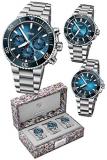
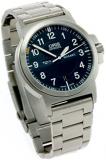
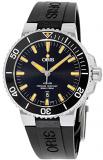
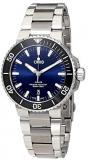
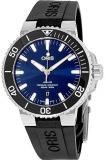
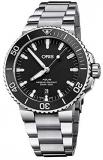
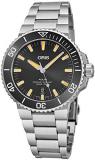
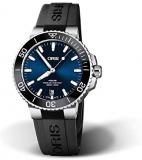
The Oris ProDiver carries a water resistance rating of 100 bar, equivalent to roughly 1,000 metres, inside a multi-piece titanium case measuring 49.00 mm across. That combination of extreme pressure tolerance and lightweight construction places it among the more specialised instruments in the Oris catalogue, a series built for saturation divers rather than desk-bound collectors. The watch exists in several expressions, including a three-hand Date, a Chronograph, and a GMT variant, each sharing the same oversized titanium architecture and the same uncompromising approach to underwater legibility.
Understanding what separates this line from ordinary dive watches requires attention to how the case is assembled, how the movement is specified, and how the design prioritises function over decoration. The details below trace those decisions through the series.
Titanium Architecture and Case Engineering
The defining material choice here is titanium, and it is not a cosmetic one. A 49.00 mm steel case at 16 mm thickness would carry substantial wrist weight; the multi-piece titanium construction keeps this large format wearable while retaining the tensile strength needed for deep-water service. The case is built from several components rather than a single machined block, a method that allows Oris to achieve secure sealing at the crystal and caseback interfaces while maintaining the angular, tool-like silhouette associated with professional dive instruments.
The interhorn measurement of 26 mm reflects the watch’s scale: a wide lug spacing accommodates a substantial strap or bracelet, distributing the mass of the case across the wrist rather than concentrating it. On titanium bracelet versions, the matching metal continues that balance; on rubber-equipped references, the ceramic minutes scale on the bezel insert adds a hard, scratch-resistant surface for tracking elapsed bottom time. The unidirectional rotating bezel is a functional requirement rather than styling, allowing a diver to mark decompression or dive duration without ambiguity.
Movement Specifications Across the Series
The Date reference, 01 733 7646 7154-07 8 26 71PEB, runs on an automatic winding calibre with a 25.60 mm diameter and the 11 1/2 ligne format common to robust diver movements. Automatic winding eliminates crown manipulation during a dive, reducing the risk of an unsealed crown tube, and it suits a tool watch expected to run continuously across a working season.
The Chronograph reference, 01 774 7683 7154-Set, shares the automatic winding architecture but adds a chronograph module, running at 28,800 vibrations per hour, or 4 Hz. That frequency provides the beat stability needed for stopwatch accuracy, and the movement is finished with a red rotor, a visual signature Oris applies to its in-house-adjacent calibres. The GMT reference, 01 748 7748 7154-07 4 26 74TEB, uses a different calibre family with a 24-hour indication, a configuration suited to travelling divers who need to track a second time zone alongside bottom time.
- Date model: Automatic winding, 25.60 mm calibre, 11 1/2 ligne format
- Chronograph model: Automatic with red rotor, 28,800 A/h, 4 Hz
- GMT model: Automatic calibre 748 with second time zone indication
- Shared platform: 49.00 mm titanium case, 100 bar water resistance
Across all three, the winding system and rate specifications point to the same design intent: the movement must be serviceable, shock-tolerant, and reliable under the vibration and temperature shifts a working dive environment imposes.
Water Resistance and Real Dive Utility
A 100 bar rating is a deliberate statement. Most recreational dive watches settle at 200 or 300 metres; the ProDiver’s 1,000-metre class positions it for saturation diving and professional offshore work, where a watch may be exposed to helium-rich atmospheres and extended pressure cycles. The robust caseback sealing and the screw-down crown arrangement are the mechanical means by which that rating is achieved, and the case thickness of roughly 16 mm exists partly to accommodate the gaskets and thread depth required.
This has practical consequences for daily wear that a buyer should weigh honestly. The ProDiver is a large watch, and on a slimmer wrist the 49 mm case and 54 mm lug-to-lug span will overhang. It is not designed to slip under a shirt cuff. Its value proposition is a genuine instrument grade of pressure tolerance in a titanium package that weighs less than its dimensions suggest, and that trade-off is precisely the point for the diver, offshore technician, or tool-watch enthusiast who values capability over versatility.
Legibility, Bezel, and Dial Design
The black dial found across the series is a legibility decision before it is an aesthetic one. High-contrast hands and applied markers allow quick reading in low light, a necessity at depth where ambient illumination falls away. The ceramic minutes scale on the bezel of the GMT reference provides a hard surface that resists the abrasion that bezel inserts typically accumulate, and the engraved numerals remain readable after years of use.
The architectural language of the case, with its angular lugs and pronounced crown guards, follows the same reasoning: every element serves sealing, protection, or grip. The ProDiver does not attempt to disguise its purpose as a dress piece. Its design lineage connects to the broader world of professional dive instruments, a category where the Breitling Superocean Heritage collection also participates, though with a distinctly more heritage-oriented aesthetic. Where the Oris emphasises raw depth rating and titanium mass reduction, the Breitling line leans toward vintage silhouette references.
The rubber strap references, identifiable by the 74TEB and 71PEB suffix patterns, pair naturally with wetsuit use, while the titanium bracelet options suit surface intervals and everyday wear. Oris supplies waterproof presentation packaging with the Chronograph set, a detail that reflects the series’ positioning as a complete diving kit rather than a showroom object.
Positioning Within the Oris Range and Beyond
The ProDiver sits at the extreme end of the Oris depth hierarchy, well beyond the brand’s more accessible dive models. That positioning is worth understanding alongside the Oris brand’s broader portfolio, where the ProDiver functions as the technical flagship for saturation-rated capability. Buyers comparing it against mainstream 300-metre divers are comparing different categories of instrument.
Within the wider market, several series occupy adjacent ground. The Omega Seamaster series offers a comparable professional diving pedigree with a 300-metre rating and a broader range of case sizes, while the Rolex Yacht-Master line occupies the luxury-sports niche with a different emphasis on materials and finishing. The Oris differentiates through titanium construction, a 49 mm format that prioritises legibility and pressure tolerance, and a price positioning that undercuts the luxury dive segment substantially for a comparable depth rating.
For those who want a large-format tool watch with genuine saturation credentials, the ProDiver represents a coherent engineering statement. For those seeking a slimmer, cuff-friendly daily wearer, other options in the dive category will serve better. The distinctions are matters of specification and intent, not of quality.
Serviceability, Ownership, and Long-Term Value
Automatic movements at this level require periodic servicing, typically on a multi-year interval depending on use. The titanium case construction and multi-piece assembly mean that gasket replacement and pressure testing are part of the ownership routine for any diver relying on the 100 bar rating in the water. Oris maintains a service network that handles these procedures, and the robust calibre architecture across the Date, Chronograph, and GMT references keeps servicing straightforward compared with more complex complications.
The finishes across the series are utilitarian: brushed titanium surfaces dominate, with the red rotor providing the one internal flourish. That approach ages well in the sense that scratches on brushed titanium blend rather than stand out, which suits a tool watch used as intended.
Who Should Consider the Oris ProDiver
The series suits three broad groups. The first is the working or technical diver who needs a real 1,000-metre rating and values titanium’s weight reduction during long bottom times. The second is the serious tool-watch collector interested in purpose-built instruments rather than lifestyle pieces, a group for whom a 49 mm case is an acceptable trade for the engineering it houses. The third is the enthusiast drawn to the Chronograph or GMT variants for their added functions, where the core platform’s pressure tolerance is a welcome byproduct rather than the primary draw.
Those with smaller wrists, those who need the watch to fit under a shirt cuff, or those who prioritise dress versatility should look elsewhere. The ProDiver is an instrument, and instruments carry their specifications visibly. Judged on that basis, its combination of titanium construction, a 100 bar rating, and a thoughtfully specified automatic movement makes it a compelling option for anyone who needs a watch built to go deep and stay accurate while it does.