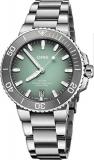
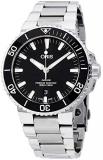
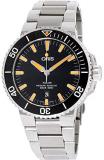
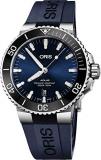
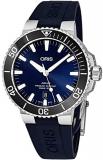
The Oris Aquis Date is built around a single, rigorous idea: a dive watch should be wearable every day, not just on the days it gets wet. That principle shows most clearly in the case dimensions of the current generation, which measure 41.5mm across, roughly 12.5mm thick, and about 47mm from lug to lug, proportions that slide under a shirt cuff as easily as they clear a wetsuit sleeve.
The Aquis line has become the reference point for Oris in the sports-watch segment, and the Date remains its most widely configured variant. Case sizes span 39mm, 41.5mm, and 43.5mm, with a long list of dial, bezel, and bracelet combinations behind them. That breadth is worth understanding before choosing a reference, because the Aquis Date is less a single watch than a family of closely related tool watches.
A Case Designed Around the Wrist
The defining design decision in the modern Aquis Date is the integration of case and bracelet. Rather than attaching a conventional strap between standard lugs, Oris machined the Aquis case so the bracelet flows directly out of the case body, with lugs that curve downward toward the wrist. The effect is visual continuity: the eye reads one object, not a case with hardware bolted on.
The refreshed Aquis line introduced in 2024 refined this further. Lugs were reshaped and the case was slimmed relative to earlier versions, addressing the one criticism that had followed the Aquis since its early days, namely that a robust 300-metre diver can feel top-heavy on smaller wrists. On the 41.5mm reference the lug-to-lug span is notably compact, so the watch sits within the wrist rather than overhanging it.
Unidirectional Bezel and Grip
The bezel is a diver’s primary instrument, and the Aquis treats it accordingly. A unidirectional rotating bezel with a ceramic insert turns with firm, defined clicks and cannot be rotated backward, so an elapsed-time reading can only be shortened, never accidentally lengthened, during a dive. The coin-edge knurling is deep enough to grip with wet fingers or a gloved hand.
Crystal, Crown, and Daily Practicality
A domed sapphire crystal with antireflective coating sits above the dial, resisting the scratches that accumulate on a watch worn daily. The screw-down crown is protected by subtle crown guards and threads cleanly, which matters because the crown is the component most likely to be operated carelessly. Water resistance is rated to 300 metres, well beyond what recreational diving requires and a meaningful buffer for swimming, snorkeling, and the occasional unplanned immersion.
Dial Legibility and the Date Complication
The Aquis Date dial is a study in restraint. Applied indices are faceted and lumed, and the hands carry luminous compound along their full length rather than in a small insert, so low-light readability is consistent across the dial. A date aperture at 6 o’clock keeps the layout symmetrical, which is a quieter choice than the 3 o’clock position many divers use.
Dial options across the range run from matte black and deep blue to sunburst finishes and gradient effects, including dials that shift tone under direct light. Because the case is available in stainless steel and in black DLC-coated titanium on higher-specification versions, the correct pairing of dial and case finish is a genuine part of the selection process rather than an afterthought.
The Automatic Movement and What It Means in Use
Inside the standard Aquis Date sits a Swiss automatic movement, visible through a sapphire case back on many references. The rotor winds with wrist motion, so a watch worn regularly stays running without intervention, and the power reserve covers a weekend off the wrist before the movement stops.
Higher-tier Aquis models, including the AquisPro Date and certain Calibre 400 references, move further up the range. The Calibre 400 is notable for a stated anti-magnetic resistance and a long power reserve, and it appears in the Aquis family as a step up in both specification and price. For buyers weighing references, the distinction between a standard automatic Aquis Date and a Calibre 400 version is one of the most consequential decisions in the lineup.
Service intervals and running costs follow the familiar pattern for Swiss automatics: periodic servicing keeps accuracy within specification, and the closed-case, high-water-resistance construction means that work is best handled by a qualified watchmaker.
How the Aquis Date Compares Within Its Segment
The Aquis Date occupies a specific position: a Swiss-made, 300-metre automatic diver with an integrated bracelet and ceramic bezel, priced below the luxury dive-watch mainstream but above entry-level Swiss sports watches. Buyers frequently cross-shop it against other integrated-bracelet divers and against more traditional lug-and-strap designs.
In that comparison, the Aquis competes on construction rather than on heritage marketing. The bracelet integration, the ceramic bezel insert, and the sapphire crystal are specification points that usually cost more elsewhere. Where competitors may offer a wider dealer network or a longer documented service history, the Aquis answers with case engineering and water resistance.
- Case sizes: 39mm, 41.5mm, and 43.5mm across the current range
- Water resistance: 300 metres on standard Aquis Date references
- Crystal: domed sapphire with antireflective coating
- Bezel: unidirectional rotating with ceramic insert
- Movement: Swiss automatic, with Calibre 400 options on higher-tier models
- Bracelet: integrated into the case design, with tool-free micro-adjustment on many references
Within the broader Oris brand’s lineup, the Aquis sits alongside the brand’s aviation and culture-series models, and it is the line most directly associated with diving. Seen against the dress-oriented references in the Rolex Datejust family, the Aquis reads as a purpose-built tool watch: thicker bezel, higher water resistance, and a bracelet designed to stay put in motion rather than to sit beneath a cuff.
Sizing, Fit, and the Choice Between References
The most useful advice for a prospective Aquis buyer concerns wrist size. The 39mm reference suits wrists under roughly 17cm, where a 43.5mm case would overhang; the 41.5mm is the middle ground that fits most wrists between 16.5cm and 19cm; and the 43.5mm gives the watch a more assertive presence on larger wrists and reads clearly at a distance. Because the lugs curve downward, the effective fit is closer than the raw lug-to-lug number suggests, but the case diameter still governs how the watch looks head-on.
Bracelet adjustment is part of the ownership experience. Many Aquis references include a folding clasp with a sliding micro-adjustment, which allows the fit to be tuned through the day as the wrist changes size in heat or after activity. That detail matters more on an integrated bracelet than on a strap, because the bracelet cannot be swapped for a third-party alternative without a dedicated end link.
Where the choice becomes more personal is in dial and finish. A matte dial with a steel case is the most versatile combination and the easiest to wear across contexts. A gradient or sunburst dial with a DLC-coated titanium case leans sportier and lighter on the wrist, and titanium models reduce the perceived weight of a 300-metre diver noticeably. Buyers comparing the Aquis to dress references such as the Rolex Datejust II should note that this is a difference of intent, not of quality: one is engineered to be submerged, the other to be worn with a suit.
For those drawn to the prestige segment, the Rolex Day-Date and the smaller Rolex Lady-Datejust represent the opposite end of the spectrum, precious-metal formality rather than tool-watch function. The Aquis Date makes its case by doing one job completely: keeping accurate time in and out of water, on a bracelet built to survive both.
Owning an Aquis Date Over the Long Term
A dive watch earns its place through consistency rather than novelty. The Aquis Date is designed to be worn through swimming, travel, office days, and the transitions between them, and its specification sheet reflects that intent: sapphire on both sides, 300 metres of pressure resistance, a bezel that will not drift, and a movement that winds itself. The integrated bracelet means the watch reads as a single considered object on the wrist, and the range of case sizes ensures that this object can be scaled to the wearer rather than the other way around.
What the Aquis Date ultimately represents is a clear design position: that a serious dive watch need not be a specialised instrument kept for occasional use. It can be the watch that is worn on the days that matter and the days that do not, and still be ready for the water when the occasion arrives.