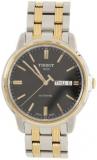
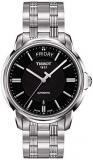
In 1978 Tissot introduced a slim quartz watch with a barrel-shaped case and an integrated bracelet whose links continued the lines of the case without a visible break. That silhouette is the foundation of the modern Tissot PRX, and the black-dial quartz version carries it forward with a thin 10.93 mm profile, a 40 mm case width and a steel architecture that reads far above its price bracket. The black variant is the quietest member of the lineup, and for many buyers that restraint is the whole point.
What separates this reference from the rest of the family is not complication but clarity. There is no date aperture, no rotating bezel, no digital layer on the dial. Instead the design leans entirely on proportion, surface finishing and the seamless flow from case to bracelet, an approach that has earned the PRX a durable place among the Tissot collection of accessible Swiss watches. Understanding why this particular configuration works requires looking at where it came from and how it is built.
The Design Lineage Behind the PRX Shape
The integrated bracelet was not invented by Tissot alone; it was a shared language of late-1970s watchmaking, when designers moved the bracelet lugs inside the case edges and let the first link continue the case flank. Royal Oak, Nautilus and Ingenieur all worked the same idea, each with its own idiom. Tissot’s contribution was to translate that idiom into a mass-market steel sports watch, which is why the PRX is often discussed alongside far more expensive designs without any implied comparison of cost.
The cushion-shaped case with its flat top surface and lightly sloped sides is the distinguishing feature. The bezel is not a separate round disc dropped onto the case; it follows the case outline, keeping the geometry coherent from the upper flank through to the base of the crystal. On a black dial, that geometry is read through reflections rather than through colour contrast, which makes the case finishing the primary visual event.
Push-pull steel pins connect each link rather than a conventional spring bar arrangement at the clasp end, and the bracelet tapers as it leaves the case. The bracelet also uses a combination of brushed outer links and polished centre links, a classic formula that keeps the piece from looking flat on the wrist and provides the definition that a pure monochrome object needs.
Case and Bracelet Finishing in Detail
At 40 mm across and 10.93 mm thick, with a lug width of 12 mm where the bracelet attaches, the case is sized to sit flat on a wide range of wrists without sacrificing presence. The published case length is 39.50 mm, an unusual specification that reflects how the turtle-style case pulls the lugs inward. Weight is cited by Tissot at approximately 130 grams, a figure that speaks to the solidity of the steel and the density of the bracelet links.
The finishing split follows a deliberate logic. The top surfaces of the case are brushed, and the transitional chamfers between top and flank are polished. On the bracelet, the broader outer links carry a brushed grain while the narrow centre links are mirror-polished. Because the black dial absorbs light, this mirrored centre line becomes the dominant highlight on the wrist, a slim quicksilver stripe that travels from the case edge to the clasp.
The Black Sunburst Dial and Its Readability
Tissot produces the PRX black variant with a sunburst-brushed dial surface, a treatment in which radial grain holds and releases light as the wrist turns. In flat light the dial reads near-matte; in angled light a subtle sheen opens across it. Applied steel indices stand proud of the surface, faceted along their length so two faces catch light differently, and the hands carry the same faceted treatment plus a luminous insert for low-light legibility.
Because the dial is uncluttered, legibility is exceptionally direct. The minute track is printed at the outer edge, the applied indices are thick enough to read at a glance, and the absence of a date window removes the one element that usually interrupts this sort of dial symmetry. This is a watch that tells time quickly and without visual negotiation, a quality that matters more on a daily-wear piece than any specification sheet suggests.
Inside the Quartz Movement
The PRX black quartz is a three-hand quartz watch with no calendar complication. Tissot specifies a battery voltage of 1.55 volts for the movement and positions the reference in its men’s main collection at an entry-level price point, with the 40 mm steel-on-steel configuration listed at approximately 450 US dollars on the brand’s official store. Timekeeping is by battery-driven stepping motor, and the practical benefit is straightforward: no winding, no service interval tied to a mainspring, and consistent rate over years of wear.
The trade-off is philosophical rather than mechanical. A quartz PRX will keep time better than a mechanical watch costing many times more, but it will not reward the owner with a movement worth watching through a display back. Buyers who accept that trade should treat the purchase as a design-led decision, because that is exactly how this reference is engineered. The case back is solid and engraved, and the entire watch is built around sealing simplicity rather than mechanical transparency.
For anyone who wants the bracelet architecture with mechanical content under the dial, Tissot offers the PRX Powermatic 80 in the same case family, and the archive-driven approach visible in the Tissot Heritage range shows how the brand reworks its history into current production. Both paths share the same slab-sided case geometry, which makes it easy to compare the two mechanisms inside an identical exterior.
Water resistance is stated by Tissot as a pressure rating suitable for everyday exposure to splashes and brief immersion; as with almost all press-fit case backs, the exact depth figure is best confirmed on the specific model page rather than assumed from the family. For daily wear this translates into confidence in rain, handwashing and kitchen work, not swimming laps.
How the PRX Black Quartz Wears Day to Day
On the wrist, the watch favours the flat, wide stance that the 1970s bracelet archetype was designed to achieve. The 10.93 mm thickness slips under a shirt cuff without catching, and the 12 mm bracelet attachment, unusually narrow for a 40 mm case, contributes a sense of taper that large integrated-bracelet watches often struggle with.
- Case: 40.00 mm width, 39.50 mm length, 10.93 mm thickness
- Bracelet attachment: 12.00 mm between lugs
- Movement: Three-hand quartz, 1.55 V battery
- Weight: approximately 130 g
- Dial: Black sunburst with applied faceted indices
- Lug character: Barrel-shaped integrated case, no traditional horns
Dress it up and the polished centre links carry the formality of a dress watch better than a brushed sport bracelet could. Wear it with a t-shirt and the architecture keeps it casual. This chameleon quality is what makes the PRX such an easy candidate for a one-watch collection, and it is why the case finishing sits closer in spirit to artful minimalism than to tool-watch functionalism.
Strap and Bracelet Flexibility
Tissot lists leather strap versions on the same 40 mm case, paired with a steel end piece that continues the case flank before the strap begins. That detail matters because it preserves the integrated aesthetic even when the bracelet is swapped for leather, allowing the same head to move from bracelet to leather without the watch losing its identity.
A black leather strap on the black dial effectively softens the case-bracelet geometry into something more formal, while the steel bracelet keeps the architectural sharpness intact. For owners who gravitate toward a single versatile piece, this provides a useful secondary look without committing to a second watch, and it reflects a broader design confidence in the classic sports-watch formula that also surfaces in racing-inspired timepieces, including the Tissot T-Sport line’s motorsport cues with comparable vintage intent.
Comparing the Three PRX Sizes
The collection spans three case diameters: 40 mm, 35 mm and 25 mm. The 40 mm black quartz is the reference model most commonly associated with the PRX line, offering the strongest case-to-bracelet continuity because the wider dial gives the design room to breathe. The 35 mm version applies the same integrated formulation at a smaller scale, and the 25 mm sits in a jewellery-watch register where the bracelet becomes the primary visual feature rather than the dial.
The practical buying rule is straightforward. A 40 mm diameter with a 39.50 mm lug-to-lug should wear comfortably on wrists from roughly 16 cm upward, and the 10.93 mm height helps the piece disappear under a cuff regardless of wrist size. Anyone comparing the PRX to conventional 40 mm round watches with standard lugs should expect the integrated case to wear smaller than the number suggests, because the lack of protruding lugs produces a compact footprint on the wrist.
There is also an allocation argument to consider. The 40 mm quartz and the 40 mm Powermatic 80 share case dimensions, so the choice between them is entirely about the movement and the dial layering. Buyers seeking maximum visual continuity from the bracelet into the case, without mechanical complexity or service overhead, will find exactly that here.
Where the Black Quartz Fits in a Modern Wardrobe
Watches positioned as artfully designed disposables are easy to buy; watches designed to stay useful for a decade are harder. The PRX black quartz makes its case against the second category. Sapphire crystal, stainless-steel construction, a proven battery movement and a bracelet engineered with a discrete aesthetic effort all point to a product that will accumulate patina in a way cheap bracelets never do, because there are real finished surfaces to scuff and then polish again.
The 1970s revival has now run through the decade strongly enough to become permanent, which removes the trend risk that once attached to this silhouette. What remains is a proportionate, confident daily watch at a price that does not force the owner to treat it as a precious object. Worn every day and serviced rarely, the black PRX will still look intentional when less considered alternatives have dated, and for many buyers that is precisely how a modern watch is supposed to work.