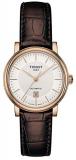
The Tissot 1853 rose gold family takes its name from the year the company was founded in Le Locle, and that date functions as more than a label. The references pair warm rose gold tones with restrained dials and confident proportions, treating the founding year as a design brief rather than decoration. Le Locle has long been associated with precision manufacturing, and that context shapes how these watches read on the wrist: quietly elegant, legible at a glance, and built around a modern automatic platform.
Across the line, the appeal comes from how the rose gold finish catches light without overwhelming the eye. Whether the tone appears on a bezel, a bracelet, or a full case, it introduces warmth that sets the series apart from the cooler steel references dominating the market. This balance between heritage and contemporary taste runs through the entire collection.
Design Language and Proportions in the Tissot 1853 Rose Gold Line
Proportion is where the collection earns its reputation for wearability. Most references are arranged around a 40 mm diameter, a size that sits comfortably on a broad range of wrists, neither retreating into the modest unisex zone nor crossing into statement territory. That shared platform gave the design team room to refine case architecture across multiple models rather than treating each as a one-off.
The case construction follows a two-part logic: a robust stainless steel base, frequently 316L grade, overlaid with rose gold tone on the bezel, the crown, and sometimes the bracelet’s central links. The result reads as gold at a glance while keeping the structural resilience of steel. Flat sapphire crystals are standard on the current generation, and many carry an anti-reflective coating on one or both faces, which keeps the dial clear under bright outdoor light.
Dial layouts favor restraint. Sunburst finishes let the rose gold indices and hands do the decorative work, while applied hour markers and slim baton hands preserve legibility. On chronograph variants, the sub-dials are recessed and framed by polished rings that echo the bezel finish. The overall effect is a watch that photographs well but is designed to be read quickly.
The Powermatic 80 Connection Behind the 1853 Name
Inside many references across the series sits the Powermatic 80, a movement that has become a signature of modern Tissot automatic watches. Its headline figure is an 80-hour power reserve, achieved in part through a lower-frequency regulation of the balance wheel at the 3 Hz (21,600 vph) beat rate common to the family. That reserve means a watch can be set down on a Friday evening and still be running accurately on Monday morning, a practical benefit for anyone rotating several pieces.
The movement architecture also includes a patented Nivachron balance spring in several current variants, a titanium-based alloy chosen to resist magnetic interference and thermal drift. For the wearer, this translates into steadier timekeeping near laptops, phones, and audio equipment, conditions that define most modern working days. Automatic winding, whether through wrist motion or a manual wind through the crown, keeps maintenance gaps relatively long.
- Movement: Swiss Made automatic, Powermatic 80 family
- Power reserve: Up to 80 hours
- Frequency: 21,600 vibrations per hour (3 Hz)
- Beat-rate tuning: Optimized for long autonomy and stable rate
Water resistance is typically rated at 5 bar (50 m) on the dress-leaning references, which covers handwashing, rain, and brief immersion but not swimming at depth. On sportier variants within the family the figure rises, and the caseback fits a screw-down type on those models. Buyers should match the rating to their habits: a rose gold dress watch rarely needs more than the base rating, while a chronograph worn on holidays may benefit from the higher figure.
Rose Gold Finish, Care, and Everyday Practicality
Rose gold tone on these watches is achieved through a PVD or plating process rather than solid gold, a distinction that matters for both price and care. The finish resists tarnishing well, but it is a surface layer: abrasive polishes and rough contact with concrete, gym equipment, or the corners of desks will gradually thin the coating at the high-polish points. The practical answer is a soft microfiber cloth after wear, a mild soap-and-water wash for the steel sections, and avoidance of ultrasonic cleaning on plated components.
On references with solid 18 ct rose gold elements, such as a gold bezel on an otherwise steel case, care is even simpler: the gold itself is durable and can be polished by a watchmaker when it dulls. The bi-colour construction also brings a visual benefit, since the steel links break up the gold tone and give the watch a more casual range. That versatility supports the case for owning one rose gold piece and wearing it often, rather than reserving it for formal occasions.
Bracelets and straps are usually interchangeable across compatible references, and the brand publishes compatibility details for quick-release systems, which supports a rotation between a rose gold-tone bracelet for dressier days and a leather strap for relaxed settings. The Tissot brand’s catalogue extends well beyond the 1853 references, but the philosophical split is clear: heritage dress on one side, sport and tool watches on the other.
Where the 1853 Rose Gold Sits in the Wider Collection
Understanding this line requires a quick tour of the family tree. The Tissot Heritage collection draws on archive designs from the company’s past and reintroduces them with modern movements and materials. The association with the founding year 1853 is not incidental: it signals the brand’s willingness to look back for inspiration while keeping the technical platform current.
Comparisons with related families sharpen the picture. The PRX line, with its integrated bracelet and faceted case, pushes into design-led territory and revisits 1970s aesthetics. The Seastar references handle diving duties with rotating bezels and higher water resistance. The Tissot Touch Collection takes the opposite path, adding digital functions and interactive crystals for wearers who want tool-like utility. Against all of these, the 1853 rose gold references stand out as the most traditionally elegant option: time-focused, warm-toned, and built to slip under a cuff.
How to Choose Among the Rose Gold References
The first decision is between solid gold accents and full rose gold-tone construction. A solid 18 ct bezel, paired with a steel case, offers a genuine precious-metal element with less surface risk than a fully plated watch. A full rose gold-tone finish, by contrast, delivers the most cohesive visual statement and usually the best value per ounce of gold appearance. Neither choice is objectively better; the right one depends on how often the watch will meet rough surfaces.
The second decision is dial complexity. Three-hand references keep the rose gold indices and hands as the only decorative elements, which suits formal wear and conservative styling. Chronograph versions add pushers, sub-dials, and a sportier silhouette, and they tend to sit slightly thicker on the wrist. For anyone uncertain, the three-hand models are the safer first rose gold purchase, because they pair with more outfits and require less thought in the morning.
The third decision is bracelet type. A rose gold-tone bracelet offers the most luxe impression and consistent tone from dial to clasp, while a leather strap in brown or black keeps the case the sole gold element and gives the watch a more relaxed, weekend-ready character. Buyers who plan to wear the watch daily should weigh the bracelet’s comfort in hot weather against its stronger aesthetic pull.
Collecting, Servicing, and Long-Term Value
Automatic watches from established Swiss makers reward routine care. For the Powermatic 80 family, a service interval of roughly four to six years is a common recommendation, though the extended power reserve and modern lubricants give owners some flexibility. The rose gold plating should not be polished aggressively; a watchmaker can assess whether a light refresh is appropriate without diminishing the coating.
Collectors sometimes gravitate toward rose gold pieces because the warm tone photographs well and ages gracefully in terms of trend cycles. The 1853 references are widely considered to fit that pattern, sitting at the intersection of everyday wear and heritage design. Buying on the secondary market means checking for plating wear at the crown, the bezel edges, and the bracelet’s clasp contact points.
Final Perspective on the Tissot 1853 Rose Gold Watches
The rose gold finish does more than imitate expensive metal; it shifts the wearer’s experience of the watch. On the wrist, a warm-toned case catches ambient light differently from steel, brightening the dial in dim rooms and giving evening wear a softer glow. The 1853 name anchors that aesthetic in a specific place and year, which lends the piece a story to tell when someone asks about it.
For the buyer weighing a first proper Swiss automatic, the appeal is straightforward: an 80-hour reserve, sapphire crystal, flexible 40 mm sizing, and a rose gold finish that feels considered rather than loud. For the collector adding variety, the line offers a dressy counterpoint to sportier references, one that pairs naturally with formal wear and still wears comfortably on a weekend. Viewed as a whole, the 1853 rose gold series reads as the brand’s warmest interpretation of its own heritage, an argument that good design neither needs to shout nor to chase fashion.