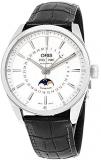
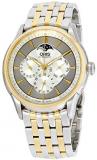
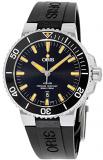
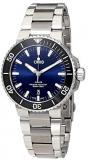
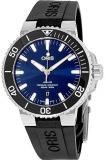
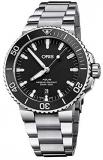
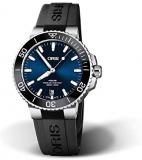
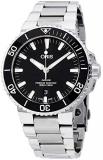
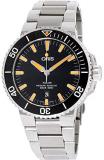
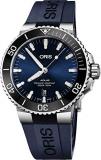
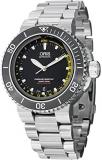
The Oris Chronoris Date measures 39mm across with a 43mm lug-to-lug span, dimensions that sit close to the vintage racing chronographs that inspired it rather than the oversized cases common to modern sports watches. That compact footprint, paired with a 12.5mm profile and 19mm lug width, gives the Chronoris Date a wrist presence that reads period-correct without feeling dated.
This watch sits within the Oris brand’s broader catalogue of independent Swiss watchmaking, a H枚lstein-based operation that has produced mechanical movements in-house since the early twentieth century. The Chronoris line itself reaches back to 1970, when Oris introduced its first chronograph for the motorsport market, and the current Date model revives that template in a simplified, time-and-date format.
Design Language Rooted in 1970s Racing
The Chronoris Date draws its visual vocabulary from the driving chronographs of the late 1960s and early 1970s, an era when cushion cases, barrel-shaped profiles, and bold dial furniture defined the sporting watch. Oris leans into that heritage carefully rather than literally, adapting the proportions without reproducing every period quirk.
What stands out at a glance is the case shape. It carries a rounded cushion geometry with noticeable curve across the top and a domed sapphire crystal that sits proud of the bezel, a combination that softens the silhouette compared to a flat-topped dive watch. The sapphire is domed rather than flat, which adds a subtle distortion at the edges when viewed from an angle and reinforces the vintage character of the piece.
The dial construction follows the same restrained philosophy. Applied hour markers sit against the grey or black dial surface, framed by luminescent material that remains legible in low light. The hands are broad enough to anchor the dial without visual clutter, and the date window at three o’clock keeps the layout practical for everyday use rather than purely decorative.
Movement and Mechanical Specification
Inside the case sits the Oris Caliber 733, the designation the brand uses for its modified Sellita-based automatic movement. The specification sheet lists 28,800 vibrations per hour, equivalent to 4 Hz, across a movement diameter of 25.60mm, which corresponds to the 11 1/2 ligne standard. That beat rate is the industry norm for mid-range automatics and contributes to a smoother seconds-hand sweep than a lower-frequency alternative.
Automatic winding removes the battery-replacement cycle entirely, and the 28,800 A/h frequency supports stable rate-keeping across normal daily wear. The movement is visible through the case back, giving the owner a view of the rotor and bridges in keeping with the exposed-mechanical convention that defines enthusiast-grade Swiss automatics in this price band.
Water resistance is rated to 100 meters, or 10 bar, as confirmed by the manufacturer’s product specification. That rating covers swimming and light water contact but sits below the 200-meter threshold that divers expect, which is appropriate positioning for a motorsport-inspired watch rather than a dedicated dive instrument.
Case, Crystal, and Wearability
The 39mm case diameter is the headline figure for anyone weighing daily comfort against wrist presence. Lug-to-lug of 43mm determines how the watch sits across the top of the wrist, and that measurement matters more than diameter alone when assessing fit. A 43mm lug-to-lug paired with curved lugs means the Chronoris Date wraps cleanly on average-to-smaller wrists while remaining proportionate on larger ones.
The 12.5mm thickness allows the watch to slide under a shirt cuff without the bulge that thicker chronographs often produce. Case finishing alternates between brushed surfaces and polished edges, a standard but effective approach that gives the case definition without heavy bling.
- Case diameter: 39mm
- Lug-to-lug: 43mm
- Thickness: 12.5mm
- Lug width: 19mm
- Water resistance: 100 meters (10 bar)
- Crystal: Domed sapphire
- Winding: Automatic (Caliber 733)
The 19mm lug width is worth noting because it narrows the strap options compared to the more common 20mm standard, though it suits a leather strap particularly well and gives the watch a dressier, driver-watch look rather than a tool-watch appearance.
Dual-Crown Operation and the Driver Control Concept
The Chronoris Date carries a dual-crown configuration, one of its more distinctive functional features. The lower crown handles time and date adjustment, while the upper crown controls the internal rotating bezel, an element designed for measuring elapsed intervals such as pit stops or pacing intervals. This control layout traces directly to the racing chronographs of the 1970s, where a rotating inner bezel offered quick timing without the cost and complexity of a full chronograph movement.
In practical terms, the internal bezel functions as a simple minute tracker that can be set quickly with a turn of the upper crown. It is an approachable complication: drivers and sportsmen could time laps without operating pushers, and the same method works for coffee brewing, parking meters, or any task requiring a countdown.
Readers comparing this control philosophy against other historical complications might find interesting parallels in classic dress references that favour refined date functionality over racing utility, a reminder that wristwatch design across the 1950s through the 1970s split into distinct functional families.
Dial, Hands, and Legibility
Whatever the dial colour variant, the Chronoris Date prioritises legibility over ornament. The applied indices, the use of luminescent compound on hands and markers, and the broad hour hand all support low-light readability. The dial carries a cleaner, less busy layout than a three-register chronograph, which suits the time-and-date format and keeps the design focused.
The domed sapphire crystal adds a slight curvature to reflections and can produce marginal distortion near the dial edges, a characteristic that many vintage watch enthusiasts accept as part of the aesthetic. It is not anti-reflective coated to the degree of a modern flat crystal, so glare control under direct sunlight is adequate rather than total.
Legibility matters in a time-only watch used for driving and daily timing, and this layout stays readable across bright and dim conditions without requiring the wearer to hunt for the hands against a busy dial texture.
Placement Within the Oris Catalogue
Oris divides its line-up between heritage-inflected sports watches and modern activewear pieces. The Chronoris Date anchors the heritage side, positioned between strict dress references and full dive watches. Watches in this category often draw comparison across brand families; those considering a classic date display with timeless proportions may also look toward mid-century date references for a different take on the same functional brief.
Within the Oris range itself, the Chronoris Date offers an entry point into vintage-inspired motor racing design without the price ceiling of a limited-edition chronograph. Its automatic movement and 100-meter water resistance make it a legitimate daily wearer rather than a display-only collector’s item.
Buying Considerations for the Would-Be Owner
Several practical dimensions define whether the Chronoris Date suits a given buyer. Wrist size ranks first: the 43mm lug-to-lug means the watch suits the majority of wrists without overhang, but those with very large wrists may find the 39mm case reads smaller on-wrist than expected. Strap choice is a secondary consideration, since the 19mm width limits quick-change options but leather straps complement the racing aesthetic particularly well.
The dual-crown arrangement adds character but also a small handling learning curve for first-time owners: the upper crown sets the internal bezel, the lower crown sets the time and date. After that adjustment period, operation becomes intuitive, and the two-crown layout reinforces the driver-centric personality of the design. The Chronoris Date applies that logic inside a motorsport template, and this dual identity is precisely what makes the specific variant worth trying on before deciding.
Finally, maintenance and servicing factor into ownership cost. Automatic movements at this level follow a roughly five-year service interval, and Oris maintains a service network that covers routine maintenance without the extended turnaround times some independent brands face.
Collector Appeal and Long-Term Wear
The Chronoris Date occupies an interesting niche: it is distinctive enough to feel intentional rather than generic, yet restrained enough to serve as a daily wearer. The cushion case, domed crystal, and dual-crown layout give it a personality that typical three-hand sports watches lack, while the 39mm case and 12.5mm thickness keep it comfortable across extended wear. Product options like the ref. 01 733 7737 4053-07 4 19 01FC help identify the leather-strap variant for those who prefer to reference the exact configuration, while the steel-bracelet reference remains the choice for buyers who prefer a one-watch solution.
Sourcing details further strengthen the Chronoris Date’s case. Buyers can also review similarly priced mechanical watches across comparable vintage-inspired references, though each brand reaches its target through different stylistic priorities.
As a long-term piece, the Chronoris Date earns its place through a combination of proportion, honesty of function, and a design story grounded in real motorsport history rather than retro styling for its own sake. It remains a compelling choice for anyone seeking a mechanical watch that balances heritage character with modern practicality and an automatic movement that needs no battery for years of reliable daily service.