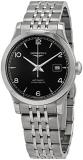
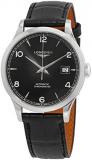
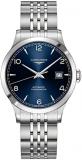
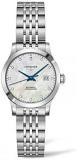
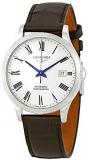
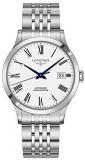
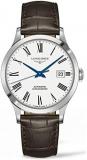
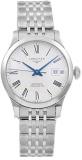
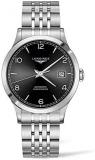
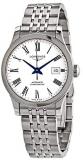
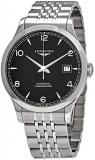
The Longines Record Heritage runs on a Swiss automatic calibre beating at 28,800 vibrations per hour, housed in a 40.00 mm stainless steel case with a 54-hour power reserve. That combination of a high-frequency movement and a restrained dress-watch profile places the Record line at a specific intersection of technical reliability and understated design.
Longines has positioned the Record collection as a bridge between its historical archives and contemporary watchmaking standards, drawing on a heritage that stretches back to 1832 in Saint-Imier, Switzerland. The result is a timepiece aimed at collectors who value provenance as much as performance.
Design Language Rooted in Classical Watchmaking
The Record Heritage distills decades of Longines design vocabulary into a single reference. Its case architecture follows the clean, round silhouettes that defined mid-twentieth-century dress watches, while the dial layout avoids unnecessary clutter. Applied indices and slender hands create a sense of restraint that has become increasingly rare in an era of oversized complications.
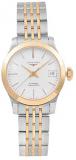
The stainless steel case measures 40.00 mm in diameter, a size that sits comfortably on a wide range of wrist profiles. Longines also offers a rose gold cap variant, which adds warmth without the full weight and cost of solid precious metal. Both executions share the same balanced proportions, ensuring that the watch reads as a cohesive design statement rather than a collection of disparate elements.
Dial options within the Record family include opaline finishes and textured surfaces that catch light in subtle, shifting ways. The Railway and Tuxedo-inspired references within the broader catalogue demonstrate how the brand approaches vintage codes with modern materials. The Record Heritage follows this same philosophy, applying contemporary finishing standards to mid-century aesthetics.
Swiss Automatic Movement and Technical Credentials
At the heart of the Record Heritage sits a self-winding mechanical calibre that operates at a frequency of 28,800 vibrations per hour, or four hertz. This rate is widely regarded as a sweet spot for mechanical watches, offering stable timekeeping without placing excessive wear on the escapement. The 54-hour power reserve means the watch can be set aside for a weekend and still be running when picked up again on Monday morning.
Longines has historically supplied movements to other manufacturers during the quartz crisis and beyond, and that engineering depth is visible in the Record line. The movement finishing includes Geneva stripes and blued screws, visible through a sapphire case back on certain references. Water resistance is rated for everyday use, protecting against splashes and brief immersion.
Inside the Record Heritage, the automatic calibre reflects the same engineering discipline found across Longines, where high-frequency regulation and extended power reserves appear consistently from the dress range through to the sportier references.
The broader Longines collection encompasses everything from the HydroConquest dive range to the Master Collection, but the Record sits in a distinct space: more formal than the Conquest, more accessible than the Master series, and more historically grounded than the PrimaLuna.
Historical Context: The Longines Archive
Longines maintains one of the most extensive brand archives in Swiss watchmaking, with records dating back to the nineteenth century. The Record name itself traces to a period when Longines produced observatory-tested chronometers that set precision benchmarks in international competitions. Those achievements informed the modern Record line’s positioning as a precision-oriented family within the catalogue.
The brand’s heritage department continues to reference specific references from the 1940s and 1950s when developing new models. This approach ensures that each design decision, from case curvature to font selection, carries a legitimate historical rationale rather than a purely nostalgic impulse.
Collectors interested in this approach to heritage design often explore other references that reinterpret archival models. The Omega Speedmaster serves as a parallel case study, where a single historical event informed decades of subsequent product development.
Similarly, brands such as Tissot demonstrate how mid-range Swiss manufacturers mine their archives for design inspiration while incorporating modern manufacturing tolerances.
Wearing Experience and Versatility
On the wrist, the Record Heritage sits flat and unobtrusive under a shirt cuff, yet it commands attention when exposed. The 40.00 mm diameter and relatively thin profile make it suitable for both suit-and-tie environments and smart-casual settings. Strap options range from alligator leather to steel bracelets, allowing owners to adjust the formality of the watch depending on the occasion.
The dial legibility remains excellent in varying light conditions. Applied indices with polished facets reflect ambient light, while the hands maintain a clear silhouette against the dial surface. The absence of complications on the base references keeps the visual field calm, which is precisely the intent of a heritage dress watch.
Longines offers the Record in several case materials and dial variants. The stainless steel model remains the most versatile, pairing well with a wide range of clothing. The rose gold cap version introduces a warmer tone that suits brown and tan leather straps particularly well.
Positioning Within the Longines Catalogue
The Record Heritage occupies a thoughtful position between the entry-level quartz offerings and the upper-tier Master Collection. It competes directly with other Swiss automatic dress watches in the same price bracket, including references from Baume & Mercier and Frederique Constant. On a specification basis, the 54-hour power reserve and 40.00 mm case size are competitive for the segment.
Within the brand’s own lineup, buyers weighing the Record against the Flagship Heritage, which includes a moonphase variant at 38.50 mm, will notice different priorities: the Record emphasises clean timekeeping, while the Flagship leans toward traditional complications and even the enamel dial craftsmanship seen in Longines’ premium heritage offerings.
Buyers exploring Longines for the first time often begin with the Record because it represents the brand’s core competencies without the complexity of chronographs or world-time mechanisms. From there, the broader catalogue opens up options including the HydroConquest for sports use and the DolceVita for rectangular-case aesthetics.
Why the Record Heritage Endures
The Swiss watch industry produces hundreds of automatic dress watches each year, yet few achieve the balance of proportion, finishing, and price that the Record Heritage delivers. Longines does not position this model as a limited edition or a collector-only piece. It is a regular-production watch designed for daily wear, and that accessibility is part of its appeal.
The movement inside is serviceable by any qualified watchmaker, which matters for long-term ownership. Parts availability through Swatch Group’s network ensures that a Record Heritage purchased today can remain in reliable service for decades. This is not a disposable product, and Longines has designed it accordingly.
Wearers who choose the Record Heritage are opting for a watch that participates in a continuous tradition of Swiss precision manufacturing. It does not shout for attention, and it does not need to. The proportions, the dial, and the movement represent a coherent design philosophy that has survived countless trend cycles because it was never built around a trend in the first place.
Longines continues to release new dial variations and case material combinations within the Record family, keeping the line relevant without compromising its foundational design principles. For anyone considering a first Swiss mechanical watch or adding a versatile dress piece to an existing collection, the Longines Record remains one of the most considered choices available.