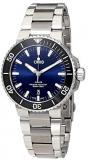
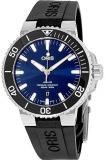
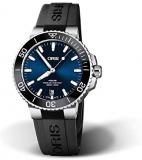
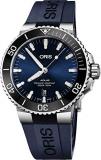
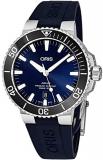
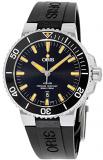
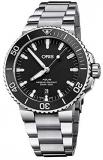
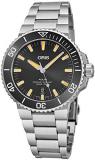
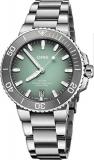
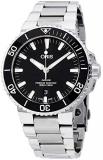
The Oris Aquis Blue centres on a deep metallic dial that shifts character as light travels across its surface, framed by a rotating bezel and a case built for underwater duty. Across the current Aquis Date range, Oris offers this blue finish in several case sizes, including 43.5mm, 41.5mm, and 36.5mm, which lets the same design language serve very different wrists. The result is a dive watch that reads as a tool first and a style piece second, without pretending to be either exclusively.
What makes the blue Aquis worth examining closely is how deliberately Oris has separated appearance from capability. The colour is not a decorative afterthought layered onto a generic case; it is one option within a coherent family that shares bezels, bracelets, and a water-resistance rating of 300 metres. Understanding that family structure is the fastest route to choosing the right version.
A Dial That Changes With the Light
The blue dial on the Aquis Date is best described as metallic rather than flat. In low indoor light it can read almost navy, while direct daylight pulls out a brighter, saturated tone across the centre of the dial. This behaviour matters because it affects legibility. The applied indices and hands carry luminous treatment, so contrast against the blue background stays strong in dim conditions, and the metallic sheen does not wash out the markers in brighter settings.
Colour consistency across the family is worth noting as well. The blue option appears in the 43.5mm reference alongside a black ceramic bezel, a pairing that keeps the case visually grounded. A coloured dial on a dive watch only works when the bezel and case do not compete with it, and the black bezel insert here performs that job cleanly. Buyers who want the dial to dominate will find the blue variant better balanced than versions where bezel and dial fight for attention.
Case Sizes and Why They Matter
Oris has made the Aquis unusually accommodating by offering the design in three distinct case diameters. The largest at 43.5mm suits broader wrists and delivers the most commanding presence on the bracelet. The 41.5mm option narrows the gap between sport and daily wear, while the 36.5mm version opens the Aquis to smaller wrists without reducing it to a token size. Thickness figures vary by reference; the 39.5mm variant has been documented at roughly 12.7mm thick with a 46mm lug-to-lug span, which illustrates how Oris tunes proportions rather than simply scaling a single case up and down.
This matters more than a spec sheet suggests. Dive watches live or die on how they sit on the wrist, and a 43.5mm case with a tall bezel can feel very different from a 41.5mm case with the same design cues. Trying the size rather than assuming one fits all is the single most useful decision a buyer can make with this model.
Engineering Beneath the Blue
The Aquis is built around genuine dive-watch fundamentals rather than styling references to them. Water resistance is rated to 300 metres, supported by a screw-down crown and a case construction designed to seal against pressure. The bezel is unidirectional, as dive practice requires, so a mistimed turn can only shorten a timing interval rather than extend it. Oris has also developed its Rotation Safety System, seen on specialised Aquis variants, which locks the bezel in place to prevent accidental movement during a dive.
Lume performance is central to the formula. Hands and indices are coated for low-light visibility, and the bezel on many Aquis references carries its own luminous marker at the zero position. For a watch intended to be read underwater, this is not a marketing detail but the core function. Buyers comparing the blue Aquis against style-led divers should weigh these practical elements heavily, because they determine how the watch behaves when conditions are poor.
Movement, Winding, and Daily Ownership
The Aquis Date line runs on mechanical movements, with winding and power-reserve figures varying by generation and calibre. Some references in the broader Aquis family are associated with reserves quoted at up to 120 hours, a figure that reflects how far Oris has pushed autonomy in recent iterations. Exact movement specification should always be confirmed against the reference number, since the Aquis range spans several calibres across its sizes and editions.
For everyday use, a mechanical diver with a multi-day reserve is forgiving. A watch left off the wrist over a weekend returns to accurate running without resetting, and the absence of a battery removes one maintenance variable. The trade-off is servicing, which mechanical ownership always carries. Buyers who want a set-and-forget quartz experience are looking at the wrong category, and the blue Aquis does not pretend otherwise. The nature of the Oris approach to tool watches is explored further through the Oris brand’s wider mechanical portfolio, which places the Aquis alongside its other tool-focused lines.
Bracelet, Bezel, and the Details That Age Well
The Aquis bracelet is integrated into the case design, tapering from the lugs in a way that gives the watch a continuous, sculpted profile. This integration is visually distinctive but also practical: it distributes weight evenly and reduces the sense that a heavy case is pulling forward on the wrist. Finishing combines brushed surfaces with polished edges, a combination that resists showing every scratch while still catching light.
The bezel deserves separate attention. Ceramic inserts resist fading and scratching far better than older aluminium alternatives, and on the blue references the black ceramic keeps the dial as the focal point. Bezel action, grip, and alignment are the things owners notice daily, long after the initial appeal of a colour has settled. A dive bezel with crisp detents and minimal play is a meaningful part of what separates a serious tool watch from a cosmetic one.
How the Blue Aquis Fits Into a Collection
A blue-dial diver occupies a useful place in a watch rotation. It is sporty enough for casual and outdoor wear, restrained enough for office settings when paired with the right strap, and visually distinct from black-dial equivalents that tend to dominate collections. The Aquis blue’s metallic finish gives it an additional register that flat blue dials lack, which makes it more adaptable across dress codes than a matte dive watch might be.
Compared with more heritage-driven divers, the Aquis leans toward contemporary industrial design rather than vintage homage. That positioning is a choice, not a deficiency. Buyers drawn to warm patina aesthetics and domed acrylic crystals will find other references more sympathetic, while those who prefer sharp case lines and modern materials will find the Aquis coherent. The broader field of dive and sport watches, including models such as the Rolex Submariner, offers a useful reference point for understanding where the Aquis sits in both price and design philosophy.
Sizing, Fit, and Practical Buying Advice
Wrist size should drive the decision far more than photographs do. A 43.5mm Aquis photographed on a large wrist can look moderate, then feel substantial on a smaller one. The 41.5mm version is the safer middle ground for most buyers, while the 36.5mm option serves those who want the Aquis design without a large footprint. Lug-to-lug distance matters as much as diameter, and the documented roughly 46mm span on one of the smaller references shows that Oris keeps overall wearability in view.
Strap and bracelet choice alters the equation further. An integrated bracelet adds presence and weight, while a rubber strap lightens the watch and suits water use and warm climates. Buyers who plan to swim and dive regularly should factor strap compatibility and comfort into the decision, not just the dial colour. The blue finish is the entry point here, but the case size and strap configuration determine long-term satisfaction.
On balance, the Aquis Blue makes its case through restraint in colour and rigour in construction: a 300-metre dive watch with a dial that rewards a second look and a build that rewards actual use. Its appeal lies less in novelty than in the consistency of the idea, from the sealed case and luminous markers to the proportions offered across three sizes. That coherence is what makes the blue Aquis a watch worth returning to, on the wrist and in a collection, long after the initial impression of colour has passed.