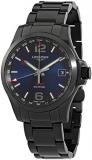
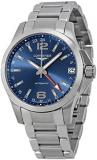
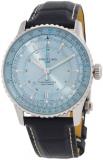
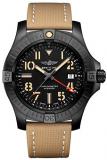
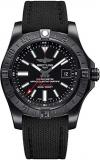
The Longines Spirit Zulu Time carries a rotating bezel with a ceramic insert and a dedicated GMT hand, a combination that lets the wearer read a second time zone at a glance. That layout ties the watch to the era of long-distance aviation, when pilots needed an independent 24-hour reference strapped to the wrist rather than pulled from a pocket.
Two case diameters anchor the line, 39mm and 42mm, both in stainless steel and both rated for everyday wear. The range sits within the broader Longines catalog as a travel-focused option, and this guide examines how the Spirit Zulu Time executes the GMT brief, where it fits among pilot and sports watches, and who will get the most from it.
Reading the Zulu Time: How the GMT Function Works
The term Zulu comes from the phonetic alphabet used in aviation and military communication, where Zulu designates Coordinated Universal Time. A watch with this label exists to answer a simple question: what time is it elsewhere, right now, without mental arithmetic. The Spirit Zulu Time answers it through an independent 24-hour hand that sweeps the dial once per day, paired with a rotating bezel graduated for a second time zone.
Mechanically, the GMT hand travels on its own gear train, driven from the base movement but linked to a separate setting mechanism. Setting the local hour without disturbing the GMT reference is the practical advantage. A traveler lands, adjusts the main hands to local time, and the 24-hour hand keeps pointing home. The rotating bezel adds a third layer: align its numerals to the GMT hand before departure, and a further offset zone can be read without touching the crown at all.
The 24-Hour Hand and Bezel Pairing
The bezel insert is ceramic, a material chosen for its resistance to scratching and its stable color under UV exposure. Its 24-hour scale is bidirectional in use, letting the wearer track eastward or westward offsets by turning it either direction. Together, the hand and bezel form a two-stage system that rewards a little familiarity and removes the need for calculation mid-flight.
Dial Legibility Under Travel Conditions
Applied numerals and a clear division between the 12-hour and 24-hour tracks keep the dial readable in low light on a night flight. The date window sits at the frame’s edge without crowding the hour markers, a layout that preserves the symmetry that matters when a glance has to be quick.
Case, Caliber, and the Numbers Behind the Watch
Both case sizes share the same technical foundation. The movement beats at 25’200 vibrations per hour, a frequency of 3.5 Hz that balances smooth seconds-hand motion against winding efficiency. Power reserve reaches up to 72 hours when fully wound, meaning the watch can sit on a nightstand from Friday evening to Monday morning and still be running when it is picked up again.
The case is stainless steel throughout, and the reference lineup pairs it with a ceramic bezel insert. A screw-in crown secures the winding and setting position, contributing to the water resistance expected of a travel watch. The 39mm version suits wrists that prefer a restrained profile, while the 42mm variant gives the bezel and dial more room to breathe on larger wrists.
- Movement: Automatic, 25’200 vph, up to 72-hour power reserve
- Functions: Hours, minutes, seconds, date, GMT second time zone
- Case: Stainless steel, 39mm or 42mm
- Bezel: Bidirectional rotating with ceramic insert, 24-hour scale
- Crown: Screw-in
That specification sheet positions the watch as a serious travel tool rather than a decorative nod to aviation. The 72-hour reserve matters most for anyone who rotates several watches through the week, since it removes the need to reset the GMT hand every time the watch is worn.
Design Heritage and the Aviation Dial Language
Longines has a documented history in timing and navigation instruments, and the Spirit family draws on that archive rather than inventing a new visual language. The Zulu Time takes the family’s dial architecture and adds the 24-hour element. What results is a watch that reads as a pilot’s instrument first and a dress piece second, without tipping into the oversized proportions that some aviation designs adopt.
For collectors comparing options in the same travel-watch territory, the Longines brand’s own catalog offers a useful point of reference, since the Spirit Zulu Time sits alongside dress models and chronographs that share the same case-making standards. The comparison is instructive because the family answers different briefs with a consistent design language. Where the dress pieces lean toward a jewelry-grade presence, the Spirit Zulu Time keeps its dials flatter and its case lines straighter, closer to a cockpit instrument than to a status object.
Similar thinking shows up across other enthusiast-favorite lines. Bracelet-led designs demonstrate how a link profile can shape the character of an otherwise technical watch, and the Spirit Zulu Time makes the same point through its case finishing: brushed surfaces on the flanks, polished accents on the lugs, a contrast that catches light without drawing attention from the hands.
Why the Bezel Is the Defining Element
On a GMT watch the bezel is not decoration, it is a second instrument panel. The ceramic insert on the Spirit Zulu Time holds a crisp engraved scale, and the decision to make it bidirectional rather than fixed reflects real use: a fixed bezel can display a second zone only through the hand itself, while a rotating one can be pre-set for a third location or for a time offset that will be crossed later in the journey.
The 39mm and 42mm Split: Choosing a Case Size
The existence of two diameters is a practical answer to a real problem in aviation watches. A case large enough to make a 24-hour scale legible on a crowded dial risks overwhelming a smaller wrist, while a compact case can compress the bezel numerals into a tight ring. Longines splits the difference by offering both, keeping movement and functionality identical across the two.
Wearers with wrists below roughly 17cm often find the 39mm version settles better between the wrist bones, leaving the crown clear of the back of the hand. Above that, the 42mm version gives the bezel insert room to display its numerals at a reading distance, which matters on a dial layout that already accommodates a date window and a 24-hour hand.
Strap and Bracelet Pairings
The line has been offered on leather straps as well as steel bracelets, and the choice changes the watch’s posture considerably. A bracelet moves it toward daily-wear territory and balances the case weight on the wrist, while a leather strap pulls the dial forward and makes the bezel the visual center. Travelers who cross climates frequently tend to favor the bracelet for its tolerance of humidity and sweat.
How the Zulu Time Fits a Wider Collection
A GMT complication earns its place in a watch box by doing something the other pieces cannot. Three-hand dress watches and divers track local time; a GMT tracks two zones at once, and does so continuously rather than on demand. That distinction makes the Spirit Zulu Time a natural companion to more specialized designs. A deep-water diver, for instance, solves the water-sports problem with high water resistance and a unidirectional bezel, while a GMT solves the timetable problem, and few wearers need the two in one case.
In the same way, integrated-bracelet dress watches lean on refined proportions and polished aesthetics rather than instrument readability, which underlines what the Zulu Time offers that pure dress designs do not: a bezel designed to be turned, a hand designed to be read at a glance, and numerals sized for navigation rather than ornament.
Within the Longines stable, the Spirit Zulu Time sits at the functional end of the family. The line’s pricing, quoted by Longines at $3,450 for the 39mm reference and $3,550 for the 42mm reference, positions a genuine GMT with a ceramic bezel below the bracket where most Swiss travel watches begin, which is a significant part of the model’s argument.
Setting and Living With a GMT Watch
The daily routine of a GMT owner is simple once established. Wind the watch or let the rotor do it, set the local time, then set the 24-hour hand to the home zone. From that point the watch carries two readings at all times, and the bezel can add a third without disturbing either.
There are a few habits worth forming. Keep the screw-in crown fully seated after setting, since a partially engaged crown compromises water resistance. Set the date with care around the midnight transition, when the calendar mechanism is engaged. And when crossing zones, adjust the local hour rather than the GMT hand, so the home reference never loses its anchor. Those habits are not unique to this watch, but a travel watch rewards them more than most because two readings depend on one correct setting.
The 72-hour reserve changes the ownership experience in a quieter way. A watch with a weekend-proof power reserve can be worn Monday through Friday and left unwound over a weekend without the reset ritual, which means the GMT hand stays true and the date stays correct. For anyone who keeps three or four watches in rotation, that convenience compounds over months of use.
Who Should Consider the Spirit Zulu Time
The strongest case for this watch belongs to the frequent traveler who wants a mechanical second time zone without adopting a bulky pilot’s watch. The 39mm version is the quieter choice, and it wears close to a standard three-hand watch while carrying a full GMT capability. The 42mm version suits those who want the bezel numerals to read easily and have the wrist to carry the extra presence.
A second audience is the collector building a small, purposeful set. A diver covers water, a dress watch covers formality, and a GMT covers movement. The Spirit Zulu Time fills that third role with a ceramic bezel and a legible dial rather than with complications that add cost without adding function. Longines states a 72-hour reserve and a 25’200 vph rate for the caliber, and those figures describe a movement tuned for dependable daily service rather than for spec-sheet extremes.
A Travel Instrument That Earns Its Bezel
The Spirit Zulu Time’s value lies in the honesty of its construction: a bidirectional ceramic bezel that turns, a 24-hour hand that tracks a second zone continuously, a screw-in crown that seals the case, and a power reserve long enough to survive a weekend off the wrist. None of those elements are novel in isolation. What distinguishes the watch is how tightly they are integrated, so that reading a second time zone requires no calculation and no app, only a glance at a hand and a scale.
Aviation watches have always been defined by the problem they solve rather than the era they reference, and the Zulu Time keeps that focus intact. Two case sizes acknowledge that wrists vary and that a GMT scale has to remain legible without dictating one body type. For the traveler who wants the mechanics of a second time zone on the wrist, in steel and ceramic, the model makes a coherent and well-considered case.