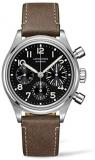
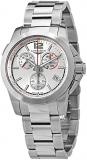
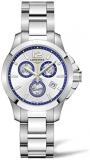
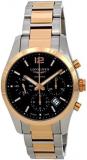
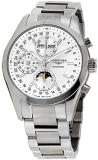
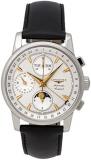
The Longines Avigation BigEye displays a 41.00 mm stainless steel case, an oversized 30-minute counter at three o’clock, and a self-winding chronograph movement beating at 28,800 vibrations per hour. These details separate it from the broader field of modern pilot watches and anchor it firmly in a specific design tradition.
This article examines the Avigation family from several angles: its historical roots, its technical specification, its dial and case architecture, and the reasons it occupies a distinct position within the broader Longines brand’s catalog of pilot and tool watches. Readers weighing a chronograph purchase will find the details below organized for reference, and the comparison points should prove worth returning to.
What “Avigation” Means in the Longines Catalog
The term avigation is a contraction of aviation and navigation, and it has appeared on Longines dials since the early twentieth century, when the brand supplied timing instruments to pilots and navigators. The Lindbergh Hour Angle watch, developed with Charles Lindbergh in 1931, remains the best-known expression of that heritage. The Avigation line revives the vocabulary of that era: large Arabic numerals, syringe hands, and luminescent paint applied generously enough to be read in a cockpit at night.
Rather than reproducing a single historical reference, the modern Avigation family draws on several mid-century pilot chronographs and consolidates their most legible features into contemporary case sizes. The BigEye name refers to one of those features directly.
The BigEye Dial: A Deliberate Asymmetry
Most chronographs use three sub-dials of equal size. The Avigation BigEye does not. Its minute counter at three o’clock is visibly larger than the running seconds at nine o’clock, a layout that mirrors vintage pilot chronographs where the elapsed-minute register was the most important readout in flight. A pilot timing a leg of a route needed to see accumulated minutes at a glance; seconds mattered far less.
That functional hierarchy produces an unbalanced dial, and the imbalance is the point. The oversized counter reads instantly, while the smaller sub-dial recedes. Longines pairs this arrangement with a black dial and contrasting numerals on some references, and with a blue or brown dial on others, but the proportion between the sub-dials stays constant across the line.
Legibility extends to the hands. The hour and minute hands are broad and filled with luminescent material, and the chronograph seconds hand is a thin needle that sweeps the full diameter. Nothing on the dial competes for attention with the elapsed-time indication.
Movement and Technical Specification
Longines equips the Avigation BigEye with a self-winding mechanical chronograph calibre running at 28,800 vibrations per hour, or 4 Hz. That frequency suits a chronograph well: a faster balance improves rate stability when the chronograph is engaged, which is why 4 Hz became a standard for mechanical stopwatches. Power reserve is quoted at up to 66 hours on the relevant reference, meaning the watch can be set down on Friday evening and still be running on Monday morning.
The movement is visible through a transparent case back, where the winding rotor, column or cam-actuated chronograph mechanism, and finishing can be inspected. A sapphire crystal protects the dial side, and the case is water-resistant to 3 bar, which corresponds to 30 metres. That rating covers splashes and rain but not swimming or diving, and it is consistent with the watch’s identity as a cockpit instrument rather than a sports diver.
The specification list below summarizes the principal figures:
- Case diameter: 41.00 mm
- Case material: Stainless steel
- Movement: Self-winding mechanical chronograph
- Frequency: 28,800 vibrations per hour (4 Hz)
- Power reserve: Up to 66 hours
- Water resistance: 3 bar (30 metres)
- Crystal: Scratch-resistant sapphire
- Distinctive feature: Oversized 30-minute counter at three o’clock
Three bar is a modest figure by contemporary standards, and buyers accustomed to 100-metre or 200-metre ratings should note the difference. The pushers and crown on a chronograph are additional sealing points, and Longines has chosen a rating appropriate to a dress-adjacent pilot watch rather than a tool diver.
Case Design and Wearing Experience
At 41.00 mm, the Avigation BigEye sits in a middle range that suits a wide variety of wrists. The lugs are relatively short and angled downward, so the watch wraps the wrist rather than overhanging it, and the case thickness remains manageable under a shirt cuff. Pilot watches of the 1940s were frequently smaller than modern reinterpretations, so a 41 mm case is already an enlargement of the original proportions.
The bezel is smooth and unmarked, keeping the silhouette clean and pushing visual weight toward the dial. Pushers are pump-style, which suits the vintage brief and provides a tactile click when starting, stopping, and resetting the chronograph. A domed sapphire crystal echoes the box-shaped crystals of mid-century watches without the scratching that acrylic would incur.
Strap options vary by reference, with leather and textile choices complementing the steel case. A brown or black leather strap reinforces the period character, while a NATO-style textile strap moves the watch toward a more casual, field-ready appearance. The lug width accommodates aftermarket straps readily, which matters for owners who like to change the character of a watch seasonally.
Reading the Chronograph in Practice
A chronograph’s usefulness depends on how quickly its information can be read. On the BigEye, the enlarged minute counter allows a user to track an interval without squinting at a small register. Common applications include timing a commute, measuring intervals during a workout, or simply tracking how long a task takes. The 30-minute capacity means the counter completes one revolution every half hour, so longer intervals require noting the position on the dial or engaging the hour counter where present on the movement.
The pusher action should be firm but not heavy. Start, stop, and reset are discrete operations, and the reset function on a mechanical chronograph should only be engaged while the chronograph is stopped to avoid stressing the mechanism. This is standard practice across mechanical chronographs and worth restating for anyone new to the category.
How It Compares Within the Chronograph Landscape
Buyers considering a mechanical chronograph typically weigh a handful of variables: case size, movement provenance, water resistance, dial legibility, and price positioning. The Avigation BigEye leans toward legibility and heritage rather than water resistance or racing aesthetics. Watches built around motor racing, such as the TAG Heuer Link, tend to emphasize tachymeter scales and contemporary styling, while aviation-oriented chronographs stay closer to the instrument-panel logic of the BigEye.
Comparisons with other pilot and tool chronographs are natural. The Rolex GMT-Master II approaches travel timing through a second time zone rather than an elapsed-minute register, so it solves a different problem. Likewise, the Omega Speedmaster brings its own flight-qualified history and a different dial architecture, with three equally sized registers rather than the BigEye’s deliberate imbalance.
What distinguishes the Avigation BigEye within this group is the combination of a large-format minute counter, a 66-hour power reserve, and a case that remains wearable at 41 mm. It is a watch designed to be read rather than admired from a distance, and that design intent is consistent from the dial layout down to the hand shapes.
Heritage Context and Design Provenance
Longines has produced aviation instruments since the 1920s, and its archives include cockpit clocks, wristwatches with rotating bezels, and navigation aids developed with aviators of the period. The Avigation family is not a single re-edition but a design language assembled from that archive: the typeface of the numerals, the syringe-shaped hands, and the oversized elapsed-time register all trace back to specific instruments.
This approach differs from a strict historical reissue. Instead of reproducing one reference number exactly, the modern Avigation watches adapt period details to current manufacturing tolerances, sapphire crystals, and contemporary movement performance. The result is a watch that reads as vintage from across a room but functions like a modern mechanical chronograph on the wrist.
Ownership and Long-Term Considerations
Mechanical chronographs require periodic servicing, typically every five to seven years depending on use. The movement in the Avigation BigEye is a standard-architecture chronograph, which means independent watchmakers as well as authorized service centers can maintain it. Parts availability for Longines movements is generally good, and that matters for anyone planning to keep a watch for decades rather than years.
Daily wear considerations are straightforward. The 3 bar rating calls for caution around water, so the watch should be removed before swimming or showering. The sapphire crystal resists scratching, the steel case can be refinished if it accumulates marks, and the automatic movement rewards regular wear by maintaining its power reserve. Winding the watch manually after a period of rest, where the movement permits it, keeps the mechanism lubricated and running.
From a collecting standpoint, the Avigation line occupies a coherent place in the Longines catalog alongside dress references and dive watches. It appeals to buyers who want a chronograph with a specific reason for its design rather than an arbitrary arrangement of sub-dials. The BigEye’s asymmetry is the clearest expression of that reasoning, and it is the detail most owners notice first when they put the watch on.
The Longines Avigation BigEye succeeds because the logic behind it is visible. A pilot needed elapsed minutes, so the minute counter grew. A pilot needed to read the dial at night, so the numerals and hands took on generous luminescent treatment. A modern owner needs a watch that works with a jacket as readily as with a flight suit, so the case settled at 41.00 mm. Each decision traces back to a requirement, and the watch is the sum of those requirements rather than a collection of decorative gestures.