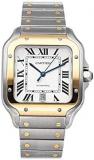
The Cartier Santos de Cartier Medium measures 41.9 mm lug to lug and 35.1 mm across the case, a geometry that sits deliberately flat on the wrist rather than doming upward like a conventional round watch. That proportion is the first thing experienced buyers notice, because it determines how the piece reads under a shirt cuff and how it balances against the forearm during a full day of wear. The medium model is not a scaled-down compromise; it is the reference size that best expresses the original 1904 design brief.
Understanding this watch requires looking past the recognizable silhouette and into the decisions Cartier made about proportion, finishing, and daily usability. Those decisions are what separate a decorative square watch from a genuinely architectural one, and they explain why the Santos remains one of the most discussed shapes in modern watch collecting.
An Architectural Shape Rooted in Function
Louis Cartier designed the Santos for Alberto Santos-Dumont, a Brazilian aviator who needed to read the time without releasing the controls of his aircraft. The exposed screws on the bezel were not ornamentation; they echoed the riveted engineering of early flying machines and signaled that this was a watch built for a machine age. More than a century later, the medium Santos retains that logic. The square case with rounded corners, the visible fasteners, and the continuous curve of the lugs into the bracelet all serve the same goal: a rigid, legible object that sits securely on a moving wrist.
That origin story matters for buyers because it frames the watch as a piece of industrial design rather than a dress accessory. The broader Cartier brand’s output has expanded in many directions since 1904, but the Santos line has stayed closest to that founding principle of exposed structure.
Case Dimensions and Wrist Presence
The numbers tell a specific story. A 35.1 mm case width paired with a 41.9 mm lug-to-lug span produces a footprint that wears larger than the width suggests, yet the relatively slim profile keeps it from feeling bulky. For reference, many 38 mm round watches occupy more vertical wrist space than this medium Santos, which is why buyers who normally avoid square cases often find this one unexpectedly comfortable.
- Case dimensions: 41.9 mm lug to lug, 35.1 mm width
- Case material: Steel with a polished and brushed finish
- Water resistance: Rated to 10 bar, approximately 100 meters
- Crystal: Square-shaped sapphire glass matched to the case geometry
- Crown: Seven-sided with a faceted blue spinel cabochon
The 10 bar rating is worth pausing on. A square case with a bezel secured by visible screws raises reasonable questions about sealing, and Cartier addresses them with a construction rated for swimming and showering rather than mere handwashing. That places the medium Santos in a practical category that many dress-oriented squares cannot claim.
Dial Legibility and the Roman Numeral Signature
The dial carries the Santos hallmarks: a silvered opaline surface, black Roman numerals, and a railroad-style minutes track. Cartier’s decision to hide the “VII” numeral beneath the date aperture is a small detail that seasoned owners appreciate, because it preserves the symmetry of the chapter ring without breaking the typographic rhythm. Sword-shaped hands in blued steel complete a layout that prioritizes reading the time at a glance, even in low light.
Legibility in a square watch is harder to achieve than in a round one, since the eye has corners to navigate. The medium Santos solves this by keeping the dial uncluttered and relying on high contrast between the numerals and the opaline ground. Compare it to the denser instrument layouts found on Breitling Colt models and the difference in intent becomes clear: one is a cockpit tool, the other a refined everyday companion.
The Bracelet and QuickSwitch System
The steel bracelet is where the medium Santos earns much of its reputation. Links taper progressively toward the clasp, and the brushed outer surfaces contrast with polished center elements to create a subtle two-tone effect within a single metal. More importantly, the bracelet integrates Cartier’s QuickSwitch system, which allows tool-free removal at the lugs, and the SmartLink mechanism, which permits sizing adjustments without a trip to a watchmaker.
For anyone who rotates watches frequently, these two features change daily ownership more than any specification on a sheet. A bracelet that can be resized at a desk and swapped for a leather strap in seconds removes the friction that often causes a watch to sit unworn in a drawer. This practicality is a large part of why the medium model appeals to buyers who want a single watch to cover office, weekend, and travel duties.
Movement and Everyday Reliability
The medium Santos is powered by a Cartier automatic calibre, a self-winding movement designed around reliable daily timekeeping rather than exotic complications. The case back is solid on the steel medium reference, which keeps the design focused on the exterior architecture rather than on exhibition. Owners who prioritize a visible movement should look to skeletonized variants, while those who value robustness and a lower servicing profile will find the closed case back an advantage.
Automatic winding suits the Santos’s role as a daily wearer, since the motion of the wrist supplies the power reserve. Compared with the hand-wound and chronograph-focused engineering seen across the TAG Heuer Grand Carrera range, the Cartier approach is deliberately understated: the movement exists to serve the design, not to compete with it.
How the Medium Compares Within the Santos Line
Cartier offers the Santos in several sizes, and the medium sits at the center of that range. Smaller versions lean toward a traditional dress-watch presence, while larger models push toward sportier proportions. The medium is the most balanced of the group, large enough for the exposed screws and rounded corners to register as design features, small enough to slide under a cuff without snagging.
Buyers weighing the Santos against other steel sports watches often cross-shop dive-oriented references like the Omega Seamaster, which offers greater water resistance and a rotating bezel but a very different visual language. The Santos does not attempt to compete on dive specifications; it competes on shape, history, and the ability to move between formal and casual contexts without looking out of place.
| Attribute | Santos Medium | Typical Steel Sports Watch |
|---|---|---|
| Case Shape | Square with rounded corners | Round |
| Case Footprint | 41.9 mm x 35.1 mm | Typically 39-42 mm diameter |
| Water Resistance | 10 bar (100 m) | Varies, often 200 m+ |
| Bezel | Fixed with exposed screws | Often rotating diver bezel |
| Dial Layout | Roman numerals, rail track | Index markers or luminous plots |
| Bracelet System | QuickSwitch and SmartLink | Standard sizing, tool required |
| Primary Intent | Refined everyday wear | Sports and dive utility |
The table makes the trade-off explicit. The medium Santos gives up rotating-bezel utility and some depth rating in exchange for a shape and finishing package that no round diver replicates. Buyers who need a watch for open-water swimming should look elsewhere; buyers who need one watch for meetings, dinners, and weekends will find the Cartier more versatile in practice.
Styling Versatility and Ownership Experience
One of the medium Santos’s quieter strengths is how well it pairs across dress codes. On steel it reads as a refined everyday watch with visible engineering character. Swapped to a leather strap via QuickSwitch, it becomes dressier without changing identity. That adaptability is rare in square watches, which often lock into a single register.
Ownership costs deserve honest consideration. Steel sports watches with the profile of a Rolex Submariner tend to hold value differently than shaped dress watches, and the Santos sits in a category where enthusiastic collector demand coexists with aesthetic risk. The square case is polarizing; it is also the reason the watch has survived for over a century. Buyers should choose it because the shape appeals to them personally, not because it resembles a safe round alternative.
Who Should Consider the Medium Santos
The medium reference suits buyers who want a recognizable luxury watch that does not rely on a rotating bezel or a dive rating for its identity. It rewards people who wear a watch daily across varied settings and who value tool-free strap changes. It is less suitable for those who need professional-level water resistance or who prefer luminous sports dials optimized for night visibility.
Its strongest case is made by its architecture: the way the case, screws, bracelet, and dial work as one coherent object rather than a collection of features. That coherence is what Cartier has preserved across generations of this model, and it is why the medium Santos remains a reference point for anyone thinking seriously about shaped steel watches.